


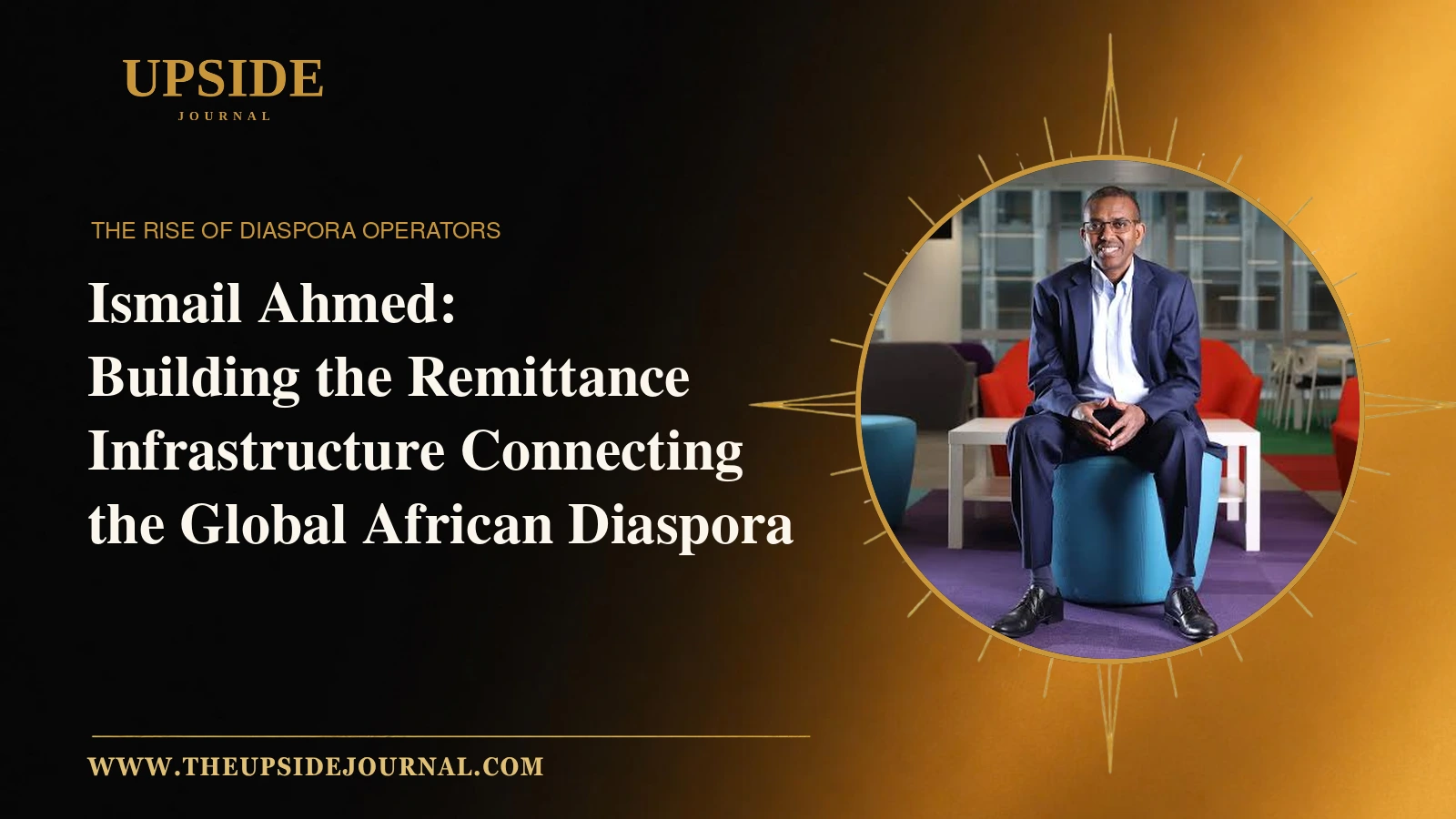
Ismail Ahmed: Building the Remittance Infrastructure Connecting the Global African Diaspora
The evidence is institutional and company-reported. The World Bank's price benchmarks show why the channel matters to families. Zepz's own figures show the scale it reports. Both are cited as reported
Executive Summary
Ismail Ahmed is usually described as a fintech founder who built a cheaper way to send money home. This article reads him differently: as an operator who saw that diaspora demand for sending money was constant, that the friction sat in how money moved, and that the answer was to rebuild the channel as an online service. That is the sense in which WorldRemit, and the later group Zepz, can be called remittance infrastructure: a repeatable layer for moving diaspora money, not a single product.
The evidence is institutional and company-reported. The World Bank's price benchmarks show why the channel matters to families. Zepz's own figures show the scale it reports. Both are cited as reported, with dates, and the article states what they cannot show.
Introduction: A Cheaper App Is Not the Story
The conventional account of WorldRemit is that it offered a cheaper, faster app. That is directionally true and analytically thin. It treats the product as the innovation and the customer's saving as the whole outcome. The more useful frame follows a four-step chain: diaspora demand, remittance friction, digital infrastructure, scalable money movement.
In that chain the app is the visible end of a system. The question is what the founder identified about the channel and how repeatable the answer became. This article treats the question the way an operator would. It does not describe WorldRemit's internal architecture, the wider argument that global remittances remain an infrastructure problem, or the operating playbook behind the company. Those belong to later pieces in this cluster. It also leaves aside extended biography.
The cluster's wider thesis, set out in The Rise of Diaspora Operators: How African Founders Are Building Global Infrastructure Companies, is that founders fluent in more than one system build layers where others see products. Ahmed is an earlier example of that pattern.
Who Is Ismail Ahmed, and Why Does the Three-Market Lens Matter?
CNBC, reporting in May 2023, describes Ahmed as a British-Somalian entrepreneur who fled civil war in Somalia and founded the company in 2010. WorldRemit's own about page places the founding in London and names two co-founders alongside him, so this article does not credit the company to him alone. He is the founder; the company is a team's work.
The three-market lens applies in a specific way. The company was founded in London, a sending market. Its customers' recipients are in Africa and other emerging regions. And the diaspora that sends the money is spread across many countries. The founder's biography sits inside that triangle, and the same CNBC report records the motivation that connects it: he moved money to family members then living in a refugee camp in Ethiopia, and the transfers were expensive and took months.
That personal account matters to the argument for one reason. It places the origin of the company in a cost and delay he had experienced as a customer, not in a market analysis. The verdict: the founder began as the user of the channel he later rebuilt.
What Problem Did Ahmed Identify?
The problem was the cost and slowness of sending money across borders, borne by the people least able to bear it. CNBC's account of Ahmed's experience is the clearest statement of it: transfers that were expensive and took months. The World Bank's price benchmarks show that the cost problem has proved durable. In Remittance Prices Worldwide, Issue 54, the global average cost of sending remittances in the third quarter of 2025 was 6.36 percent, and sub-Saharan Africa remained the most expensive region to send money to, at 8.46 percent.
The report also separates channels. The global average for digital remittances was 4.59 percent, against 7.30 percent for non-digital remittances. The UN Sustainable Development Goals and the G20 have set a target of 3 percent for the global average by 2030, and of 5 percent or less in all corridors.
On a US$200 transfer, those percentages translate into about US$9.18 for a digital transfer and US$14.60 for a non-digital one, and about US$12.72 at the global average. These are calculations from the reported percentages. The gap between the channels, about US$5.42 per transfer, is the economic content of the problem: it is a cost the sender pays every time.
The problem was therefore a mismatch between what a transfer should cost and what the channel charged, and it persists, in the World Bank's data, well after the founder began.
What Did WorldRemit Change?
The change was to move the transaction onto an online service. CNBC's account places the founding in 2010 and records that Sendwave was acquired in 2020, with the WorldRemit and Sendwave brands combined under the parent Zepz. The direction of the move is documented. The mechanism is not described in the sources opened for this article, and how WorldRemit's network operates is the subject of a later piece in this cluster.
The distinction matters. A product change alters what one customer sees. A channel change alters the cost and speed of every transfer that channel carries. This framing is editorial, not a sourced finding, and it is the reason this article treats the company as infrastructure and not as an app: the value is created below the interface, where the same rail serves every customer.
Where the economics sit is the relevant point. A remittance network earns on money that moves between people in different places. The corridor logic, and the way regulated rails become a moat, are examined in Why Diaspora Payment Networks May Become Africa's Most Valuable Financial Infrastructure, and this article does not repeat them.
The same corridor logic appears in Ridwan Olalere's LemFi, which the sibling profile reads as a regulated consumer product on a cross-border payments layer. WorldRemit is a different operator's answer to the same problem: the channel moved online, the cost fell, and the volume became a platform.
The verdict: the founder's change was to treat the remittance channel as something that could be rebuilt in software, and the rest of the company followed from that decision.
Why Does Remittance Infrastructure Matter to the Diaspora Economy?
The analytical formula runs as follows. What it says: money sent home can move on an online channel at a lower reported cost than on a non-digital one. What it means: the sender keeps more of each transfer, and the recipient receives more. Who benefits: families on both sides, and the operators that carry volume. The economic consequence is that a cost gap repeated across millions of transfers becomes a transfer of value to households, and a recurring revenue base for the operator.
One volume figure sets the stakes. The International Fund for Agricultural Development (IFAD), in its report of 14 September 2026, puts remittance inflows to Africa at US$124.2 billion in 2025. The report does not state whether the regional figure covers all of Africa or only sub-Saharan Africa, so it is read here as an indicator of scale and not set against the sub-Saharan cost benchmark.
The figure is not a trend and is not charted here, and it is not a measure of any one operator's share. What it shows is scale: the flows are large enough that a small percentage difference in cost is a large sum in aggregate.
The diaspora economy depends on this channel before it depends on any investment product, and what the diaspora does with money after the transfer is the subject of The Diaspora Capital Stack. The verdict: remittance infrastructure matters because it is the first link in a longer chain of diaspora capital.
What the Reported Numbers Show, and What They Cannot
Zepz, the group that owns WorldRemit and Sendwave, reported its scale in a release on 9 March 2026. The figures below are company-reported, each from that one dated release, and this article did not verify them independently.
| Measure | As reported by Zepz (9 March 2026) |
|---|---|
| Customers | More than 9 million |
| Reach | 2,000 corridors across more than 130 countries |
| Value transferred in 2025 | More than US$17 billion |
| Transactions processed in 2025 | Over 120 million |
| Growth | 25 percent revenue growth in the fourth quarter of 2025; about 20 percent year-on-year growth expected for 2026 |
Dividing the two 2025 figures gives an average transfer of roughly US$140. That is a calculation from rounded minimums, so it is indicative only, and it sits close to the US$200 transfer the World Bank uses as its benchmark. The two figures support one observation: the typical transfer is small, so the economics depend on volume and on repeat use.
The growth lines need the same care. The fourth-quarter figure is a company statement about revenue, not audited accounts, and the 2026 figure is an expectation, not an outcome. Neither is accompanied by a revenue amount in the figures reviewed.
They do not show profitability, market share or the cost Zepz charges its customers. They do not allow a comparison with competitors, because the release gives no like-for-like figures. Older figures for countries, corridors and customers differ across earlier sources and dates, so this article uses the 2026 release for every metric and no other.
The numbers describe a platform operating at scale, and they leave the question of margin open.
Where the Infrastructure Claim Stops
The claim has three boundaries. The first is evidence about the founder. The independent source opened for this article is one 2023 news report, and nothing opened dates from the last year. The founder's current role is therefore not stated as fact. Per the 2023 CNBC reporting, he stepped down as chief executive in 2018 and remained on the board as non-executive chairman. The March 2026 Zepz release does not mention him, and this article states no current title.
The second is leadership. The same release announces that Mark Lenhard is stepping down as chief executive and that Barrie Morris, chief financial officer since 2023, is interim chief executive while the board searches for a permanent successor. A founder-led story becomes, in the company's own latest account, a story about a professional management team in transition.
The third is scope. The infrastructure reading rests on scale and on the channel's cost benefit, both of which are reported rather than audited here. It does not address the regulatory and compliance burden that comes with moving money across borders, which sits in a separate analysis of the remittance system.
The reading holds as an analytical frame, and its limits are the limits of any payment layer: the economics depend on volume, and the channel depends on continuing to meet the regulator's standards.
Why This Matters for Diaspora Operators and Capital Allocators
For operators building in the diaspora economy, the lesson is about where the friction sits. Ahmed's account, as reported, begins with a cost he paid as a customer. The question to ask of any diaspora product is whether the friction is in the interface or in the channel beneath it, because only the second supports an infrastructure business.
For capital allocators, the useful reading is the one the data allow. The scale is reported by the company, the cost benchmarks are independent, and the founder's current role is unstated. The diligence questions are the durability of the margin at an average transfer of roughly US$140, and the effect of leadership change on a company that began as one founder's response to a problem.
For policy teams, the benchmark targets frame the question. The global average of 6.36 percent is about twice the 3 percent target for 2030, and the sub-Saharan Africa average of 8.46 percent is nearly three times it, both calculations from the World Bank figures. A channel that already reports a lower digital cost shows that the gap is not fixed, though it does not show that the target will be met.
A comparison with Ham Serunjogi's Chipper Cash shows the same pattern in a different corridor set. That piece owns its own framework and its own company figures, and none is reused here. The pattern is that founders who have used the channel are the ones who rebuild it.
Key Takeaways
- The founder's move was to rebuild the channel, not to build an app: CNBC's account is that Ahmed began as a customer of an expensive, slow channel.
- The cost gap is the economic content: the World Bank reports 4.59 percent for digital transfers and 7.30 percent for non-digital in the third quarter of 2025, a gap of about US$5.42 on US$200.
- The flow is large and its coverage is loosely stated: IFAD reports US$124.2 billion of remittance inflows to Africa in 2025, without saying whether the figure covers all of Africa or sub-Saharan Africa.
- Scale is reported by the company: Zepz states more than US$17 billion transferred and over 120 million transactions in 2025.
- The founder's current role is unstated: per 2023 reporting he was non-executive chairman, and the March 2026 release does not mention him.
Conclusion
Ismail Ahmed's contribution, as the sources opened show, was to treat the remittance channel as something that could be rebuilt online, starting from a cost and delay he had experienced himself. The evidence for the channel's importance is the World Bank's price benchmarks and the scale of the flows. The evidence for the company's scale is Zepz's own release.
The evidence against overreading it is that the founder's present role is not documented in the sources opened, the scale figures are company-reported, and the leadership of the company is in transition. What the case teaches is that diaspora infrastructure begins with a customer's experience of a channel that does not work.
External References
- World Bank: Remittance Prices Worldwide, Issue 54 (Q3 2025)
- Zepz: Zepz appoints Barrie Morris as Interim CEO as Mark Lenhard steps down
- CNBC: Fintech unicorn Zepz, owner of WorldRemit, lays off 26% of staff
- WorldRemit: About us
- IFAD: Remittances nearly doubled in a decade to reach US$729 billion in 2025, new IFAD report finds