


Why Diaspora Payment Networks May Become Africa's Most Valuable Financial Infrastructure
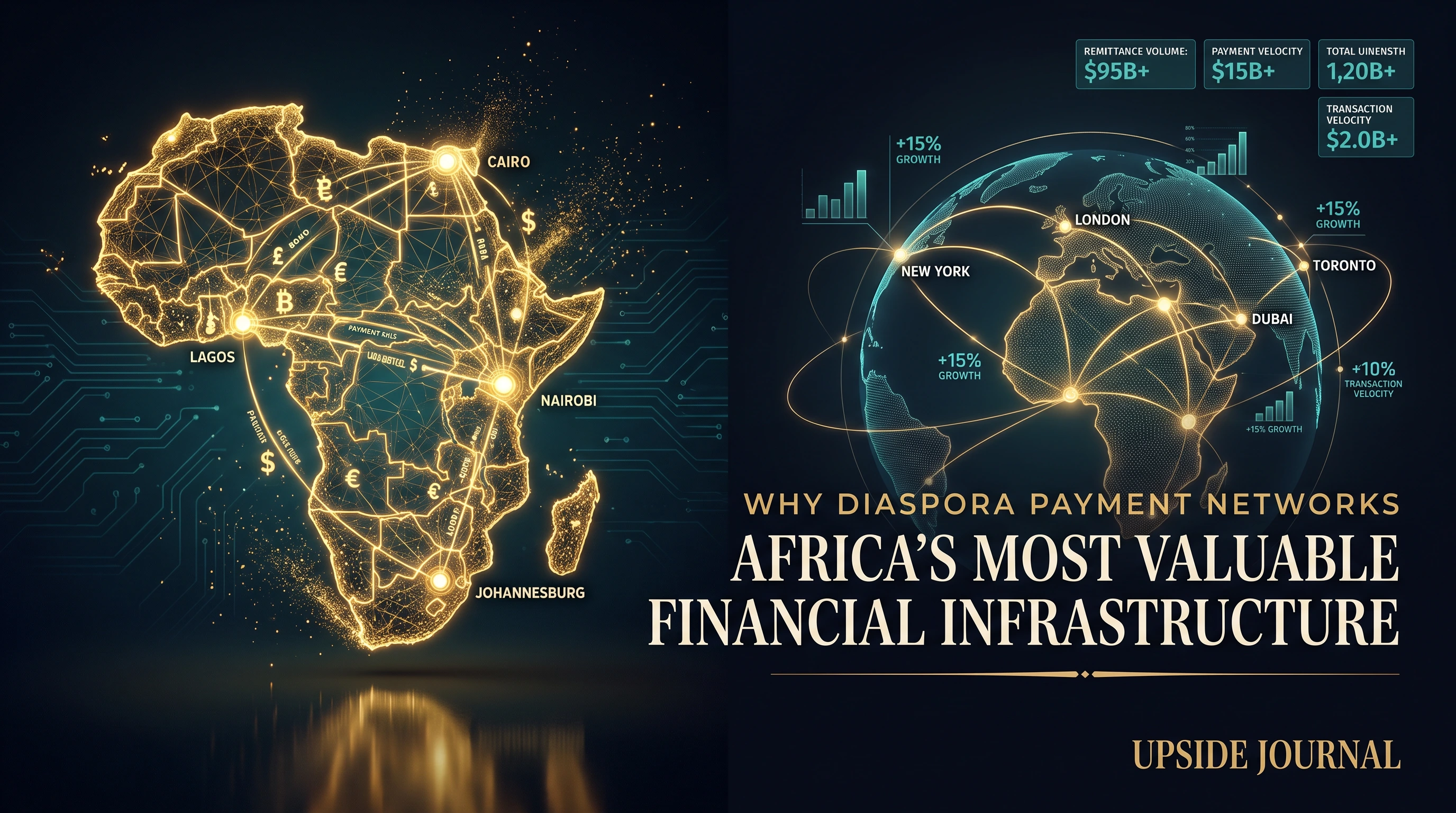
Diaspora remittances aren't just transfers — they're becoming persistent financial networks. Here's why diaspora payment infrastructure may outvalue any single fintech product across Africa.

Why This Question Matters Now
Every year, formal remittance flows into Sub-Saharan Africa run into the tens of billions of dollars — a number large enough that it regularly exceeds official development assistance to the region combined. The conventional framing of this flow is simple: family support, sent home, spent quickly. That framing is not wrong. It is just incomplete.
The more consequential question is not how much money moves — it is what happens to the relationship that produces that money movement once it is digitized, repeated, and observed over time. A remittance sent once a month for five years through the same digital rail is not really a transaction anymore. It is a data trail, a trust signal, and a distribution channel that a growing number of companies are now trying to build additional financial services on top of.
This is the distinction this article exists to draw out: the difference between a payment product — a single-purpose app that moves money from A to B — and a payment network, an accumulating layer of infrastructure that other financial products can be built on. Africa's diaspora corridors are where this distinction is currently being tested at the largest scale, and the outcome will shape how a meaningful share of the continent's financial inclusion problem gets solved over the next decade.
What Turns a Payment Product Into Infrastructure
A payment product solves one problem: move money from a sender to a receiver, reliably and at reasonable cost. Plenty of companies do this well. What separates a product from infrastructure is not execution quality — it is whether the relationship generated by that transaction can be reused for something else.
Four conditions distinguish infrastructure from product:
* Persistence. The same sender and receiver transact repeatedly over months or years, generating a data history rather than a one-off event.
* Identity accumulation. Each transaction adds to a verified profile — KYC data, transaction patterns, income signals — that becomes more valuable to the platform (and potentially to other institutions) with every repeat use.
* Multi-directional flow. Money, information, and eventually credit or investment move both ways across the corridor, not just remittance-inward.
* Layerability. Other financial products — savings, credit, insurance, cross-border commerce — can be attached to the existing relationship without re-acquiring the customer from scratch.
A single wire transfer meets none of these conditions. A five-year relationship between a diaspora sender in London and a receiver in Lagos, mediated by the same platform every month, meets all four. That second scenario is what "payment infrastructure" actually means, and it is structurally different from — and more defensible than — any individual remittance product built to serve it.
Defining "Valuable": The Measurable Dimensions
Calling diaspora payment networks Africa's "most valuable financial infrastructure" is a claim that needs grounding in something other than transaction volume alone. Value in a network context is better measured across several dimensions simultaneously:
* Transaction frequency, not just volume. A corridor with high-frequency, recurring transfers produces more usable data and stronger retention economics than one with large but infrequent transfers.
* Network effects. Value increases non-linearly as more senders, receivers, and downstream financial products connect to the same rail — the classic infrastructure signature that distinguishes a rail from a single app.
* Customer lifetime relationship. A diaspora sender who remains active on a platform for years, and whose receiver eventually becomes a customer in their own right, represents a durable annuity rather than a one-time acquisition.
* Cross-border economic activity enabled, not just captured. The real infrastructure value shows up when the network starts financing trade, tuition, small-business inventory, or property purchases — activity the payment relationship makes possible but doesn't itself capture as a fee.
* Dependency. The strongest infrastructure signal is when banks, merchants, or other fintechs begin building on top of the rail rather than around it — the same dynamic that made card networks and mobile money switches structurally important beyond their transaction fees.
Judged against these dimensions, diaspora payment corridors score unusually well relative to other categories of African fintech infrastructure, precisely because they combine high recurrence, strong identity signal, and a natural on-ramp into adjacent financial products — savings, credit, and insurance — that a purely domestic payments product rarely has by default.
The Stack Sitting on Top of Every Remittance
The more interesting story is not the payment itself but what gets built once the payment relationship exists. A useful way to see this is as a stack, where each layer becomes possible only once the layer beneath it is established:
Payments — the base layer: moving money reliably across a corridor, the function every diaspora fintech starts with. Accounts — once payments recur, holding a balance becomes natural. Multi-currency accounts let senders and receivers hold value in more than one currency without a full bank relationship. Identity — recurring, verified transactions generate a compliance-grade identity profile that would otherwise require a separate, expensive onboarding process for a traditional bank or lender. Credit — a verified identity plus a transaction history is exactly the underwriting signal that has historically been missing for diaspora-linked borrowers and small businesses on the receiving end. Several diaspora-focused platforms are now piloting credit products that rely on remittance history in place of, or alongside, traditional credit bureau data. Savings and investment — once trust and a funded account exist, diaspora capital can be directed into structured savings products or, increasingly, direct investment vehicles — see our earlier reporting on how diaspora networks are already driving AI and climate tech returns through informal syndicate capital that could plausibly route through exactly this kind of formalized rail. Commerce and insurance — the final layer, where the payment relationship becomes the distribution channel for cross-border e-commerce, diaspora-funded health insurance for family members, or trade finance for small businesses.No single company currently owns this entire stack, and it would be inaccurate to suggest otherwise. What is genuinely happening is that different companies are building different layers on top of the same underlying corridor logic — which layer a given platform occupies, and how many of the others it can credibly expand into, is the more useful question than asking which company "wins" the category outright.
Who Is Building Which Layer
A handful of companies illustrate different points on this stack, without any one of them representing the entire thesis.
* LemFi is one example of a platform moving from single-corridor remittance into licensed, multi-jurisdictional settlement — a structural move up from "product" toward "rail," as we detailed in our founder profile of Ridwan Olalere.
* Mobile money operators across East and West Africa have spent over a decade building the receiving-end distribution layer that any diaspora-facing platform ultimately has to plug into, regardless of which sending-side app the customer uses.
* A newer wave of diaspora-focused savings and investment platforms are explicitly trying to route remittance-adjacent capital into structured products — a dynamic connected to the broader diaspora talent and capital flywheel reshaping how African-origin capital moves globally.
* Traditional banks in receiving markets are, in some cases, beginning to accept remittance-platform transaction histories as a supplementary underwriting input — an early but meaningful sign that the "identity layer" of diaspora payment data is starting to be treated as infrastructure by institutions that didn't build it themselves.
The pattern across all of these is the same: none of them is simply "a remittance app." Each is a bet, at different stages of maturity, that the underlying corridor relationship is worth more than the fee generated by any individual transfer.

Why This Connects to a Bigger Pattern
This dynamic is not unique to payments. It is the same structural logic explored in our pillar piece on The Rise of Diaspora Operators: founders who have lived inside both a high-regulation, high-trust sending market and a high-friction, high-informality receiving market are structurally positioned to build the connective infrastructure that neither a purely local nor a purely global founder tends to prioritize. Payment networks are simply the clearest, most measurable expression of that broader thesis — because unlike most infrastructure categories, payment flows are directly quantifiable, corridor by corridor, in a way that makes the network-effect argument easier to test against real data rather than narrative alone.
It is also worth situating this within the continent's wider infrastructure conversation. Just as digital identity and land registries function as trust infrastructure that unlocks downstream economic activity, diaspora payment corridors function as a parallel trust layer — one built not from government mandate but from voluntary, repeated, cross-border financial behavior. The two are structurally comparable even though one is public infrastructure and the other is privately built.
What Prevents the Thesis From Becoming Reality
None of this is guaranteed to compound the way the optimistic version of the story suggests, and a credible analysis has to name the friction directly.
* Regulatory fragmentation. A platform licensed to move money into Nigeria does not automatically hold the license to extend credit there, or to operate the same product suite in Kenya or Ghana — the same multi-jurisdictional compliance burden explored in our reporting on regulatory frameworks functioning as competitive moats across African markets.
* Interoperability gaps. A sender's transaction history on one platform does not automatically transfer if the receiver primarily uses a different mobile money operator or bank — fragmenting the very data advantage the network-effect thesis depends on.
* FX and settlement cost volatility. Currency instability in receiving markets can erode the margin that funds the build-out of higher layers of the stack, particularly credit and savings products that require the platform to hold risk.
* Trust concentration risk. A network built on repeat behavior is also vulnerable to a single high-profile failure — fraud, a licensing dispute, or a collapse — undermining trust across an entire corridor rather than a single product.
These are not arguments against the thesis. They are the reason the thesis remains a bet rather than a settled outcome, and the reason the companies executing best against it are the ones treating regulatory depth and interoperability as core product work rather than downstream legal overhead.
The Strategic Takeaway
The headline claim — that diaspora payment networks could become Africa's most valuable financial infrastructure — does not rest on remittance volume alone. It rests on whether the industry succeeds in converting millions of individually unremarkable transfers into a small number of durable, identity-rich, multi-product financial relationships spanning continents.
That conversion is already underway, unevenly, across several companies and corridors. The winners will not necessarily be the platforms moving the most money. They will be the ones that succeed in layering accounts, identity, credit, and commerce on top of a payment relationship that was, at the outset, just a way to send money home.
Related Reading
- The Rise of Diaspora Operators: How African Founders Are Building Global Infrastructure Companies
- Ridwan Olalere: Building the Financial Infrastructure Connecting Africa's Global Diaspora
- Digital Trust Infrastructure: The Foundation of Africa's Next Economic Leap
- Regulatory Weaponization: How Open Banking and Data Protection Laws Became Africa's Ultimate Tech Defense
- Africa's AI Talent Diaspora Flywheel
- Diaspora Networks Driving AI & Climate Tech Returns in 2026
- The $705 Million Surge: De-Risking Non-Traditional Venture Hubs
- Startup Infrastructure: The Invisible Systems Powering Africa's High-Growth Companies
External References
- World Bank — Migration and Remittances Data
- GSMA — Mobile Money State of the Industry Report
- AfricaNenda — State of Instant and Inclusive Payment Systems (SIIPS)
- International Finance Corporation — Trade and Supply Chain Finance
---
Intelligent. Cultural. Global. Human. "Where the world's conversations become movements."