


Iman Abuzeid: Building the Workforce Infrastructure Behind Modern Healthcare
The easy story about a healthcare hiring startup is supply and demand: not enough nurses, more hospitals competing for them, a market inefficiency someone eventually built software to fix. That story
Executive Summary
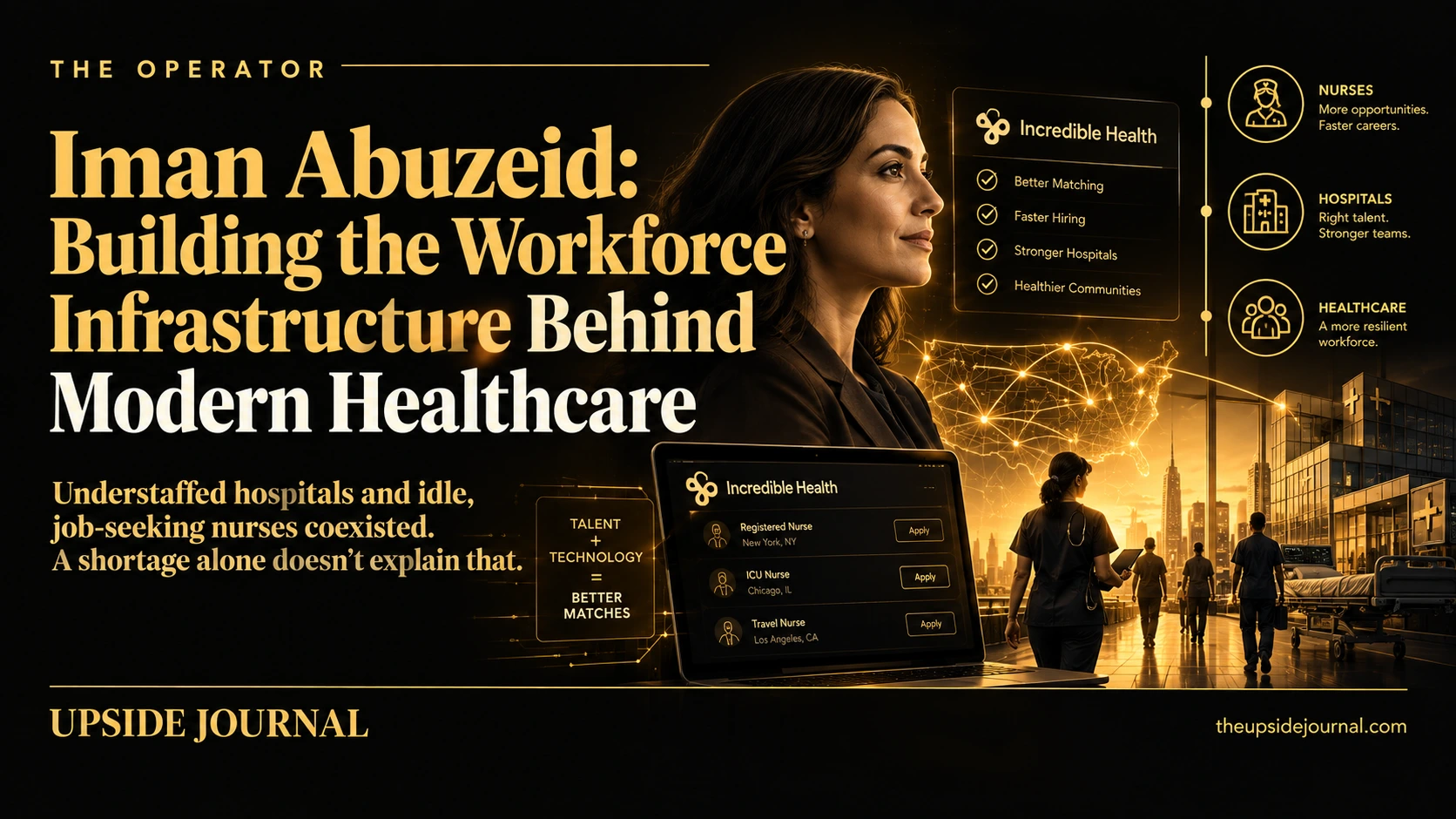
Before the pandemic, the United States was already projected to face a shortage of roughly one million nurses. That statistic gets cited constantly as an explanation for why hospitals struggle to staff their floors. Iman Abuzeid looked at the same numbers and noticed something the shortage narrative alone couldn't explain: physicians she knew complained constantly about understaffed hospitals, while nurses her co-founder knew complained just as constantly that it took months to land a job. A genuine shortage does not produce that contradiction. A broken matching system does. Abuzeid co-founded Incredible Health in 2017 on the recognition that healthcare's workforce problem was not purely a supply problem — it was, in large part, an infrastructure problem: the tools connecting available nurses to open hospital positions were slow, manual, and structurally mismatched to the scale and urgency of the need.
Introduction
The easy story about a healthcare hiring startup is supply and demand: not enough nurses, more hospitals competing for them, a market inefficiency someone eventually built software to fix. That story isn't wrong, but it skips the more interesting diagnostic step. If the problem were purely a shortage, nurses actively seeking work should have had no trouble finding it quickly — there would always be more open positions than applicants. What Abuzeid and her co-founder Rome Portlock actually observed was the opposite pattern sitting alongside the shortage: understaffed hospitals on one side, nurses stuck in hiring limbo for months on the other. That contradiction, not the shortage statistic on its own, is the more precise starting point for understanding what she built and why.
Who Is Iman Abuzeid?
Abuzeid was born in Saudi Arabia to Sudanese parents; her father worked there as an otolaryngologist. She earned her medical degree from University College London, then moved into healthcare consulting rather than clinical practice, working at McKinsey & Company and Booz & Company before joining AliveCor, a venture-backed mobile health company, as a product manager. She later earned an MBA from the Wharton School. That path — medical training, management consulting, product management inside a health-tech company — gave her a specific vantage point most healthcare founders don't have: fluency in how hospitals actually make staffing decisions, combined with product and operating discipline from outside clinical medicine entirely. Choosing consulting and product management over clinical practice after completing a medical degree is itself a data point about how she approaches problems: rather than working inside the system as a practitioner, she chose roles that let her study how multiple systems — hospitals, health-tech products, corporate operations — actually functioned, before deciding which one to try to fix.
Rome Portlock, an MIT-trained software engineer with several nurses in his own family, supplied the direct, ongoing exposure to what the job search actually felt like from the nurse's side. Incredible Health was co-founded in 2017 from that combined vantage point: one founder who understood the hospital's hiring problem from the inside, one who understood the nurse's job-search problem from the inside, comparing notes and concluding, in Abuzeid's own words, that "there has to be a better way." Neither founder, notably, came to the problem as a career recruiter or staffing-industry veteran — a detail that matters for what comes next in this piece, because the diagnosis that follows required exactly the kind of outsider pattern-recognition that someone deeply embedded in the existing staffing industry's own assumptions might have missed.
What Problem Did Abuzeid Actually Identify?
The specific diagnosis mattered more than the general shortage narrative. Hospital hiring for nursing roles, before Incredible Health, ran on a process built around manual resume screening, slow multi-step interview scheduling, and a default assumption that candidates should apply to employers rather than the reverse. That process routinely took 80 to 90 days from a nurse's first application to an accepted offer — an extraordinary amount of time for a role where hospitals were simultaneously reporting acute staffing shortages severe enough to affect patient care. A nurse motivated enough to actively job-search, and a hospital desperate enough to be short-staffed, should not, in a well-functioning labor market, take three months to find each other. The gap between those two motivated parties was not explained by a lack of nurses in the labor market; it was explained by the infrastructure connecting them being too slow and too manual to match supply to demand at the speed either side actually needed.
What Did She Build?
Incredible Health's core mechanism inverted the standard hiring flow: rather than nurses applying to postings and waiting to be selected, employers browse a matched pool of candidates and apply to them — a structural change to who initiates contact, designed specifically to compress the multi-week back-and-forth that traditional applications generate. Combined with automated screening and custom matching criteria supplied by both sides of the marketplace, the platform's own reported outcomes show hiring cycles dropping from the 80-to-90-day industry norm to roughly 15 to 30 days. The deeper product architecture behind that outcome — how the matching algorithm actually works, and how the platform has evolved since 2017 — is examined elsewhere in this network; the relevant point here is narrower: Abuzeid built connective infrastructure specifically targeting the handoff between supply and demand, not a better version of the job board format that preceded it.
Why Is This an Infrastructure Problem, Not Just a Shortage Problem?
Applying the standard this network uses for any defined concept — what it says, what it means, who benefits, what economic consequence it creates — clarifies why the infrastructure framing matters more than the shortage framing alone. What the shortage statistic says: the US healthcare system does not have enough nurses to fill projected demand. What that actually means, once matching failure is accounted for, is more specific: even the nurses who do exist and are actively seeking work are not reaching open positions at anywhere near the speed the underlying shortage would demand, because the infrastructure connecting them was never built for that speed. Who benefits when that infrastructure is fixed: hospitals recover staffing capacity faster than population-level nurse-training pipelines alone could ever produce it, and nurses spend less unpaid time in job-search limbo. What economic consequence it creates: understaffed hospitals lean more heavily on higher-cost temporary and contract staffing to cover the gap while permanent hires are still working through a slow pipeline — a cost that a faster matching layer directly reduces, independent of whether the underlying nurse shortage itself has been solved. A pure shortage narrative implies the only lever is training more nurses, a slow, expensive, multi-year undertaking. An infrastructure framing adds a second lever available immediately: get the nurses who already exist matched to open roles faster, which does not solve the shortage but meaningfully reduces its practical bite while structural training pipelines catch up.
Why Does This Framing Matter Beyond Incredible Health?
Abuzeid's diagnosis belongs to a pattern this network tracks closely: founders who look at a resource everyone agrees is scarce and ask whether the scarcity is real or partly an artifact of bad matching infrastructure sitting on top of it. Abbey Wemimo's Esusu is built on a structurally similar recognition in an entirely different domain: on-time rent payments, a genuine and reliable financial signal, were simply never being captured by the credit system that was supposed to reward that reliability. Wemimo didn't treat "credit invisibility" as an unsolvable fact about millions of renters; he treated it as an infrastructure gap between an existing signal and the system meant to use it — the same move Abuzeid made in treating the nurse shortage as partly a matching-infrastructure gap rather than a pure supply constraint. Tade Oyerinde's work rebuilding higher education around workforce outcomes sits in the same family: a scarce resource — in his case, workforce-ready graduates — treated as an infrastructure design failure upstream of the education system, not an immutable talent shortage. And this network's broader argument that education infrastructure, not just capital, shapes Africa's founder pipeline rests on exactly the same distinction: whether a scarcity is a hard ceiling or a symptom of infrastructure that hasn't been built yet.
This pattern connects, more broadly, to Ridwan Olalere's approach to building LemFi for an underserved diaspora population and to the wider thesis this network has named the Rise of Diaspora Operators: founders whose own biography — medical training and consulting experience, in Abuzeid's case — gives them dual fluency in a system's stated problem and its actual operating mechanics, which lets them see an infrastructure gap that someone without that specific combination of experience would more easily mistake for an unsolvable scarcity. The recurring shape across every one of these cases is the same two-step move: first, refuse to accept the headline scarcity number as the whole explanation; second, go looking for the specific mechanical failure sitting between an existing resource and the system meant to make use of it. Abuzeid's version of that move happened to concern nurses and hospitals; the underlying discipline is portable to any market where a widely cited shortage coexists, on close inspection, with an unexplained surplus of the very resource supposedly in short supply.
How Do We Know the Diagnosis Was Right?
A diagnosis is only as good as the evidence that it held up once acted on. Incredible Health's own reported outcomes — hiring cycles compressed to 15 to 30 days, adoption by health systems including Kaiser Permanente and other major hospital networks, and a base that grew to more than a million healthcare workers on the platform — are the most direct evidence that the matching-failure diagnosis, not just the shortage narrative, was the more actionable half of the problem. If the shortage alone had been the binding constraint, faster matching should have made only a marginal difference, since there simply wouldn't have been enough nurses to match regardless of process speed. Instead, tens of thousands of hires moved through a system built specifically to compress the handoff between supply and demand, at a pace the old process structurally could not support.
The company's own workforce research adds a further, less comfortable layer to the diagnosis: a 2022 study using its own hiring data of more than 400,000 nurses found that roughly a third planned to leave their current roles within the year, with burnout and high-stress conditions cited as the leading reasons. That finding complicates any simple story where faster matching alone solves healthcare staffing — it suggests the matching-infrastructure fix increases the speed at which existing nurses can move between jobs, which helps individual hospitals refill vacancies faster, without necessarily addressing the underlying conditions driving nurses to leave the profession's available pool in the first place. Abuzeid's diagnosis targeted the connective infrastructure between supply and demand; it was never a claim that faster matching alone would fix the conditions producing burnout-driven attrition, and treating it as such would overstate what the infrastructure argument actually claims.
Why This Matters for Healthcare Systems and Policy
For hospital administrators and health-policy audiences, the practical implication is that staffing strategy built solely around expanding the nurse training pipeline addresses only half of the actual problem. Training more nurses takes years and is necessary regardless, but it does nothing about the months-long matching delay stranding already-qualified, already-motivated nurses outside the jobs hospitals urgently need filled today. A staffing strategy that treats matching speed as its own lever — not a side effect of eventually training more nurses — can meaningfully reduce a hospital's reliance on expensive temporary and contract labor well before any pipeline expansion produces results. Recognizing scarcity and matching failure as two separate, independently solvable problems, rather than treating the second as a footnote to the first, is the specific reframing this piece is arguing for.
For policymakers evaluating healthcare workforce shortages more broadly, Abuzeid's diagnosis is a useful caution against a single-lever mental model. A policy response built entirely around expanding nursing school capacity, immigration pathways for foreign-trained nurses, or loan-forgiveness incentives to grow supply treats the shortage as a pure production problem, measured only in how many new nurses enter the pipeline each year. The matching-infrastructure lever operates on a completely different timescale and targets a different failure point: it does not add a single new nurse to the workforce, but it can materially shorten how long already-trained, already-licensed nurses sit outside employment while a slow process runs its course. Any serious healthcare workforce strategy has reason to pursue both levers simultaneously rather than treating one as a substitute for the other.
Where This Doesn't Fit
This is a founder-and-diagnosis piece, not a product walkthrough. It does not detail Incredible Health's matching algorithm, screening technology, or platform evolution since 2017 — that belongs to a forthcoming companion piece in this cluster. It does not lay out the broader argument for why healthcare staffing constitutes a structural infrastructure problem across the industry, which is reserved for a separate node, and it does not extract a repeatable operating playbook from Abuzeid's approach, which is reserved for a fourth. This piece is deliberately limited to who she is and what specific diagnosis she made.
Key Takeaways
A projected shortage of roughly one million US nurses does not, by itself, explain why hospitals stayed understaffed while actively job-searching nurses waited months for offers — that contradiction pointed to a matching failure, not just a supply failure.
Abuzeid and co-founder Rome Portlock brought complementary vantage points — her hospital-and-consulting fluency, his direct exposure through family members to the nurse job-search experience — that let them see the diagnosis clearly.
Incredible Health's core structural change was inverting who initiates contact: employers apply to matched candidates rather than candidates applying and waiting, compressing hiring cycles from roughly 80–90 days to 15–30.
Treating a scarce resource as partly a matching-infrastructure problem, not purely a supply problem, opens a second, faster lever than waiting years for training pipelines to expand.
Abuzeid's pattern — dual fluency in a system's stated problem and its operating mechanics, used to distinguish real scarcity from infrastructure failure — recurs across this network in founders addressing credit invisibility, workforce-ready education, and diaspora financial access.
Conclusion
The significant part of Iman Abuzeid's story is not that she built a healthcare hiring company that grew into a large, well-funded platform. It is that she and her co-founder looked past a widely cited shortage statistic to a specific, checkable contradiction — understaffed hospitals and idle, job-seeking nurses coexisting — and correctly diagnosed that contradiction as a matching-infrastructure failure sitting on top of a real but partial shortage. That diagnosis, more than any feature of the platform itself, is what makes her case worth examining alongside the other founders in this network who have made the same move in other domains: treating scarcity as something to interrogate rather than simply accept.
External References
The Rise of Diaspora Operators: How African Founders Are Building Global Infrastructure Companies
Tade Oyerinde: Reimagining Higher Education Infrastructure for a Global Workforce
Why Education Infrastructure Will Shape Africa's Next Generation of Founders
Abbey Wemimo: Building the Financial Infrastructure That Turns Rent Into Credit
Ridwan Olalere: Building the Financial Infrastructure Connecting Africa's Global Diaspora
Forthcoming Reading
Incredible Health and the Infrastructure Behind Modern Nurse Matching
Why Healthcare Staffing Is a Structural Infrastructure Problem
Operator Playbook: The Incredible Health Playbook
External References
TechCrunch: Incredible Health's Hiring Platform for Nurses Gets $15M Led by Andreessen Horowitz
Osmosis/Raise the Line: Creating a Better Way to Hire Nurses — Dr. Iman Abuzeid
Wharton Digital Health (Medium): Iman Abuzeid on Helping Healthcare Workers Find and Do Their Best Work