


LemFi and the Future of Diaspora Financial Infrastructure
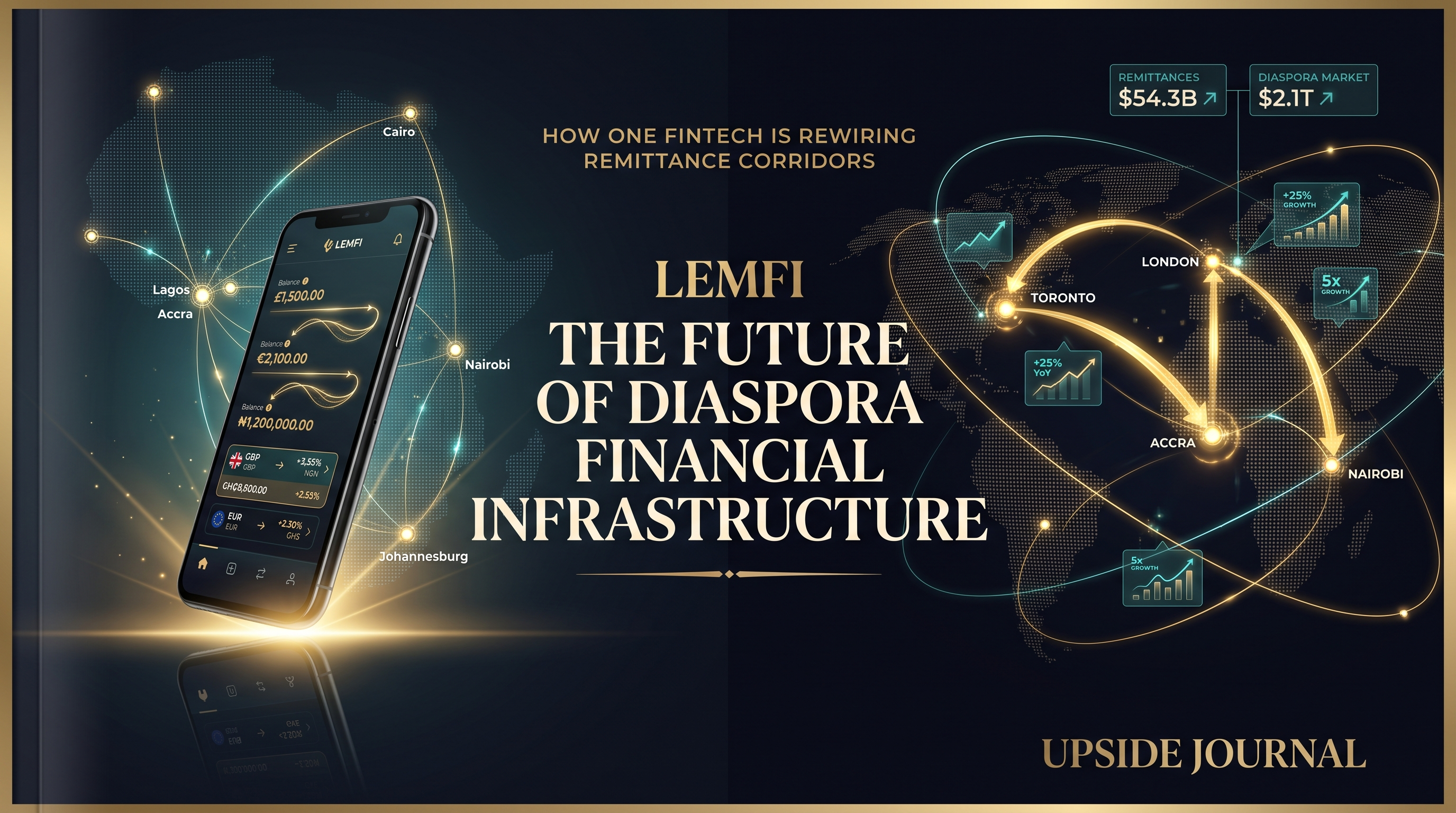
LemFi isn't just a remittance app — it's a case study in the emergence of diaspora financial infrastructure. Here's how the category is being built, layer by layer.

Executive Summary
"Diaspora financial infrastructure" is not yet a category with agreed boundaries. Most coverage still treats companies like LemFi as remittance apps — faster, cheaper alternatives to Western Union. That framing misses the more consequential shift happening underneath the product layer: a small number of companies are building the persistent financial infrastructure — identity, compliance, FX, settlement, multi-currency accounts — that connects diaspora communities to multiple markets simultaneously, rather than facilitating one-off transfers.
This article maps that infrastructure stack explicitly, using LemFi as the clearest available example of how the layers fit together — and, just as importantly, which layers any single company like LemFi actually controls versus which it still depends on third parties for.
Why This Matters Now
Global remittance flows into low- and middle-income countries exceed $650 billion annually, with Sub-Saharan Africa alone receiving tens of billions in formal, trackable flows every year — a figure that understates real volume given how much still moves through informal channels. For decades, that flow was served by a narrow set of intermediaries: banks, money transfer operators, and — more recently — a wave of consumer remittance apps competing almost entirely on fee percentage and speed.
That competitive frame is now exhausted. Fees across the sector have compressed toward a floor set by regulation and competition alike. The companies still growing are the ones that stopped competing on the transaction and started competing on the relationship — building accounts, multi-currency balances, and repeat financial touchpoints rather than a single send-and-forget transfer.
This is the shift this article is naming: diaspora financial infrastructure as distinct from remittance apps.
Background: From Transaction to Infrastructure
The first generation of diaspora-focused fintech optimized a single moment: the transfer. A sender in London wants to move money to a receiver in Lagos, and the product's entire job is to make that one moment cheaper and faster than the bank did.
Infrastructure companies optimize something different — the relationship between a diaspora individual and the multiple financial systems they touch across their life: the account they hold in their country of residence, the account or wallet their family holds at home, the currencies they need to move between, the credit history neither system currently sees, and the compliance obligations both jurisdictions independently impose on every transaction.
A transaction-layer company solves the first problem. An infrastructure-layer company is built to solve all of them, because the underlying customer relationship is the same person navigating the same structural gap, repeatedly, for years.

The System: Mapping the Diaspora Financial Infrastructure Stack
To understand what "diaspora financial infrastructure" actually consists of, it helps to separate the stack into its component layers — the same way Digital Trust Infrastructure separates identity, registries, and exchange rails rather than treating "trust" as one undifferentiated thing.
Layer 1: Identity and Verification
Every cross-border financial relationship begins with a version of the same question: who is this person, on both ends of the corridor? Western credit bureaus and identity systems were not built with African diaspora populations in mind, and African identity infrastructure — improving rapidly, but still uneven — was not built with a UK or US regulatory audience in mind. Infrastructure companies serving this corridor have to solve identity verification twice, in two systems that don't natively talk to each other.
Layer 2: Compliance and Licensing
This is the layer most competitors underweight and the one that determines whether a company can actually operate at scale. Money transmission licensing in the US is state-by-state. UK operation requires FCA-equivalent authorization. Each African receiving market has its own central bank approval process, its own KYC threshold, its own reporting obligation. A company operating six corridors is not running one compliance program — it is running six, reconciled against each other continuously. This is the specific dynamic explored in Regulatory Weaponization: How Open Banking and Data Protection Laws Became Africa's Ultimate Tech Defense, where compliance depth functions as a moat rather than a cost center.
Layer 3: FX and Settlement
Every cross-border transfer requires converting one currency to another at some point in the chain, and settling the resulting obligation between financial institutions in different jurisdictions. Legacy correspondent banking routes this through multiple intermediary banks, each adding a fee and a delay. Infrastructure companies reduce this friction by owning more of the settlement path directly — holding liquidity in-market, netting flows across corridors, and reducing the number of intermediary hops a given transaction has to clear.
Layer 4: Multi-Currency Accounts
The infrastructure shift becomes most visible here. A remittance app facilitates a transfer and the relationship ends. An infrastructure company gives the diaspora user a persistent account — often multi-currency — that holds a balance, receives repeat inflows, and becomes the default financial home for that user's cross-border activity. This is the layer where "app" becomes "infrastructure": the product is no longer a single transaction but an ongoing account relationship.
Layer 5: Distribution and Repeat Relationship
The final layer is the compounding one. A user who holds a balance, receives their salary or business income through the platform, and uses it for both sending and everyday spending generates a fundamentally different unit economic profile than a user who transacts once a month through a pure remittance app. This is where diaspora financial infrastructure starts to resemble a banking relationship more than a payments relationship — without necessarily requiring a full banking license to achieve it.
What LemFi Illustrates — And What It Doesn't Prove
LemFi is a useful lens on this stack precisely because its product evolution mirrors it: from a remittance-focused offering into multi-currency accounts, card products, and expanding licensed corridors across the US, UK, Canada, and multiple African and now Asian and Latin American markets.
It is important to be precise about scope here. LemFi does not uniquely own every layer of this stack — no single diaspora fintech does. Identity verification frequently depends on third-party verification providers. Card issuance depends on network partnerships. Some settlement legs still route through correspondent banking relationships rather than fully proprietary rails. What LemFi demonstrates is not that one company has vertically integrated the entire diaspora financial stack, but that the category is moving in that direction — companies progressively pulling more layers in-house as licensing, capital, and scale allow.
This is the more credible and more useful claim than "LemFi has built the full stack." The honest picture is a company steadily acquiring licenses and building account infrastructure layer by layer, in the sequence the market allows rather than the sequence a pitch deck would prefer.
Why Diaspora Finance Is Becoming More Than Remittances
Three structural forces are pushing the category beyond pure remittance economics.
- Fee compression has eliminated the old competitive moat. When transfer fees converge toward a market floor, competing purely on price stops being defensible. Companies need a second revenue and retention layer — accounts, cards, credit — to sustain growth.
- Diaspora populations increasingly need year-round financial services, not just periodic transfers. Business owners with cross-border suppliers, remote workers paid in one currency and spending in another, and families managing dual-country expenses all need persistent infrastructure, not single transactions.
- Mobile money penetration in receiving markets created the last-mile rails infrastructure companies can plug into, removing the need to build physical distribution from scratch — a dynamic detailed in Africa's AI Talent Diaspora Flywheel.
What This Category Could Become Over the Next Decade
If the infrastructure trajectory holds, diaspora financial infrastructure companies plausibly evolve into something closer to a distributed, licensed bank for globally mobile populations — holding deposits, extending credit against income the traditional credit bureau system can't see, and settling cross-border obligations on owned rails rather than rented correspondent banking relationships.
Stablecoin-based settlement is a relevant but overstated part of this story. Where regulatory clarity exists, stablecoin rails can reduce settlement time and cost for specific corridor legs. They do not, on their own, solve identity, compliance, or distribution — the harder layers of the stack that determine whether a company can operate legally and reach real customers. Treating stablecoins as the infrastructure story, rather than one component of it, overstates their role relative to licensing and compliance work that receives far less attention but does far more of the defensibility work.
Where the Limitations Are
The honest constraints on this category are worth stating plainly. Licensing remains slow and jurisdiction-specific, which caps how fast any single company can expand corridor coverage. Identity infrastructure on the African side, while improving, remains uneven across markets — meaning verification friction persists even for well-capitalized infrastructure companies. And multi-currency account products, while structurally more valuable than single transactions, still face real regulatory questions in some jurisdictions about deposit insurance, capital requirements, and consumer protection that pure remittance products largely avoided by never holding a balance.
Operator and Investor Takeaways
- Evaluate diaspora fintech on layer ownership, not transaction volume. A company that owns identity, compliance, and settlement is structurally different from one renting all three.
- Fee compression is now table stakes, not a differentiator. The defensible layer is the account relationship, not the transfer.
- No company has vertically integrated the full stack yet — the category is still being built layer by layer, corridor by corridor. Discount pitches that claim otherwise.
- Stablecoin rails are a settlement optimization, not a substitute for licensing and identity infrastructure.
Key Takeaways
Diaspora financial infrastructure is an emerging category distinct from remittance apps, mobile money, and traditional correspondent banking — defined by companies that own progressively more of the identity, compliance, settlement, and account layers connecting diaspora populations to multiple financial systems simultaneously. LemFi is the clearest current example of this trajectory, though it illustrates a category in formation rather than a stack already fully owned by any single company. The next decade will likely see this category consolidate around companies that treat licensing and compliance depth as their core asset — not their cost center.
External References
- World Bank — Migration and Remittances Data
- GSMA — Mobile Money State of the Industry Report
- Financial Conduct Authority (UK) — Money Transmission Regulation
- AfricaNenda — State of Instant and Inclusive Payment Systems
- Consultative Group to Assist the Poor (CGAP) — Cross-Border Payments Research
Intelligent. Cultural. Global. Human. "Where the world's conversations become movements."