


CloudTrucks and the Future of Small-Fleet Trucking Infrastructure
It is tempting to describe CloudTrucks as \"logistics software,\" and that description is not false so much as it is uninformative. Trucking already has logistics software — load boards, ELD compliance
Executive Summary
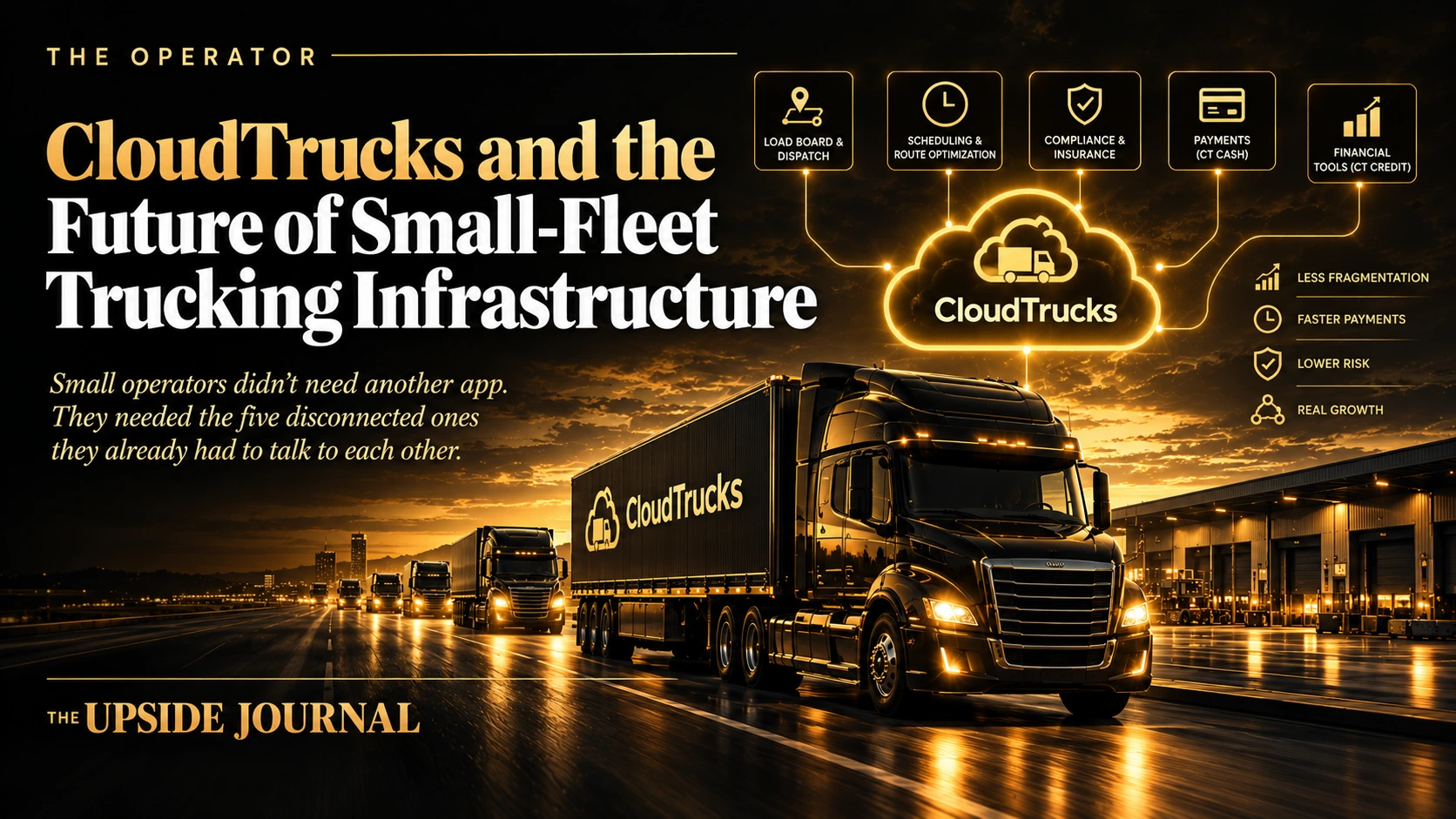
A one- or two-truck operator does not run one business. They run five: dispatch, scheduling, compliance, insurance, and cash management — each traditionally bought as a separate product from a separate vendor, if it is bought as software at all. CloudTrucks is built on the premise that this fragmentation, not a lack of driver-facing apps, is what caps how far a small trucking operation can scale. Rather than adding another point tool to that stack, CloudTrucks consolidates it into a single operating layer — an approach this network has already documented once, in LemFi's consolidation of diaspora payment rails, and is now examining in a market with no diaspora dimension at all: independent American trucking.
Introduction
It is tempting to describe CloudTrucks as "logistics software," and that description is not false so much as it is uninformative. Trucking already has logistics software — load boards, ELD compliance tools, dispatch platforms, invoicing systems — and none of it solved the problem CloudTrucks was built to solve. The relevant question is not whether trucking has enough software. It is why a one- or two-truck operator, after buying five separate tools, still runs a less coordinated business than a large fleet running none of them individually.
What Did the Trucking Technology Stack Look Like Before?
Before CloudTrucks, a small operator's technology stack was assembled the way most fragmented industries assemble one: piecemeal, vendor by vendor, with no shared data layer connecting the pieces. A driver might use one app to find loads, a second to log hours for compliance, a third to invoice brokers, a fourth — a factoring company — to get paid faster than the standard 30-to-45-day cycle allowed, and a spreadsheet or a notebook to track whether any of it actually added up to a profitable month. Each tool solved its own narrow problem competently. None of them talked to each other, which meant the operator, not the software, was the integration layer — reconciling data by hand, absorbing the cost of every gap between systems.
Large fleets do not carry this cost, because they can afford dedicated back-office staff and integrated enterprise systems. The fragmentation tax falls almost entirely on the operators least able to pay it: exactly the 350,000-plus independent owner-operators and small carriers this network's founder-entity profile of Tobenna Arodiogbu examines from the biography side. This article is concerned with what he built, not why he built it.
What Does CloudTrucks Actually Provide?
CloudTrucks replaces that patchwork with a single operating layer: an aggregated load board and schedule optimizer for finding and sequencing freight, dispatch support, compliance and insurance handled as part of the platform rather than a separate purchase, and an integrated payments system — CT Cash — that pays drivers within roughly two hours of a completed, proof-of-delivery load instead of the industry-standard 30 to 45 days. Operators who want to keep their own operating authority and insurance, rather than run under CloudTrucks', can use CloudTrucks Flex, a lighter version of the same stack that still includes the schedule optimizer, load board, and instant pay. A Visa-backed credit product, CT Credit, extended the same logic to smoothing costs between completed jobs, letting an operator cover fuel or maintenance without waiting on the next payout cycle. What distinguishes this from a bundle of five separate apps under one login is that each piece reads from and writes to the same operator record: a completed delivery does not just trigger a payment, it updates the same data set that feeds compliance tracking and the operator's own business-performance view.
The Stack, Layer by Layer
Operational Layer | Legacy Approach | CloudTrucks Consolidation |
|---|---|---|
Finding freight | Separate load board, manually cross-checked | Aggregated load board + Schedule Optimizer |
Getting paid | 30–45 day broker terms, or 3%+ factoring fee | CT Cash — instant pay on proof of delivery |
Managing cash between jobs | Personal savings or high-cost short-term credit | CT Credit — Visa-backed operator credit line |
Staying compliant and insured | Separate insurance broker and compliance vendor | Built into the CloudTrucks or Flex operating layer |
Understanding the business | Manual spreadsheet reconciliation across tools | Business Intelligence — unified operator-level data |
Business Intelligence, the platform's data layer, is the clearest evidence of what consolidation is actually for: it exists only because every other layer already shares a common data structure. A dashboard summarizing performance across five disconnected vendors would require the operator to do the reconciliation CloudTrucks was built to remove; a dashboard drawing from one integrated stack requires nothing from the operator at all. In a fragmented stack, a comparable dashboard is not simply harder to build — it is close to impossible to build accurately, because no single vendor's data can be trusted to reconcile cleanly against another vendor's without manual intervention. Business Intelligence is not, in other words, an additional feature CloudTrucks bolted on top of the stack; it is the byproduct that only becomes possible once the stack has actually been unified underneath it, which is why its presence is a reasonable test of whether a "consolidated" platform has genuinely consolidated its data, or merely its branding.
Why Did Point Solutions Fail to Solve This Already?
Trucking software did not arrive with CloudTrucks. Load-matching apps, ELD compliance platforms, and factoring services have existed for years, each addressing a genuine pain point. Their collective failure to solve small-operator fragmentation was not a failure of execution within any single category — it was a structural limit of the point-solution model itself. A load-matching app has no reason to also solve compliance; a factoring company has every reason not to solve the cash-flow problem it profits from leaving open. Each vendor optimizes its own narrow slice, and none of them is incentivized to build the connective layer between slices, because that layer is not where any individual vendor's revenue sits. The result is a market where dozens of adequate point tools coexist and the coordination problem between them remains completely unaddressed — not because nobody noticed it, but because no single participant in the existing stack benefited from fixing it.
This is the condition CloudTrucks was built to exploit, in the analytical sense: a gap that persists not from technical difficulty but from misaligned incentives among the vendors already serving the market. Solving it required a company with no stake in any single point solution's revenue — free to treat the connective layer itself as the product, rather than as an afterthought bolted onto an existing tool.
What Does Fragmented Cost Structure Actually Look Like?
The economics behind this are specific. An independent owner-operator's largest costs — fuel, insurance, financing on the truck itself, and maintenance — are fixed or near-fixed regardless of how efficiently the business is run, which means operating margin is disproportionately determined by two variables the operator can actually influence: how much of the truck's available time is spent hauling revenue-generating freight, and how quickly earned revenue converts into usable cash. A fragmented stack degrades both. Time spent manually cross-referencing load boards, invoices, and compliance records is time not spent driving or securing the next load; cash trapped in a 30-to-45-day broker payment cycle is cash unavailable to cover the fixed costs due that same month. Neither failure shows up as a single dramatic loss — each is a small, continuous drag that compounds across every load, every month, every truck an operator tries to add.
This is why the value of consolidation is not intuitive from the outside. It does not read as a single killer feature the way a new payments product might. It reads, instead, as the removal of dozens of small frictions simultaneously — which is precisely why competitors offering one best-in-class point solution rarely dent CloudTrucks' positioning: a superior load board does nothing to fix the cash-flow layer, and a superior payments product does nothing to fix the scheduling layer. The advantage compounds only when the layers are unified.
Full Carrier or Flex: Why Offer Both?
CloudTrucks' decision to offer both a full carrier model and the lighter-touch Flex option is itself a data point about how consolidation should be sold into a fragmented market. Operators who want CloudTrucks to hold operating authority and insurance get the deepest version of the stack, with the platform absorbing the most administrative overhead on their behalf. Operators who have already built their own authority and insurance, and are unwilling to give that up, still get the core of the same operating layer — schedule optimization, the aggregated load board, and instant pay — without being forced into a single all-or-nothing operating structure. That flexibility matters because the fragmentation problem this article is concerned with is not unique to operators without their own authority; it affects any small carrier running a disconnected stack, regardless of who technically holds the insurance policy. A consolidation model that only worked for operators willing to give up independence would have solved a narrower version of the problem than the one actually constraining the market.
Why Does Fragmentation Function as a Constraint, Not Just an Inconvenience?
Fragmentation in trucking is not merely annoying — it is a growth ceiling. Every additional truck an operator adds multiplies the coordination cost of a fragmented stack: more loads to track across systems that don't talk to each other, more invoices to reconcile against payments that arrive on different schedules from different brokers, more compliance records to keep straight across more drivers. A one-truck operation can absorb that overhead by working longer hours. A five-truck operation cannot, which is precisely the point at which many small carriers stop growing — not because demand or capital is absent, but because the operator has hit the limit of what a fragmented, manually reconciled stack can support.
A consolidated operating layer removes that ceiling by making growth an arithmetic problem instead of a coordination problem: each additional truck adds volume to the same system rather than adding a new set of disconnected tools to manage. That distinction — between software that adds a feature and infrastructure that removes a constraint — is the same one this network traced in its broader examination of the infrastructure layers high-growth companies need before they scale, applied here to an industry with none of the venture-backed companies that piece was written about.
Why This Matters for Operators Evaluating Vertical SaaS
For operators and technical leaders assessing vertical software in fragmented industries, CloudTrucks argues for a specific design principle: consolidation only creates value when the pieces share a data layer, not merely a login screen. A bundled product that still requires the customer to reconcile data between its own modules has not actually removed the fragmentation tax — it has relocated it. The products worth building, and worth backing, are the ones where completing one action in the system automatically updates every other layer that depends on it, the way a completed CloudTrucks delivery updates payment, compliance, and business-performance data in the same motion.
Where This Doesn't Fit
This article is about the technology layer, not the founder or the operating playbook behind it. Tobenna Arodiogbu's background and the reasoning that led him to trucking are covered fully in this network's founder-entity profile and are treated here only as necessary context, not repeated. Nor does this piece walk through CloudTrucks' internal playbook for onboarding and retaining operators — that operational mechanics question belongs to a forthcoming article in this cluster. And this is not a generic explainer of SaaS consolidation as a category, or a history of logistics software; both are deliberately out of scope so the piece can stay specific to what CloudTrucks' stack actually does.
Key Takeaways
Small trucking operators historically ran five disconnected systems — load boards, compliance tools, invoicing, factoring, and manual tracking — with the operator absorbing the integration cost between them.
CloudTrucks consolidates that stack into one operating layer where a completed delivery updates payment, compliance, and business data simultaneously, rather than bundling five logins under one brand.
CT Cash's roughly two-hour payout and CT Credit's between-jobs credit line exist specifically to remove the cash-flow layer of fragmentation, not merely to add a payments feature.
Fragmentation functions as a growth ceiling: each additional truck multiplies coordination cost under a fragmented stack, which is why many small carriers stop scaling well before capital or demand run out.
Consolidation only creates real value when the layers share one data structure — a bundle of disconnected tools under one login has not removed the fragmentation tax, only relocated it.
Conclusion
The trucking technology stack did not fail small operators for lack of individual tools; each layer, bought separately, worked adequately on its own. It failed them by leaving the integration between those layers as unpaid, invisible labor that only the operator could perform. CloudTrucks' contribution is not a new feature category but a structural one: proof that consolidating a fragmented operational stack into a single data layer changes what a small operator can grow into, independent of any other market condition. Whether that consolidation model transfers to other fragmented, owner-operator-heavy industries — construction subcontracting, independent courier fleets, small-scale agricultural equipment operators — is the next question this network will take up, and the answer will hinge on the same test applied here: whether a would-be consolidator is unifying data, or only unifying a login screen.
Related Reading:
Pillar
The Rise of Diaspora Operators: How African Founders Are Building Global Infrastructure Companies - https://theupsidejournal.com/articles/the-rise-of-diaspora-operators-how-african-founders/
Siblings:
Ridwan Olalere: Building the Financial Infrastructure Connecting Africa's Global Diaspora - https://theupsidejournal.com/articles/ridwan-olalere-lemfi-diaspora-financial-infrastructure/
Joe Kinvi: Building the Infrastructure That Connects Global African Investors -
https://theupsidejournal.com/articles/joe-kinvi-borderless-diaspora-investment-infrastructure/
LemFi and the Future of Diaspora Financial Infrastructure - https://theupsidejournal.com/articles/lemfi-future-diaspora-financial-infrastructure/
Forthcoming:
CloudTrucks and the Future of Small-Fleet Trucking Infrastructure
Why Small Trucking Businesses Need an Operating Infrastructure, Not More Trucking Software
How Digital Infrastructure Is Changing the Economics of the Independent Trucking Business
External References:
https://medium.com/cloudtrucks/announcing-cloudtrucks-17a98e7e7d10 - Announcing CloudTrucks — Tobenna Arodiogbu, CloudTrucks (Medium)
https://afrotech.com/tobenna-arodiogbu-founder-of-trucking-startup-cloudtrucks-closes-20-5m-series-a-round - Tobenna Arodiogbu, Founder of Trucking Startup CloudTrucks, Closes $20.5M Series A Round — AfroTech
https://www.joc.com/aro/tobenna-arodiogbu-ceo-cloudtrucks - Tobenna Arodiogbu, CEO, CloudTrucks — Journal of Commerce
https://www.blackventures.org/blackleaders/tobenna-arodiogbu - Tobenna Arodiogbu — Black Ventures Founder Profile