
Executive Summary
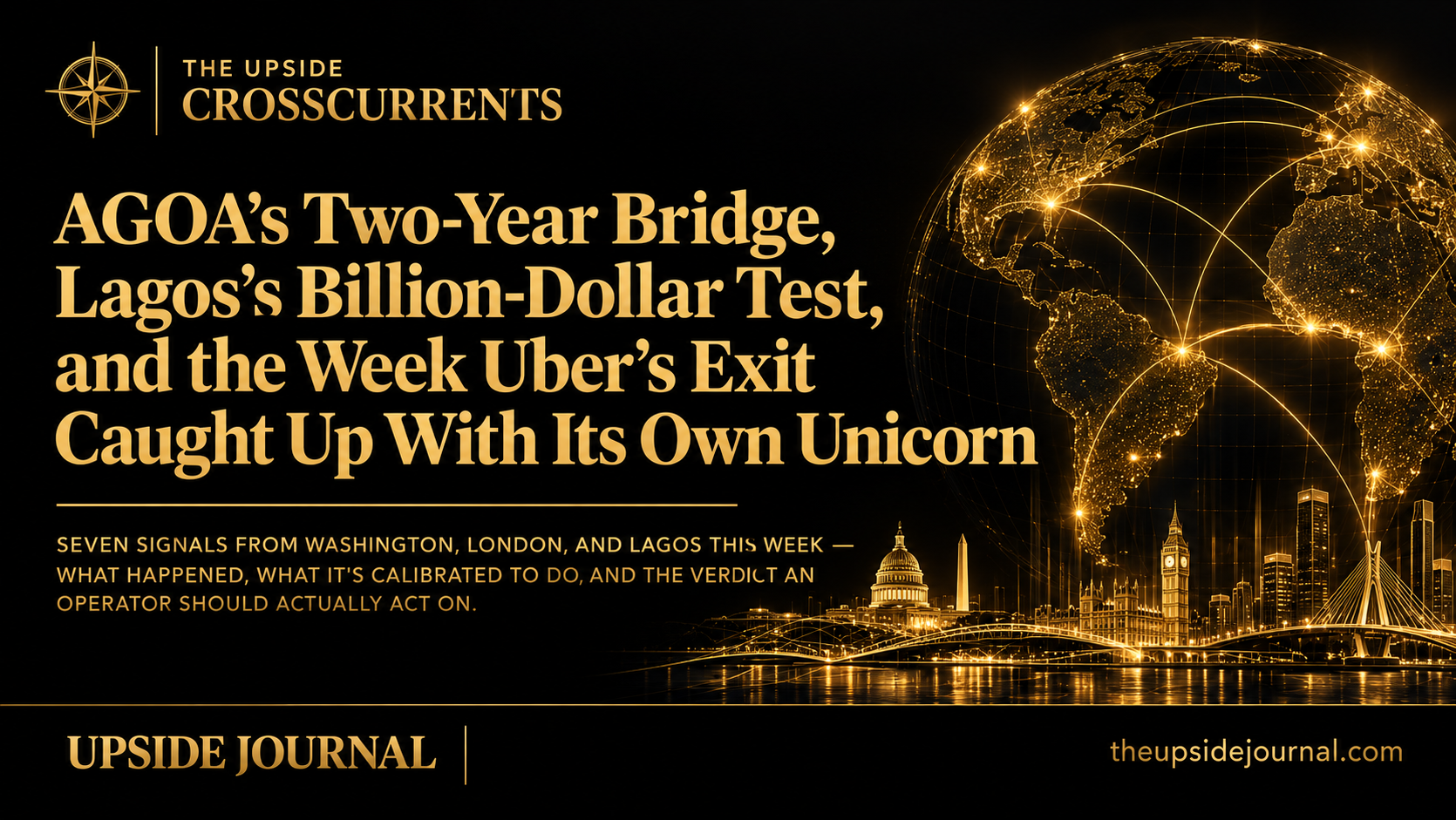
This week's graph pulls in three directions at once: a trade policy renewal that buys Nigerian exporters time without certainty, a Lagos capital-markets test case worth $1.6 billion, and a mobility-sector retreat that turned Uber's own backed unicorn into collateral. Underneath all of it, a flat funding number and a founder's on-record warning both point to the same theme — the easy years of assuming growth are over; the operators who win this cycle are the ones pricing risk correctly, not the ones with the biggest headline number.
What Does a Two-Year AGOA Extension Actually Buy Nigerian Exporters?
President Trump signed a two-year extension of the African Growth and Opportunity Act — through 2028 — as part of the Continuing Appropriations and Extensions Act, 2027. Nigeria and 31 other eligible African countries retain duty-free access to U.S. markets, with retroactive treatment reaching back to the program's September 2025 lapse. South Africa had pushed for fifteen years and got two.
The mechanism: the extension keeps the trade preference alive, but Trump retains sole discretion over annual eligibility review — a 2027 review is already scheduled. That discretion, not the two-year clock, is the actual variable Nigerian exporters are underwriting.
Can Lagos Absorb a $1.6 Billion IPO in One Sitting?
Dangote Refinery set its IPO price at ₦525 per share, targeting roughly $1.6 billion — Africa's largest single-asset listing — with a Nigerian Exchange listing expected after the offer closes in October.
The mechanism: this is less a referendum on Dangote than a live capacity test for Lagos capital markets — can the exchange clear a raise this size without crowding out the rest of 2026's pipeline?
What Happens to Moove Now That Uber Has Left Nigeria?
Uber shut down its Nigerian operations after twelve years as part of a global retreat. Moove — the vehicle-financing unicorn Uber backed with roughly $100 million and whose business model depends on Uber driver demand — is now weighing its own Nigeria exit, weeks after closing a $250 million Series C.
The mechanism: Moove's underwriting was built on Uber demand as a given. Remove Uber, and the unit economics that justified both the financing model and the fresh $250 million round come into direct question.
Is Nigeria's Doubled Trade Surplus Actually a Growth Story?
Nigeria's trade surplus roughly doubled to $9.5 billion, per National Bureau of Statistics data, driven by a fall in fuel imports alongside rising crude oil and raw-material exports.
The mechanism: a meaningful share of this surplus is import substitution — Dangote's refinery output reducing the fuel import bill — rather than new export demand. Those are two different economic stories wearing the same headline number.
Where Is Africa's Flat Startup-Funding Number Hiding Its Risk?
African startups raised $2.10 billion across 275 tracked deals from January through August 2026 — up just 1.4% year-over-year — with Nigeria leading at $528.6 million. Moove's $250 million Series C and Jumia's $50 million round account for a disproportionate share of that total.
The mechanism: a nearly flat aggregate is masking growing concentration in a handful of mega-deals. This week's other news makes that concentration concrete — the single largest Nigerian round on this list is the same Moove now reconsidering its Nigeria business.
Why Does a US Visa Rule Change Matter to Nigerian Operators This Week?
DHS finalized fixed duration caps on F (student), J (exchange visitor), and I (foreign journalist) visas — four years for F and J, 240 days for I, 90 days for Chinese nationals on I visas — ending indefinite duration-of-status. The rule takes effect roughly 60 days after its July 16 Federal Register publication, landing in the days around this window.
The mechanism: Nigerian students and exchange visitors currently operating on indefinite duration-of-status now face a hard clock and a DHS extension-application burden with no guarantee of renewal.
What's the Real Cost of Buying a Microfinance Bank in Nigeria?
Sycamore founder Babatunde Akin-Moses warned publicly that fintechs acquiring regulated microfinance banks (MFBs) to gain deposit-taking licenses are inheriting the target's full regulatory history and governance obligations — not just a license and a customer base. His own acquired Kano-based MFB had its license revoked by the CBN in July 2026. He named a pattern already visible in Payhippo's acquisition of Maritime MFB, C-One Ventures' acquisition of Bankly, and Paystack's acquisition of Ladder MFB.
The mechanism: “Regulation is not something you deal with after building the business,” per Akin-Moses — insufficient due diligence on an acquired MFB's compliance history converts a shortcut into deferred liability.
Key Takeaways
- AGOA's two-year extension is a bridge for Nigerian exporters, not security — annual presidential review, not the clock, is the real variable.
- Dangote Refinery's $1.6B IPO is less a company story than a stress test of how much capital the Lagos exchange can clear in one sitting.
- Uber's Nigeria exit puts Moove's independence from its own backer to a live test, weeks after Moove closed a $250M round built on Uber demand.
- Nigeria's doubled trade surplus is partly an import-substitution effect from Dangote's refinery, not purely new export strength.
- Africa's near-flat startup funding total is masking concentration in a handful of mega-deals — one of which just got materially riskier this week.
- DHS's new fixed-duration visa caps remove the open-ended runway Nigerian students and exchange visitors have relied on, landing the same week as AGOA's renewal.
- A Lagos fintech founder is warning publicly that MFB acquisitions transfer the target's full regulatory history, not just its license.
Conclusion
Read together, this week's signal is the end of easy assumptions: trade cover that resets annually, a capital market about to be tested at scale, a mobility unicorn whose independence from its backer was never proven, a surplus that is partly a substitution effect, a funding total masking concentration, a visa regime removing an open-ended runway, and an acquisition strategy quietly accumulating regulatory liability. Operators across all three markets should price each of these as a conditional, not a given.