

Why Agentic AI Hype Will Under-Deliver for Most Enterprises in Late 2026 — And the 3 Governance Bets That Will Win
The agentic AI hype cycle is peaking. Every boardroom presentation promises autonomous workflows that will transform productivity. Yet beneath the excitement, a more sobering reality is forming: for m


The agentic AI hype cycle is peaking. Every boardroom presentation promises autonomous workflows that will transform productivity. Yet beneath the excitement, a more sobering reality is forming: for most enterprises, agentic AI will under-deliver in late 2026 — not because the technology fails, but because governance and orchestration maturity lag dangerously behind deployment speed.
Gartner and others warn that up to 40% of enterprises may demote or decommission autonomous agents by 2027 due to governance gaps identified only after production incidents.
This is not pessimism. It is the predictable outcome of treating agents like faster chatbots instead of autonomous actors with real agency.
The Predictable Hype-to-Reality Gap
2025 was the year of pilots. Early 2026 brought ambitious roadmaps — with 100% of surveyed organizations placing agentic AI on their agenda. But scaling remains elusive. McKinsey datashows only about 10% of organizations have successfully scaled AI agents in any function. The gap between experimentation and production is widening, driven by data readiness issues, change management shortfalls, and — most critically — insufficient governance.
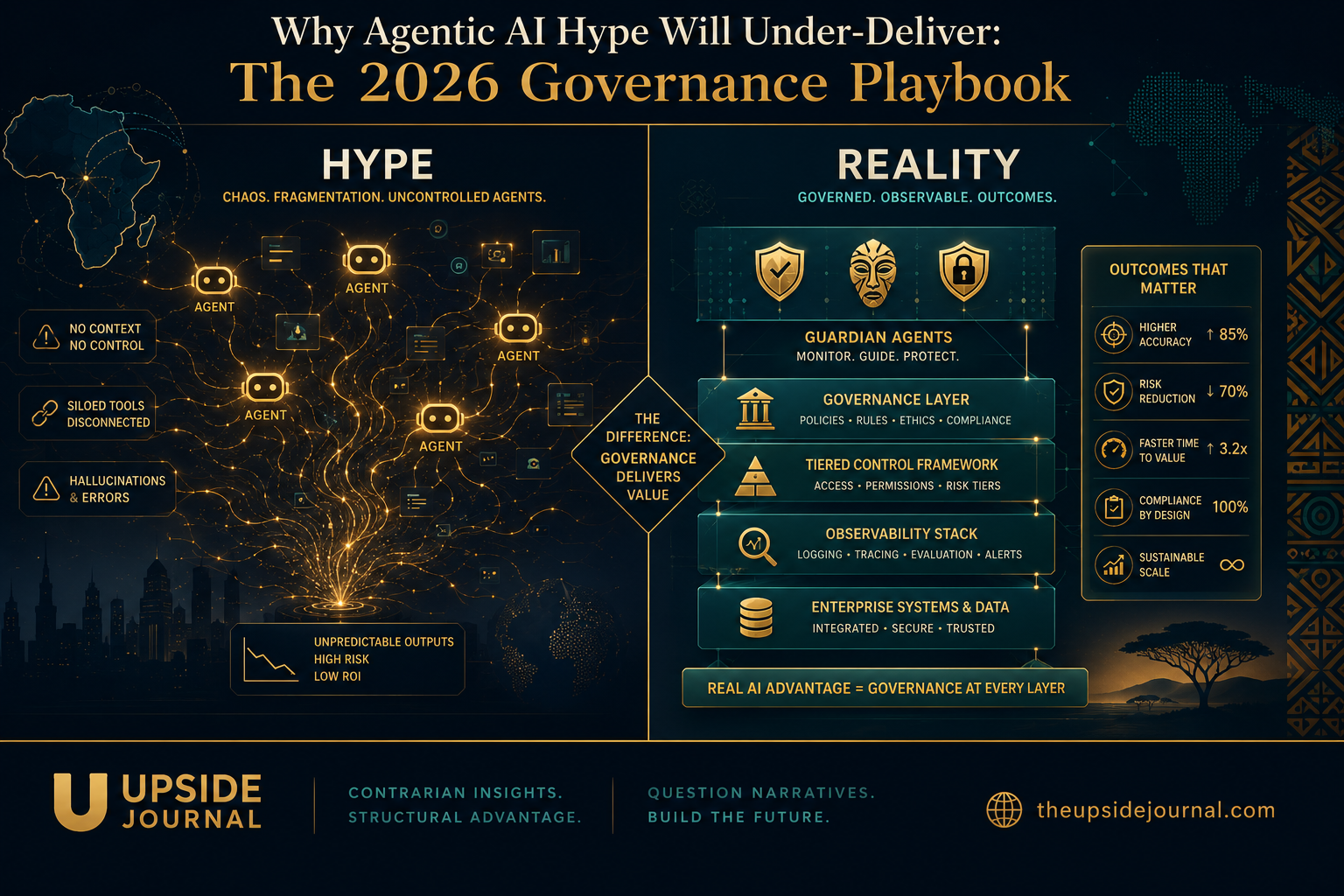
Why Most Deployments Will Under-Deliver
Enterprises are racing to deploy agents that can reason, plan, and act across systems. However, many lack the controls for runtime behavior, privilege management, and cascading failure prevention. Common failure modes include:
- Agent sprawl and shadow agents
- Unintended actions from over-permissioned systems
- Exploding costs from inefficient orchestration
- Compliance and security incidents that erode trust
The result? Stalled ROI, executive frustration, and potential “death by AI” legal claims.
The Governance Blind Spots Already Emerging
Uniform governance applied indiscriminately — either too loose or overly restrictive — is a primary culprit. Agents operate at varying autonomy levels and trust boundaries. Treating them the same leads to either innovation paralysis or uncontrolled risk.
The 3 Governance Bets That Will Win in Late 2026
Bet 1: Runtime Guardian AgentsGuardian agents — specialized supervisors that monitor, audit, and intervene in other agents’ behavior — are emerging as a critical layer. They provide real-time oversight without killing velocity. Organizations investing here early will avoid the bulk of runtime failures.
Bet 2: Tiered Autonomy FrameworksMove beyond binary “on/off” controls. Define clear autonomy tiers based on task risk, data sensitivity, and business impact. Combine this with human-in-the-loop escalation paths and auditable decision chains. This approach respects different agent roles while maintaining accountability.
Bet 3: Sovereign Observability StacksBuild unified observability that tracks agent actions, data flows, and outcomes across hybrid environments. Include kill switches, purpose limitation enforcement, and explainability tools. Enterprises with strong sovereign observability will turn governance into a competitive moat rather than a cost center.
The Operator’s 2026 Playbook
Leaders who succeed will:
- Audit current agent initiatives against governance maturity
- Prioritize high-value, low-risk workflows for initial scaling
- Invest in guardian and orchestration layers now
- Treat governance as a business enabler, not a checkbox
The hype will fade, but the organizations that bet on disciplined governance will capture outsized, sustainable value from agentic AI.
What governance challenge are you facing with agentic AI?Share in the comments or join our premium membership for deeper contrarian briefings, operator playbooks, and private intelligence networks.
Intelligent. Cultural. Global. Human.“Where the world’s conversations become movements.”