


EU AI Act 2026: Why US Tech Companies and African Fintechs Can't Ignore Europe's AI Rules
Three US Big Tech lobbying briefs landed in Brussels last month. None mentioned Africa.
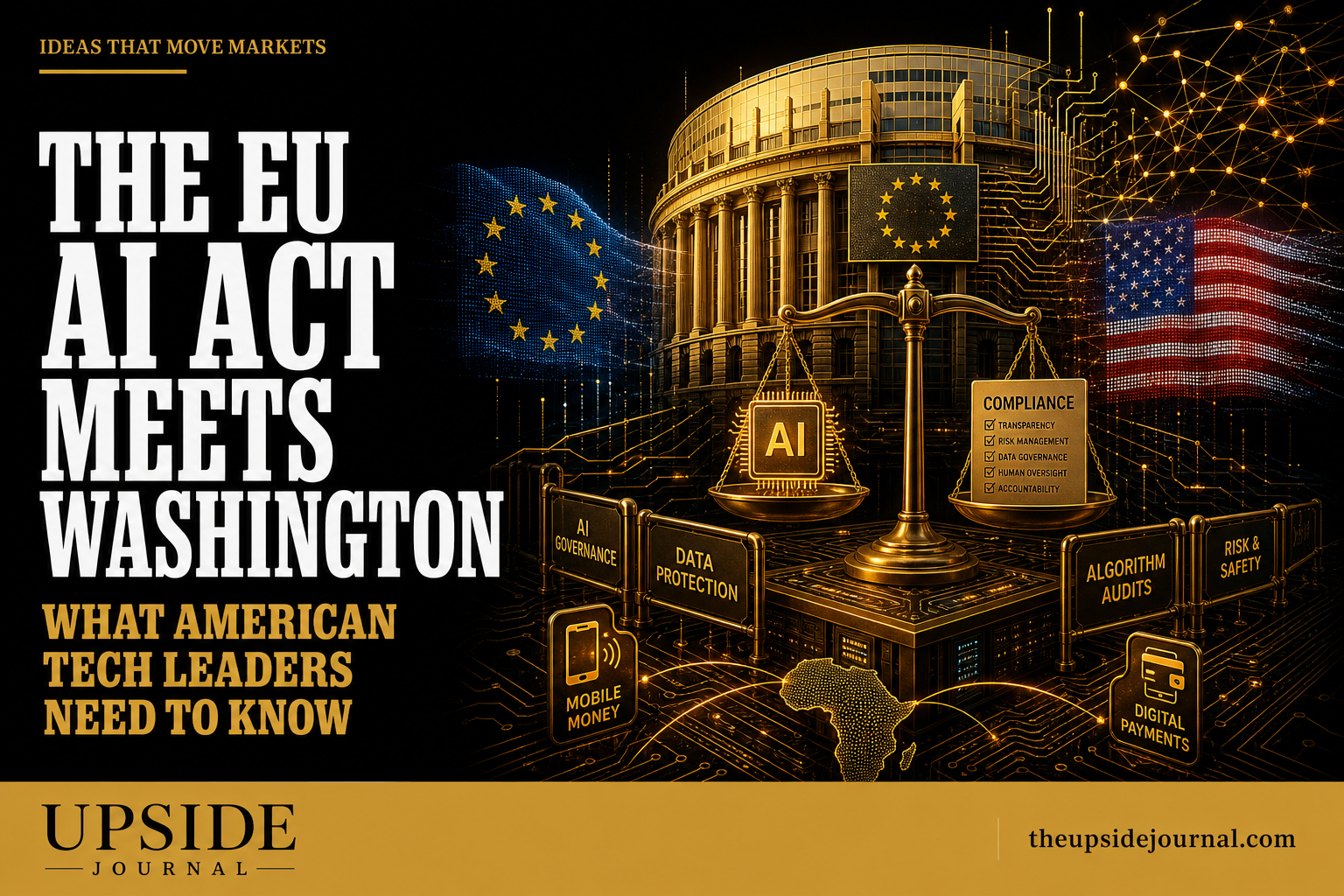
The EU AI Act Meets Washington: What American Tech Leaders Need to Know
Three US Big Tech lobbying briefs landed in Brussels last month. None mentioned Africa.
That omission tells you almost everything you need to know about the future of artificial intelligence.
While Silicon Valley debates model performance and Washington wrestles with executive orders, Europe has quietly done something far more consequential: it has written the world's first comprehensive rulebook for artificial intelligence.
The European Union's AI Act is often described as a compliance framework. That description misses the bigger story.
This is not simply about regulation.
It is about power.
The AI Act represents Europe's attempt to shape how artificial intelligence is developed, deployed, and governed across the global economy. And because of the EU's enormous market influence, companies from San Francisco to Lagos may soon find themselves adapting products, processes, and business models to rules written in Brussels.
For American technology leaders, the AI Act is becoming impossible to ignore.
For African startups with ambitions beyond their home markets, it may become impossible to avoid.
The question is no longer whether the legislation will affect your company.
The question is whether you're preparing for it early enough.
Why Brussels Is Becoming AI's Global Referee
For decades, the global technology industry followed a familiar pattern.
Innovation emerged from Silicon Valley.
Investment flowed from Wall Street.
Regulation arrived later—if it arrived at all.
Europe is attempting to change that equation.
The EU's approach to digital governance has already reshaped industries through landmark regulations such as GDPR, the Digital Markets Act, and the Digital Services Act. Together, these laws established what economists call the "Brussels Effect"—the phenomenon where companies adopt European standards globally because maintaining separate systems for different markets is expensive and inefficient.
Artificial intelligence is the next frontier.
The AI Act applies not only to companies headquartered within the European Union but also to organisations whose AI systems are used by European citizens or operate within the bloc's market.
In practical terms, that means a startup in Nigeria, a fintech in Kenya, or a software company in Texas may fall within the legislation's reach if European customers are involved.
Europe's message is clear:
If you want access to our market, you will play by our rules.
For the first time, a major economic bloc is attempting to define what trustworthy AI should look like before the technology becomes fully embedded in society.
That decision could influence AI governance worldwide.
The Lobbying Battle Happening Behind Closed Doors
The public conversation around artificial intelligence often focuses on model releases, funding rounds, and breakthrough capabilities.
Behind the scenes, another contest is unfolding. A political one.
Major technology companies have spent years lobbying policymakers on both sides of the Atlantic.
Their concerns are understandable. AI regulation has the potential to affect product development timelines, operational costs, liability exposure, and competitive advantage.
But the AI Act reveals a growing divergence between Washington and Brussels.
The United States has traditionally favoured innovation-first frameworks that encourage rapid experimentation and private-sector leadership.
Europe has increasingly prioritised risk management, accountability, transparency, and citizen protections.
These philosophies are now colliding.
At stake is more than regulatory compliance.
It is a battle over who gets to define the rules of the AI economy.
Europe sees itself as a guardian against unchecked technological power.
American technology firms see themselves as drivers of innovation in a fiercely competitive global race.
Neither side is entirely wrong.
Yet one reality is becoming unavoidable: companies operating internationally may have to satisfy both approaches simultaneously.
For executives, this means AI governance is no longer a legal department issue.
It is a boardroom issue.
The CEO's Six-Point AI Act Checklist
Many business leaders still assume the AI Act is a distant concern.That assumption may prove costly.
The organisations best positioned to thrive under the new framework will treat compliance as a
strategic capability rather than a regulatory burden.
Every leadership team should be asking six questions.
1. Do we know where AI is being used?
Many organisations have adopted AI incrementally across departments. Marketing teams use generative tools. Customer service teams deploy chatbots. Product teams integrate machine learning features.
If leadership cannot map AI usage across the business, governance becomes impossible.
2. Could any of our systems be classified as high-risk?
The AI Act imposes stricter requirements on applications that affect areas such as employment, education, finance, law enforcement, and critical infrastructure.
Companies must understand where their products fit.
3. Can we explain our AI decisions? Transparency is rapidly becoming a competitive advantage.
Customers, regulators, and investors increasingly expect organisations to explain how AI systems arrive at outcomes.
4. Are we documenting model performance and risk?
Documentation requirements are no longer optional in many contexts.
Organisations should begin building governance processes before enforcement pressures arrive.
5. Who owns AI accountability internally?
AI cannot remain everyone's responsibility and nobody's responsibility simultaneously. Clear executive ownership matters.
6. Are we building for global standards or local exceptions?
The companies that align with the highest standards today may avoid costly redesigns tomorrow. The AI Act rewards preparation.
Why African Fintechs Should Be Paying Attention
Perhaps the most overlooked dimension of the AI Act lies thousands of miles from Brussels.
Across Africa, a new generation of fintech companies is scaling rapidly. Many aspire to become global businesses.
Many already use artificial intelligence. And many underestimate how quickly regulation could affect expansion plans.
Consider a typical fintech growth journey.
A startup launches in Lagos.
It uses machine learning to assess creditworthiness.
AI tools detect fraud.
Automated systems support customer onboarding and compliance.
The company succeeds domestically and begins exploring opportunities across Europe.
At that moment, the regulatory environment changes dramatically.
AI systems involved in lending decisions, fraud detection, identity verification, and risk assessment may attract increased scrutiny under European rules.
The challenge is not that regulation exists.
The challenge is that many emerging-market startups are building for scale before building for governance.
History suggests this can become expensive.
The companies most likely to win internationally will not necessarily be those with the most sophisticated algorithms.
They may be those with the strongest governance structures.
For African founders, this represents both a warning and an opportunity.
Regulatory readiness could become a competitive differentiator.
Investors are paying attention.
Enterprise customers are paying attention.
Soon, regulators will be too.
AI's GDPR Moment
Nearly a decade ago, many organisations dismissed GDPR as a European compliance exercise.
They were wrong.
The regulation transformed privacy practices worldwide.
Today, businesses routinely discuss consent management, data protection, and privacy governance because GDPR forced those conversations into the mainstream.
The AI Act has the potential to follow a similar trajectory.
Its long-term significance extends beyond legal obligations.
It establishes a framework for how societies may choose to balance innovation and accountability in the age of intelligent systems.
The organisations that recognise this shift early will gain an advantage.
Those that view regulation purely as paperwork risk missing the broader strategic picture.
The future of AI will not be determined solely by engineers.
It will be shaped by policymakers, regulators, investors, customers, and business leaders.
That future is already being negotiated in Brussels.
And whether you're building in Silicon Valley, London, or Lagos, the outcome will likely affect you.
The companies that win the next decade will not be those asking how little compliance they can get away with.
They will be the ones asking a more important question:
How can trust become our competitive advantage?
Because in the emerging AI economy, trust may prove to be the most valuable technology of all.