

How CEOs Are Using AI for Decision Intelligence
How AI decision intelligence is changing executive decision support — what CEOs should own, what they should delegate, and how to build an AI strategy that improves decision quality without eroding judgment.

Introduction
AI does not make CEOs better decision-makers by generating faster answers. It makes them better decision-makers by changing what a CEO is structurally responsible for owning. That distinction is the difference between AI as a productivity tool and AI as decision infrastructure — and most enterprise AI strategies are still being built around the former when the real institutional value sits in the latter.
The Leadership Operating Rhythm established the cadence a leadership team runs on. Executive Decision Frameworks established how that team should govern decision quality once assembled — bias correction, decision rights, escalation. This article sits beneath both, as the technology layer: what changes when AI systems generate a meaningful share of the recommendations, forecasts, and risk assessments that reach the CEO's desk, and how executive decision support should be architected so AI improves decision quality rather than quietly degrading it.The question this article answers is narrow and specific: how should AI actually improve executive decision-making — not accelerate it, not automate it, but genuinely improve the quality of what a CEO decides.
Background: From Dashboards to Decision Intelligence
Enterprise AI's first wave inside the C-suite was almost entirely dashboard-shaped: real-time metrics, faster reporting, better visualization. That wave solved an information-latency problem — how quickly data reaches a decision-maker — without touching the harder problem of decision quality once that data arrives. A CEO with a beautifully instrumented real-time dashboard can still make a poorly reasoned call if the underlying judgment process around that data is unchanged.
Decision intelligence is the category that has emerged to close that gap. Analyst firm Gartner defines decision intelligence platforms as software that combines data, analytics, and AI to model, execute, and monitor decisions — not simply to display information faster, but to make the mechanics of a decision explicit, auditable, and improvable over time. Gartner's own market research frames this shift directly: as AI systems take on a growing share of strategic, tactical, and operational decisions, "decision governance" has become one of the top data and analytics trends for 2026, specifically because ungoverned AI-assisted decisions expose organizations to legal, operational, and reputational risk that dashboards alone never created.
This reframes what "AI strategy" should mean at the CEO level. It is not a technology procurement decision about which model or vendor to adopt. It is a decision-architecture decision: which categories of judgment the organization is willing to accelerate with AI, which it is not, and how the difference is enforced structurally rather than left to individual discretion in the moment.
The Purpose AI Should Serve in Executive Decision-Making
Compression, Not Replacement
The most consequential shift AI introduces to executive decision-making is not automation of the decision itself — it is compression of the distance between a question forming and a defensible answer becoming available. McKinsey's research on CEO-led AI transformation describes this directly: AI accelerates decision-making and helps organizations respond to market shifts faster, with early movers who redesigned decision workflows around AI achieving materially higher profitability than peers who simply layered AI onto unchanged processes. The value did not come from AI making the decision. It came from AI compressing the time required to assemble a well-reasoned option set for a human to decide between.
This distinction matters because it defines the correct purpose for AI inside a CEO's decision process: AI should shrink the time and effort required to reach a rigorous recommendation, not shrink the human judgment applied to that recommendation once it exists. Systems designed around the second goal — replacing judgment rather than accelerating the path to it — are precisely the deployments generating the governance failures analysts are now flagging across the industry.
From Individual Judgment to Institutionalized Judgment
A second, less discussed purpose AI decision intelligence serves is institutionalizing judgment that has historically lived only inside individual executives' heads. When a CEO's pattern-matching on a category of decision — pricing, market entry, resource reallocation — is only ever exercised informally, that judgment does not transfer when the executive leaves, and it cannot be audited, corrected, or improved systematically. Decision intelligence platforms that model a decision explicitly — the inputs considered, the weighting applied, the confidence level attached to the output — convert tacit judgment into an inspectable asset the organization can review, retrain, and hand off.
This is the structural reason decision intelligence belongs in the same knowledge cluster as operating cadence and decision governance rather than being treated as a standalone technology topic: it is not a tool bolted onto the executive process, it is a mechanism for making the executive process itself more durable and less dependent on any single individual's memory.
What Decision Quality Means Once AI Is in the Loop
The Confidence Disclosure Problem
The single most common failure mode in AI-assisted executive decisions is not a wrong recommendation — it is a correct-sounding recommendation presented without its actual confidence level, reviewed by an executive who has no basis for knowing how much weight to place on it. A model output phrased with the same fluency and authority regardless of whether it is drawing on strong signal or thin, noisy data removes the decision-maker's ability to calibrate their own scrutiny.
Gartner's research on explainable AI makes the mechanism explicit: as enterprises scale generative and agentic AI, the trust requirement is growing faster than the underlying technology itself, and organizations without dedicated explainability and observability layers cannot reliably tell whether an AI output reflects genuine analytical strength or a plausible-sounding hallucination. For a CEO reviewing an AI-generated market entry recommendation or resource reallocation proposal, this is not an abstract technical concern — it is the difference between an informed decision and an uninformed one wearing the appearance of rigor.
Decision quality in an AI-assisted context, therefore, requires a specific and non-negotiable standard: no AI-generated recommendation should reach a CEO-level decision without an explicit, disclosed confidence indicator attached to it. This single requirement does more to protect decision quality than any amount of downstream review, because it restores the calibration signal that fluent AI output otherwise removes.
Decision Quality Is Not the Same as Decision Speed
AI's most visible benefit — speed — is also its most seductive distortion. An organization that measures its AI decision intelligence investment purely by how much faster decisions now happen is measuring the wrong variable. Speed without a corresponding confidence and validation layer produces the illusion of decisiveness while quietly degrading the quality of what is being decided.
The correct framing, consistent with the decision-quality principles established in Executive Decision Frameworks, is that AI should be evaluated on whether it improves the process by which a recommendation is generated and reviewed — richer scenario coverage, faster access to a wider evidence base, systematic bias-checking applied at machine speed — not simply on how many days it shaved off the calendar.
What a CEO Must Own — And What AI Should Never Be Allowed to Own
The Ownership Line
The most important architectural decision a CEO makes about AI decision intelligence is not which platform to deploy — it is where to draw the ownership line between what AI is permitted to generate and what a human, specifically a named accountable individual, must retain final authority over. McKinsey's research on CEO-led AI transformation is explicit that this requires deliberate redesign: the speed of AI-generated intelligence must be matched by an equally deliberate redesign of workflows, roles, and governance, or the organization ends up with intelligence that moves faster than its accountability structures can absorb.
Three categories of ownership should never transfer to an AI system, regardless of how sophisticated the underlying model:
* Accountability for the outcome. A named human must be identifiable as accountable for any AI-informed decision above a defined stakes threshold — diffusing accountability to "the model recommended it" is a governance failure, not risk mitigation.
* The final call on irreversible decisions. Decisions that are expensive or impossible to unwind — market exits, major capital commitments, workforce restructuring — should always terminate in explicit human judgment, with AI positioned strictly as an input to that judgment, never as the decision-maker.
* The framing of the question itself. AI systems are exceptionally good at generating strong answers to well-posed questions and structurally weak at recognizing when the question being asked is the wrong one. Framing what decision actually needs to be made is a judgment task that should remain fully with executive leadership.
What AI Should Be Trusted to Own
Conversely, there is a category of decision support work that AI systems now perform with genuine reliability and where withholding AI involvement mostly just slows the organization down without protecting anything meaningful:
* Scenario generation and stress-testing. Producing a wider range of plausible outcome scenarios than a human team can generate manually under time pressure.
* Pattern detection across large, high-dimensional datasets where the volume of signal exceeds what human analysts can process comprehensively.
* Systematic bias-checking of draft recommendations — running the kind of structured dissent and pre-mortem checks described in Executive Decision Frameworks: How Great Leadership Teams Make Better Decisions at a scale and consistency human reviewers struggle to sustain.
* Continuous monitoring for decision drift — flagging when the real-world outcome of a prior decision is diverging from its original assumptions, faster than a quarterly review cycle would surface it.
The dividing line is not sophistication — it is reversibility and accountability. AI should own the categories of work where errors are cheap to catch and correct, and humans should own the categories where errors are expensive or irreversible.
Frameworks for Deploying AI Decision Intelligence
The Three-Layer Deployment Model
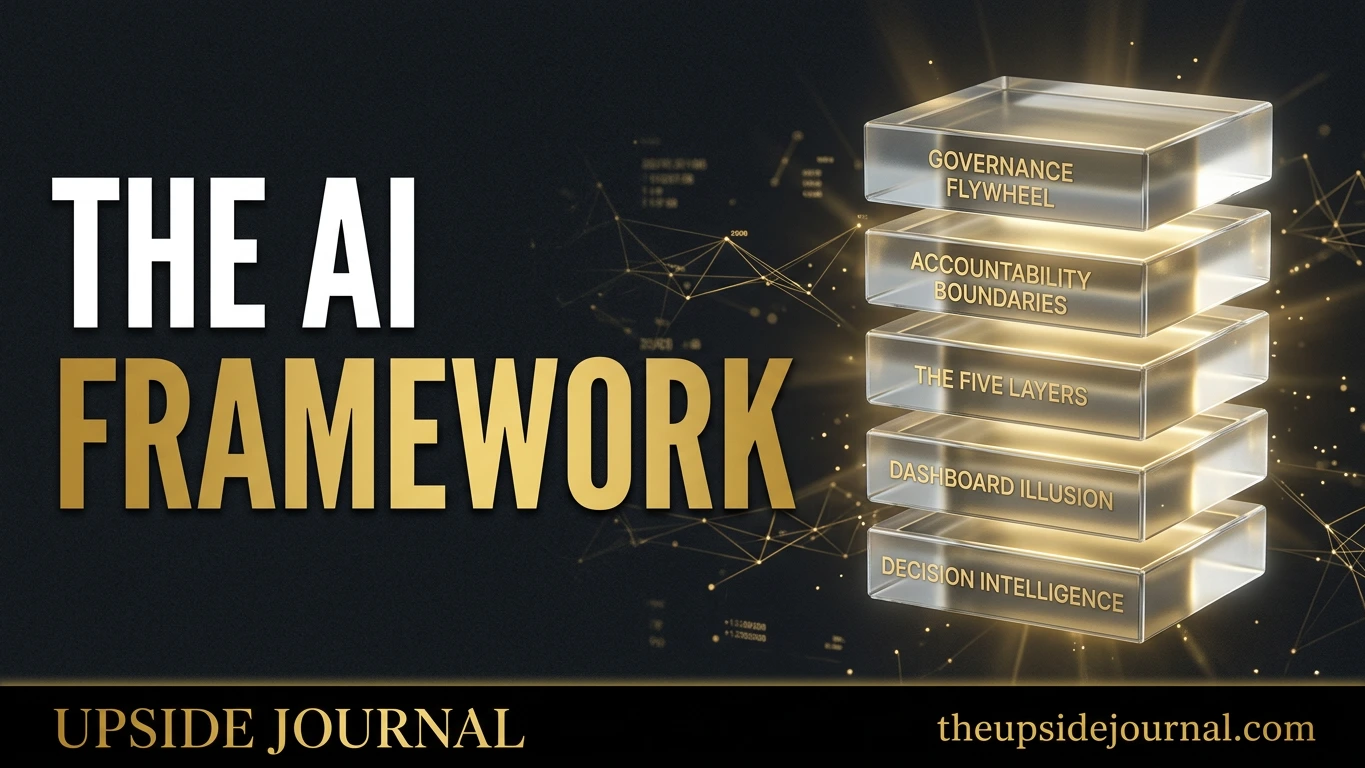
Organizations building a genuine AI decision intelligence capability, rather than a collection of disconnected AI tools, generally converge on a three-layer architecture:
1. The generation layer — the models and agents that produce recommendations, forecasts, and scenario analyses from underlying data.
2. The governance layer — the explainability, confidence-disclosure, and audit infrastructure that makes generation-layer outputs inspectable rather than opaque.
3. The accountability layer — the human decision-rights structure, consistent with the Decide/Agree/Recommend/Perform model, that determines who reviews an AI-generated recommendation and who bears final responsibility for acting on it.
Enterprises that deploy the generation layer without the governance and accountability layers are the ones producing the trust failures analysts are increasingly documenting — fluent, fast, ungoverned output reaching decision-makers with no mechanism for calibrating how much to trust it.
The CEO-Level AI Strategy Checklist
For a CEO evaluating whether the organization's AI decision intelligence deployment is structurally sound, five questions serve as a practical audit:
1. Does every AI-generated recommendation reaching an executive-level decision carry a disclosed confidence level, not just a conclusion?
2. Is there a named human accountable for every AI-informed decision above a defined stakes threshold?
3. Are irreversible decisions structurally required to terminate in human judgment, with AI positioned as input rather than authority?
4. Is decision drift — outcomes diverging from original assumptions — monitored continuously rather than discovered only at the next scheduled review?
5. Does the organization measure AI decision support on process quality (evidence coverage, bias-checking, scenario range) rather than on speed alone?
An organization that can answer yes to all five has built AI decision intelligence as genuine infrastructure. An organization that cannot has deployed a productivity tool wearing the language of strategy.
Governing Agentic Decision-Making at Scale
As agentic systems increasingly execute multi-step decisions with limited human oversight, the governance burden compounds. This is the specific risk category Gartner's 2026 data and analytics research flags under "decision governance" — the recognition that AI agents are now executing strategic, tactical, and operational decisions directly, which means the accountability and confidence-disclosure standards described above cannot be applied only to recommendations a human reviews before acting; they must be embedded in the agent's operating parameters from the outset, because by the time a human is reviewing the outcome, the decision has often already been executed. The technical architecture underpinning this shift is addressed in depth in Agentic AI in enterprise stacks 2026 and the governance risks of under-designed autonomy are explored further in Why agentic AI hype will under-deliver for most enterprises in late 2026; this article's scope is narrower — what the CEO specifically must own once agentic systems are making decisions, not the systems themselves.
Key Takeaways
* AI's real value in executive decision-making is compressing the path to a rigorous recommendation, not replacing the judgment applied to it.
* Decision quality collapses when AI outputs are presented without disclosed confidence levels — fluency should never be mistaken for reliability.
* Three categories should never transfer to AI: outcome accountability, final authority on irreversible decisions, and the framing of the question itself.
* AI should be trusted to own scenario generation, large-scale pattern detection, systematic bias-checking, and continuous decision-drift monitoring.
* A sound AI decision intelligence deployment has three layers — generation, governance, and accountability — and fails when the generation layer is built without the other two.
* Agentic systems compound the governance burden because accountability standards must be built into the agent's operating parameters before execution, not applied only after the fact.
Conclusion
AI decision intelligence is not a faster version of the executive dashboard, and it is not a replacement for executive judgment. It is a redesign of what a CEO is structurally responsible for owning: the confidence standards recommendations must meet before they are acted on, the categories of decision that must always terminate in named human accountability, and the governance architecture that keeps AI-generated speed from outrunning the organization's ability to remain accountable for its own decisions.
CEOs who treat AI strategy as a technology procurement question will accumulate fast, fluent, ungoverned recommendations. CEOs who treat it as a decision-architecture question — layering generation, governance, and accountability deliberately — will build something durable: a decision intelligence capability that gets better with scale rather than riskier.