Executive Summary
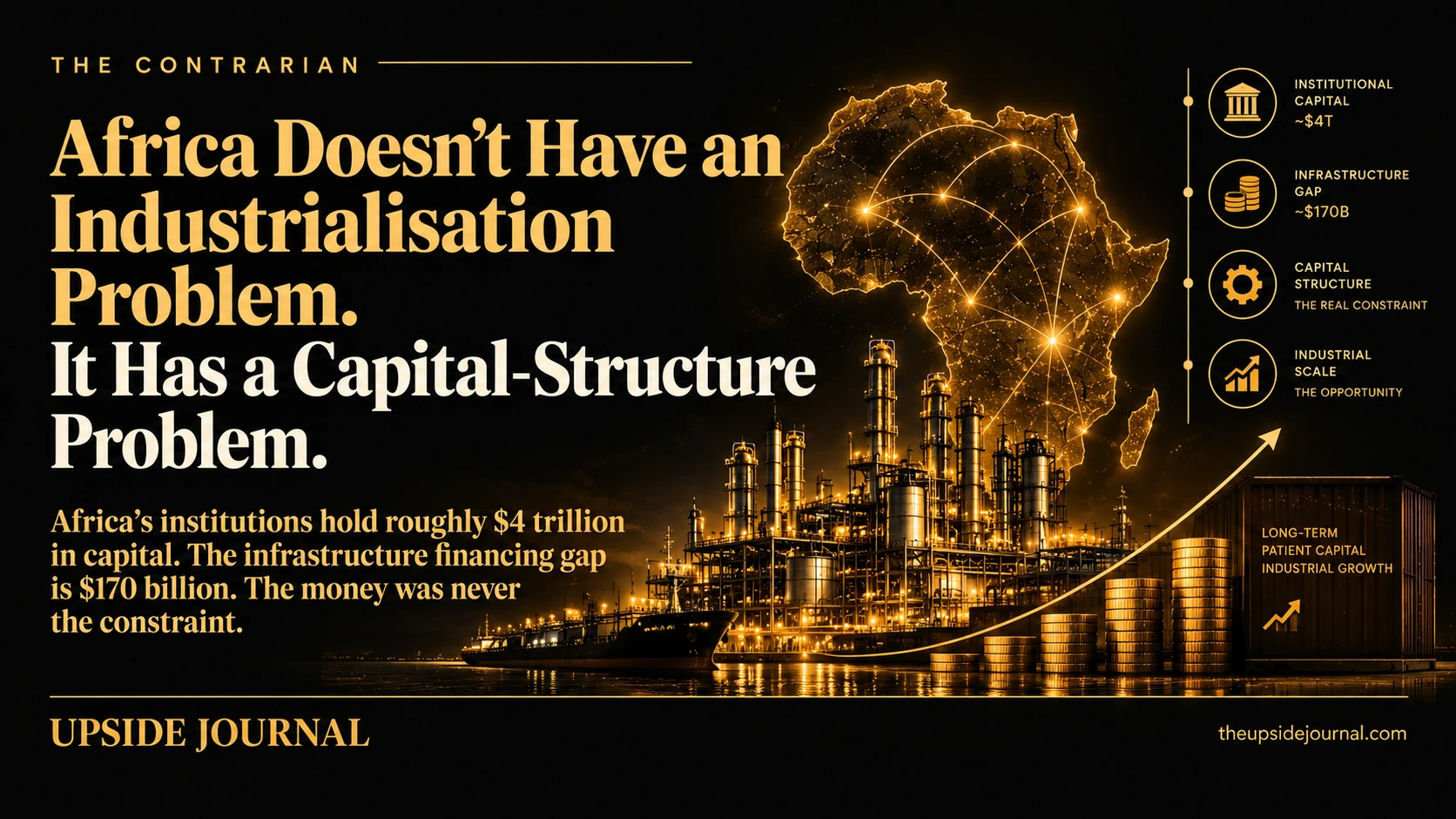
Africa's industrialisation constraint is not what most commentary assumes. According to the Africa Finance Corporation's own 2026 State of Africa's Infrastructure Report, the continent's banks, pension funds, insurers, and sovereign institutions collectively hold roughly $4 trillion in capital — a sum that dwarfs the African Development Bank's estimated $170 billion annual infrastructure financing gap. The capital exists. What doesn't exist, at anything like sufficient depth, is capital structured to absorb the risk, duration, and scale that industrial projects require. Dangote's $19 billion refinery is Exhibit A for this argument — not because Aliko Dangote's story is unusual, but because the financing structure behind that refinery reveals, in granular detail, exactly what "capital-structure problem" means in practice.
Introduction
I want to argue against a framing that has become almost unquestioned in coverage of African economic development: that the continent's industrialisation is being held back primarily by a shortage of capital. It isn't. Africa's own development finance institutions have said as much directly, and the evidence sits in plain view in how the continent's single largest recent industrial project actually got financed. The real constraint is structural — not how much capital exists, but what kind, held by whom, and on what terms it can be deployed against industrial risk.
What Does "Capital-Structure Problem" Actually Mean?
Before going further, it's worth taking the strongest version of the opposing view seriously: that Africa genuinely does face a capital shortage, because the $4 trillion figure is a stock of savings, much of which is already committed to government financing needs, insurance reserves, and other obligations that can't simply be redirected toward industrial risk on demand. That's a fair objection as far as it goes — not all of that capital is freely deployable. But it doesn't rescue the shortage narrative, it sharpens the structural one: the question isn't whether every dollar of that $4 trillion could theoretically fund a refinery, it's why the deployable portion of it is so narrowly mandated that a single multilateral bank ends up as the financing counterparty of last resort for the continent's largest industrial projects, again and again. A genuine capital shortage and a capital-deployment mandate problem produce the same visible symptom — projects struggling to get financed — but they call for entirely different fixes, and conflating them is exactly how the wrong policy conversation keeps happening.
A capital-structure problem is not a shortage of money. It is a mismatch between the kind of capital available and the kind of capital a given category of project actually requires. Industrial projects — refineries, ports, power plants, rail corridors — share a specific financial profile: enormous upfront cost, multi-year construction timelines before any revenue arrives, and payback periods measured in decades rather than years. Patient capital — funding structured to accept that duration and the risk that comes with it, in exchange for returns that arrive on a correspondingly long horizon — is what this profile requires. Most capital sitting inside African financial institutions today is structured for the opposite: short duration, low risk tolerance, and a strong preference for liquid, low-risk instruments like sovereign securities over long-dated industrial exposure. The $4 trillion figure and the $170 billion gap can both be true simultaneously precisely because they are measuring different things: one measures capital that exists, the other measures capital appropriately structured for a specific category of risk.
Why Does This Constrain Industrial Scale?
When patient, appropriately structured capital is scarce relative to available capital generally, industrial projects don't simply fail to happen — they happen anyway, but financed by an unusually narrow set of institutions willing to absorb risk the broader market won't touch. That concentration is itself the cost. A financing structure dependent on a small number of willing institutions is fragile in a way a deep, diversified capital market is not: it caps how many projects can be financed simultaneously, and it means any single institution's balance sheet constraints become a binding constraint on an entire continent's industrial pipeline, rather than one input among many diversified sources.
What Does Dangote Demonstrate?
The Dangote Petroleum Refinery is the clearest available evidence of exactly this pattern. The African Export-Import Bank — a single pan-African, multilateral development institution — has committed roughly $15 billion to the Dangote Group since 2015, including underwriting $2.5 billion of a recent $4 billion syndicated loan explicitly structured to refinance existing debt and optimise the refinery's capital structure. Nigeria's state oil company, NNPC, financed its own 20% equity stake in the refinery largely through debt as well, borrowing over $1 billion from a special-purpose financing vehicle and separately arranging oil-for-debt financing with the same institution, Afreximbank, that has anchored much of the refinery's broader debt stack.
Read that financing history carefully and a pattern emerges that has nothing to do with Dangote's personal wealth or business acumen: one institution, again and again, is the counterparty willing and structurally positioned to absorb long-duration industrial risk at this scale. That is not evidence of a uniquely well-connected founder. It is evidence of how thin the pool of appropriately structured capital actually is when a project of this size needs financing — and it demonstrates the exact distinction this piece is making between capital availability and capital structured for industrial risk, examined in more detail in this network's own coverage of the refinery's IPO and industrial-policy implications.
What Does Historical Precedent Show?
This is not a uniquely African problem, which is itself instructive. Every economy that has industrialised at scale had to solve the same capital-structure mismatch before it could build heavy industry, and the solution was rarely "wait for private markets to develop patient capital on their own." Postwar Japan and South Korea both built dedicated industrial development banks — state-backed institutions explicitly mandated to supply long-duration, high-risk-tolerant capital that private commercial banks and nascent capital markets weren't yet structured to provide. Those institutions didn't replace private capital; they existed specifically to absorb the risk private capital wouldn't take until domestic capital markets matured enough to share the load. Afreximbank's role in Dangote's financing is structurally the same function, performed by a single pan-African institution rather than a dense network of them. The difference between Africa's position today and South Korea's in the 1960s and 70s is not that the underlying financing problem is different in kind — it's that the institutional response so far is narrower: one or two development banks doing the work that industrialising Asia eventually spread across a deeper bench of domestic development finance institutions, specialised industrial lenders, and eventually private capital markets willing to follow.
Why Doesn't Domestic Capital Fill This Role Instead?
The honest answer is that most domestic institutional capital across the continent is not built, mandated, or incentivised to take on industrial project risk at this duration and scale. Pension funds and insurers, the natural long-duration capital pools in any developed market, operate under regulatory and fiduciary structures across much of Africa that favour government securities and other liquid, low-risk instruments — a rational response to their own obligations, but one that leaves a $4 trillion pool of capital structurally unavailable for exactly the kind of financing Dangote's refinery required. A related, separate report from the OECD and African Union Commission puts the continent's annual infrastructure investment need at roughly $155 billion — about 5.6% of GDP — against actual spending closer to $83 billion, a gap the report attributes not to an absence of capital but to insufficiently deep pipelines of "bankable" projects and the regulatory frameworks needed to route existing capital toward them. That framing matches Dangote's case precisely: the refinery was, eventually, bankable enough for Afreximbank and NNPC's financing vehicles to commit tens of billions of dollars to it. The unresolved question is why so few other African industrial projects can currently clear that same bar, and why the institutions capable of clearing it remain so few in number. This is the deeper meaning behind the AFC's own diagnosis that Africa is "not lacking in capital, it is trapped by it": the capital sits inside institutions with mandates that were never designed to deploy it toward long-duration industrial risk, regardless of how attractive the underlying returns might be.
How Is This Different From a Venture-Capital Framing?
This network has already drawn a related distinction between venture capital and private equity as fundamentally different operating systems for different kinds of company risk. The same logic scales up to industrial infrastructure: financing a refinery is not a bigger version of financing a startup, and treating "more investment" as a single undifferentiated category obscures the fact that industrial risk requires an entirely different capital architecture — multilateral development finance, long-dated project finance, sovereign-backed guarantees — than equity capital built for high-growth, faster-exit company risk. Africa arguably has reasonable access to the latter. It has structurally limited access to the former, and conflating the two is part of why the "capital shortage" narrative persists uncorrected.
What Changes Could Deepen Industrial Capital Formation?
None of this is unfixable, and it isn't unique to Africa — every industrialising economy has had to build the institutional capacity to convert existing savings into long-duration industrial capital; the difference is how far along that build Africa currently is. Deepening domestic capital markets specifically for long-duration industrial exposure, expanding the mandates under which pension funds and insurers can hold infrastructure and industrial assets, and building more of the credit-enhancement and guarantee mechanisms that let a development bank like Afreximbank share risk with private domestic capital rather than absorb it alone, would each independently widen the pool of institutions capable of financing the next Dangote-scale project without leaning on the same handful of willing lenders every time. Whether that model can actually scale across the continent, and what would have to change structurally for it to, is the question this network takes up in full elsewhere; the point that matters here is narrower and, I'd argue, more fundamental — that question cannot even be asked correctly until the capital-availability narrative is retired in favour of the capital-structure one.
Where This Doesn't Fit
This is a contrarian thesis piece using Dangote's refinery financing as evidence, not a profile of Dangote himself, a breakdown of the refinery IPO's specific mechanics, or a scenario exercise about the model scaling continent-wide — each of those is covered fully elsewhere in this network. Dangote's personal wealth and business history are deliberately absent here; they explain nothing about the capital-structure argument this piece is making.
Key Takeaways
Africa's financial institutions hold an estimated $4 trillion in capital, dwarfing the African Development Bank's roughly $170 billion annual infrastructure financing gap — the constraint is not capital scarcity.
Industrial projects require patient capital: long duration, high risk tolerance, decades-long payback. Most African institutional capital is structured for the opposite — short duration, low risk, liquid instruments.
Dangote's refinery financing shows the pattern directly: a single institution, Afreximbank, has committed roughly $15 billion to the Dangote Group since 2015, absorbing concentration risk a deep domestic capital market would otherwise spread across many lenders.
Pension funds and insurers — the natural long-duration capital pools in developed markets — remain structurally mandated toward liquid, low-risk instruments across much of Africa, leaving trillions of dollars unavailable for industrial risk regardless of underlying returns.
Treating industrial financing as a bigger version of venture or growth-equity financing misdiagnoses the problem; industrial risk requires its own capital architecture, and Africa's real gap sits there, not in aggregate capital availability.
Conclusion
Africa does not have an industrialisation problem in the sense most coverage implies — a continent too poor or too undercapitalised to build what it needs. It has a capital-structure problem: trillions of dollars sitting inside institutions whose mandates were never built to deploy that capital against long-duration industrial risk. Dangote's refinery got built anyway, but the financing trail behind it — one development bank, again and again, absorbing risk a deep domestic market should be spreading across many institutions — is not a success story to be generalised. It is evidence of exactly how narrow the path to industrial financing remains, and how much capital-market architecture still has to be built before that path can widen.