Executive Summary:
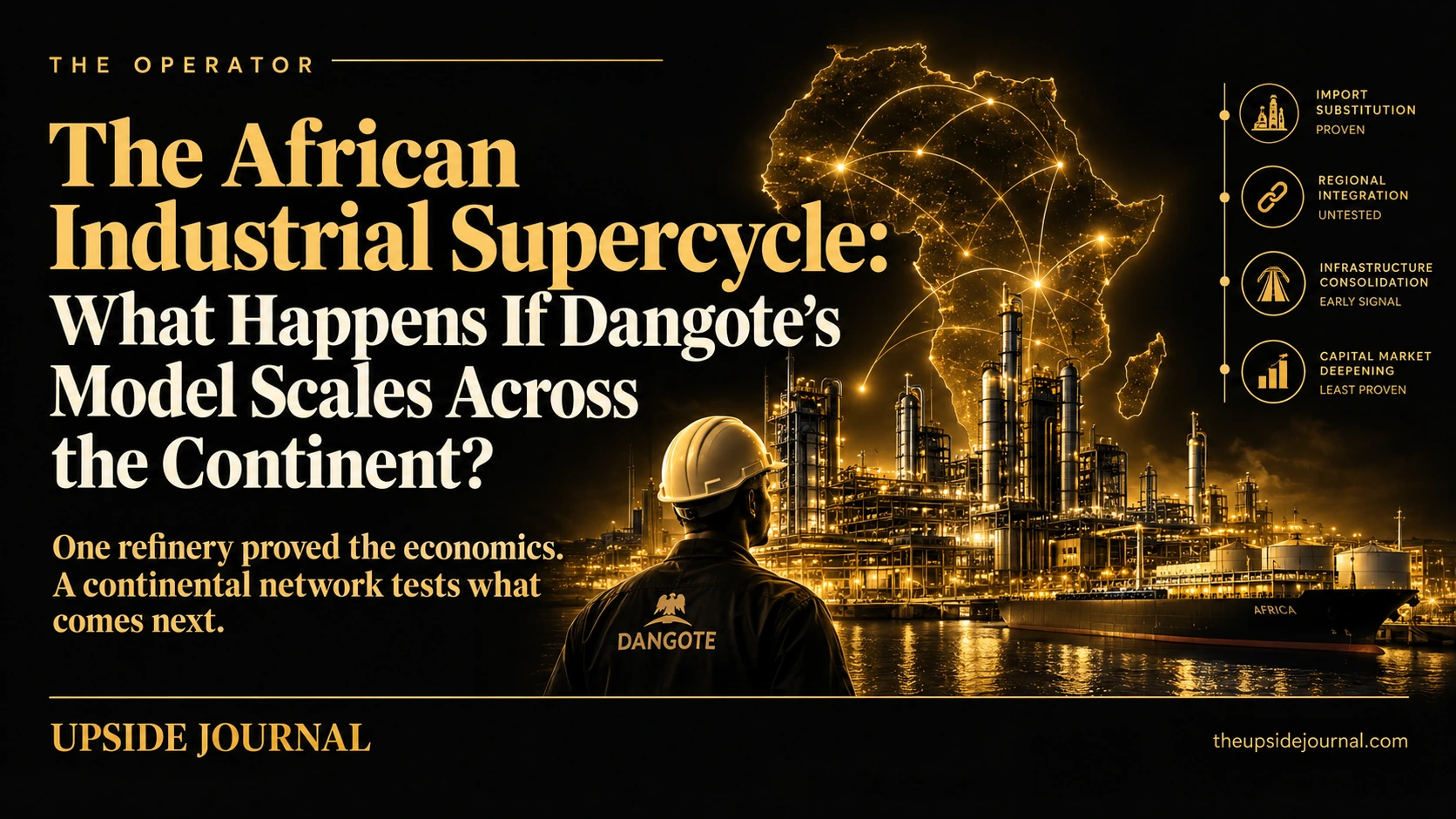
On 30 September 2026, Aliko Dangote breaks ground on a $17 billion, 700,000-barrel-a-day refinery in Lamu, Kenya — the first physical export of a model built entirely inside Nigeria. Alongside it sits a disclosed $46 billion, 2026–2028 capital-expenditure plan across refining, cement and fertiliser, targeting 2.1 million barrels a day of combined capacity, plus early talks with the Republic of Congo's state oil company for a Central African foothold. The question this raises is no longer whether Dangote's industrial model can leave Nigeria — it already has. The question is what has to be true, structurally, for it to become a continental pattern rather than one balance sheet's geographic footprint. This piece separates that claim into four testable stages — import-substitution industrialisation, regional manufacturing integration, infrastructure consolidation, and capital-market deepening — and scores each against what has actually happened, not what a press release implies.
Introduction
The easy version of this story treats Kenya's groundbreaking as proof of concept: one refinery worked, so more will follow, so Africa is industrialising. That version mistakes a single successful instance for a generalisable model — the same error analysts made about Chinese manufacturing in the 1990s, when one special economic zone's success was treated as evidence that the model itself, and not the specific conditions around it, had been proven.
What actually happened in Lagos is narrower and more useful than the easy version admits. Dangote solved a specific problem — Nigeria imported more than 80% of its refined fuel despite being a major crude producer — with a specific instrument: privately financed, vertically integrated industrial capacity, built at a scale no government agency or joint venture had managed in three decades of trying. That the same operator is now attempting to replicate the instrument in Kenya does not tell us the underlying conditions that made it work in Nigeria — a large captive domestic market, a tolerant regulatory environment for a single dominant operator, and one individual's capacity to mobilise tens of billions in patient capital — travel with it. This piece treats the Kenya refinery and the wider $46 billion continental plan as the first real data points in a scenario, not as its confirmation.
From One Balance Sheet to a Continental Model
The mechanics of the expansion are already public. The Lagos refinery reached its full 650,000 bpd nameplate capacity in February 2026 and is now being expanded toward 1.4 million bpd, at an estimated cost of $14.3 billion, with completion targeted for 2029 — a project scale that would make it the largest single-train refinery in the world, ahead of India's Jamnagar complex. Layered on top of that domestic expansion is the Lamu project: a separate 700,000 bpd facility, costing roughly $17 billion, financed through a mix of internally generated funds, bonds, and a future initial public offering, with construction beginning this week and a three-year completion timeline. Dangote has also offered East African governments a combined 30% equity stake in the Kenyan facility, worth an estimated $1.5 billion — a capital-structure choice, not a philanthropic one, that binds host-government political interest directly to the project's completion.
Kenya currently imports roughly 92% of its petroleum products. That number is the entire commercial logic of the Lamu refinery, and it is structurally identical to the number that justified the original Lagos investment. This is the first honest test of whether Dangote's model generalises: does a repeatable arbitrage — import dependency minus domestic refining capacity equals a bankable investment case — exist in enough African markets to support a continental network, or does it exist in exactly the handful of large, import-dependent economies (Nigeria, Kenya, arguably Ethiopia) where Dangote has already moved?
The disclosed $46 billion capital-expenditure plan for 2026–2028 spans three separate product lines — refining, cement, and fertiliser — rather than one. That detail matters more than the headline figure. A single-product expansion (more refineries, nothing else) would suggest a company scaling one arbitrage as far as it goes. A multi-product plan targeting a combined 2.1 million bpd of refining capacity alongside parallel cement and fertiliser investment suggests something closer to an attempt at building a diversified industrial holding company at continental scale — which is a materially larger and structurally different claim than "more refineries." It is also a claim this piece treats with more scepticism, precisely because diversification across product lines multiplies the number of country-specific regulatory, logistics, and demand conditions that all have to hold simultaneously for the plan to execute as disclosed.
The pattern being tested here belongs to a wider category this publication tracks under African Capital Builders — private individuals whose capital allocation decisions are large enough to reshape an entire economic system rather than a single company's balance sheet. Dangote is the founding case study in that network; this piece asks what happens when the case study tries to become a template.
What Precedent Exists for This Kind of Scaling — and Where It Breaks Down
Industrial conglomerates attempting to replicate a domestic model across borders is not a new pattern, and the comparisons are instructive precisely where they diverge. Reliance Industries built Jamnagar into the world's largest refining complex inside India, then spent two decades attempting to extend that domestic dominance into international downstream and retail ventures with a distinctly mixed record — succeeding where it partnered on local terms (Gulf petrochemicals joint ventures), struggling where it attempted to transplant the Indian model wholesale. Chinese state-linked industrial groups scaled cement and steel capacity across Africa and Southeast Asia through Belt and Road-linked infrastructure financing, and the pattern that emerges from a decade of that experience is consistent: the industrial asset itself (a plant, a refinery, a rail line) is the easiest part to replicate; the surrounding conditions — financing terms host governments will accept, regulatory environments that tolerate a single dominant operator, and regional trade rules that let the asset's output move freely — are what determine whether replication becomes a network or remains a series of disconnected, one-off deals.
Dangote's own history supplies the closer precedent. Dangote Cement expanded across roughly ten African countries over the 2010s before the refinery project began, and that expansion offers a genuine before-and-after test case sitting inside the company's own record: cement plants in Ethiopia, Zambia, Senegal, and elsewhere achieved domestic-market dominance in most host countries, but never consolidated into the kind of cross-border, integrated regional network this piece is testing for refining. Cement, unlike refined fuel, is heavy, low-value-per-tonne, and expensive to transport — which made national-level dominance the ceiling rather than a stepping stone to regional integration. Refined fuel has different transport economics, which is precisely why the pipeline disclosure matters more for this scenario than anything in the cement expansion's history did. The relevant assumption, made explicit: refined petroleum's more favourable transport economics compared to cement is a necessary condition for regional integration to be more achievable here than it was in Dangote's own cement expansion — not a guarantee that it will be.
The Four-Stage Scenario Architecture
A continental industrial model does not scale in one motion. It has to clear four separable conditions in sequence, each with its own evidence bar and its own point of failure. Treating them as one undifferentiated story — \"Dangote is expanding across Africa\" — obscures exactly where the model is proven and where it is still an assumption. The table below scores each stage against what has actually happened as of this writing, not what the expansion announcements imply.
Scenario stage | Status as of Sept 2026 | Key assumption still untested | What would falsify it |
|---|---|---|---|
Import-substitution industrialisation | Proven in Nigeria; underway in Kenya | That the arbitrage (import cost minus domestic refining cost) holds outside large, high-import-dependency markets | The Lamu refinery missing its three-year completion window, or failing to displace imports at the projected rate once operational |
Regional manufacturing integration | Assumption stage — no completed cross-border facility yet | That refined-product and industrial-input trade flows smoothly across borders under AfCFTA rather than being re-nationalised by each host government | Kenya, Ethiopia, or Rwanda imposing local-content or export-restriction rules that fragment the intended regional market |
African infrastructure consolidation | Early signal only — pipeline and logistics plans disclosed, not built | That a single operator's infrastructure (ports, pipelines, storage) becomes shared regional infrastructure rather than proprietary capacity | Neighbouring governments building competing, duplicate infrastructure rather than connecting to Dangote's network |
Capital-market deepening | Furthest from proven — one IPO, on one exchange, for one asset | That African capital markets can absorb and price a second, third, and fourth industrial listing at the scale the Lagos refinery IPO required | The Lagos refinery IPO underperforming its book, or no comparable Kenyan or pan-African listing materialising within the three-year build window |
Stage One: Import-Substitution Industrialisation — Proven, Not Generalised
This is the only stage with a completed, operating result behind it. The Lagos refinery's transition to full 650,000 bpd capacity in February 2026 already measurably reduced Nigeria's refined-fuel import bill, and the Kenya project applies an almost identical logic to a market with an even higher import-dependency ratio. The assumption still being tested is narrower than "does import substitution work" — it clearly can, at sufficient scale and with sufficient patient capital. The real assumption is whether the specific combination that made it work in Nigeria — a market large enough to absorb 650,000 bpd domestically, a government willing to grant one operator effective market dominance, and an individual capable of raising roughly $20 billion in initial capital — exists in more than two or three African economies. Kenya is the test case precisely because it is the closest available match on market size and import dependency; it is not yet evidence that the model works in smaller or less energy-intensive economies.
The market-size constraint is worth stating in concrete terms. Nigeria's population of roughly 230 million and Kenya's of roughly 56 million both clear the threshold needed to justify domestic refining at the scale Dangote builds; most African economies do not. Ethiopia, at over 130 million people, is the other market disclosed as being in early discussions, and its inclusion is consistent with the pattern rather than a departure from it — large population, high import dependency, government interest in reducing foreign-exchange exposure to fuel imports. Smaller economies (Rwanda, at roughly 14 million, is the partial exception under discussion, likely as a minority equity participant in the regional project rather than a standalone refining market) do not offer the same domestic-absorption case on their own, which is precisely why Stage One's real ceiling is a handful of large economies, not the whole continent.
Stage Two: Regional Manufacturing Integration — Underway, Structurally Unproven
The Central Africa discussions with Congo's state oil company and the disclosed 2,650-kilometre pipeline plan through southern Africa are the first concrete signals of an attempt to move beyond bilateral, country-by-country deals toward something resembling a regional network. Regional manufacturing integration succeeds only if refined products and industrial inputs can move across borders on commercial terms rather than being renegotiated politically each time a shipment crosses a frontier — the precise problem the African Continental Free Trade Area was designed to solve, and the precise problem it has not yet demonstrated it can solve at industrial scale.
AfCFTA's own implementation timeline is relevant here, not as background, but as a direct input into whether Stage Two is achievable on the schedule Dangote's construction timelines imply. The agreement's tariff-liberalisation schedule commits signatories to phasing out duties on the large majority of tariff lines over a multi-year transition period, with rules-of-origin negotiations — the mechanism that determines whether a Kenyan-refined product qualifies for preferential treatment when sold into Uganda or Tanzania — still being finalised sector by sector years into implementation. A refined-fuel network spanning Nigeria, Kenya, and prospective Central African capacity needs those rules settled specifically for petroleum products, not just in principle for goods generally. Assumption, explicitly labelled: this piece assumes AfCFTA's tariff and rules-of-origin framework continues moving toward implementation rather than stalling; if regional trade liberalisation reverses or fragments — or if petroleum products specifically remain carved out of preferential treatment, which several African governments have historically resisted liberalising given fuel-subsidy politics — Stage Two does not merely slow, it becomes structurally impossible regardless of how much refining capacity exists.
Stage Three: African Infrastructure Consolidation — An Early Signal, Not Yet a Pattern
Consolidation means something specific here: existing infrastructure built for one purpose (a refinery's export pipeline, a port's fuel-storage terminal) becoming shared regional infrastructure that other operators and governments build around, rather than proprietary capacity that competitors have to duplicate. The disclosed southern African pipeline plan gestures toward this outcome but does not yet demonstrate it — a pipeline announcement is not a shared-access agreement, and nothing in the public disclosures to date specifies whether third-party operators or governments would have contracted access to the pipeline's capacity or whether it remains proprietary to Dangote Group's own distribution needs.
The more likely near-term failure mode is not that consolidation fails outright, but that neighbouring governments, wary of dependency on a single private operator's infrastructure, choose to build parallel, duplicate capacity rather than connect to Dangote's network — a pattern with precedent in African power-sector history, where cross-border transmission interconnection has consistently lagged individual countries' preference for sovereign generation capacity, even where interconnection was demonstrably cheaper. That outcome would preserve import substitution at the national level while foreclosing the continental efficiency gains the "supercycle" framing implies. The honest read of Stage Three at this point is that it is a stated intention with a capital commitment behind it, not yet a structure any third party has agreed to use.
Stage Four: Capital-Market Deepening — The Least Tested Claim in the Whole Scenario
This is where the scenario is most exposed. Industrial finance in Africa is constrained less by the absence of capital than by the absence of patient, appropriately structured capital at the scale industrial assets require — and Nigeria's own market has a documented investor-confidence problem rather than a market-access problem, which bears directly on whether it can absorb repeat industrial listings. The Lagos refinery's own transition into a public-market asset — a hybrid-currency IPO structure that let investors subscribe in naira while receiving dollar-denominated dividends, targeting a raise of up to $5 billion at a valuation near $40–50 billion — was itself a novel financial-engineering solution to that exact constraint, not evidence that the constraint has been solved generally. Pre-IPO private placements reportedly secured roughly $2.5 billion in commitments ahead of the public offering, led by regional financial institutions — a genuine signal of institutional appetite, but appetite concentrated in a single, closely watched, first-of-its-kind transaction is a different claim from durable market depth.
A single successful IPO, however large, does not establish that Nigerian or Kenyan capital markets can repeat the exercise for a second and third industrial asset without exhausting the pool of investors willing and able to underwrite that scale of risk. The test to watch is not whether the Lagos IPO's book fills — recent reporting on institutional demand suggests it will — but whether a comparable structure can be replicated for the Kenyan asset, on a different exchange, with a different regulatory regime, without simply re-tapping the same pool of Nigerian and pan-African institutional capital that absorbed the first offering. That question is inseparable from a wider one this publication has tracked directly: whether African capital markets currently offer investors a credible exit pathway at all, independent of asset class — a market that struggles to provide liquidity for venture-backed exits is not obviously better positioned to absorb a second multi-billion-dollar industrial listing. A less-examined alternative source of the patient capital Stage Four requires sits with the diaspora rather than domestic or purely institutional pools: policy proposals aimed at channelling diaspora remittance flows toward structured investment vehicles point at a capital source large enough, in aggregate, to matter at this scale, though no disclosed element of the Dangote financing plan currently draws on it. If Kenya's own capital markets, or a secondary cross-listing structure, cannot independently support financing at this scale, capital-market deepening remains a claim about one exceptional transaction rather than evidence of a deepening market. This is also where the piece deliberately hands off rather than re-argues: whether Africa's industrialisation constraint is fundamentally about capital structure rather than capital availability is a separate, fuller argument reserved for this network's forthcoming Contrarian node, which treats Dangote as evidence rather than as the subject.
Where the Model Breaks
Three conditions would collapse the scenario from "continental pattern" back to "one operator's geographic footprint," and each is worth naming explicitly rather than leaving implicit.
Host-government equity terms harden into political liability rather than alignment. The 30% equity offer to East African governments is designed to convert political risk into political buy-in. It can just as easily reverse: if a change of government in Kenya, Ethiopia, or Rwanda treats an existing equity stake as leverage for renegotiation rather than partnership, the financing structure that made Lamu bankable becomes the mechanism that stalls it. Sovereign equity in privately controlled infrastructure has a mixed record across the continent precisely because it creates two decision-makers with different time horizons — a private operator optimising for construction timelines and return on capital, and a government optimising for the political calendar — and there is no disclosed mechanism yet for resolving disagreement between them once construction is underway.
The financing model does not survive a second cycle. The Lagos refinery drew on a specific, largely unrepeatable combination — one individual's balance sheet, a decade of patient construction, and a domestic IPO market willing to absorb the largest listing in Nigerian Exchange history. If the Kenya project or any subsequent expansion requires external debt markets to price African infrastructure risk on less favourable terms than Dangote's own capital allowed, the unit economics that worked in Nigeria do not automatically transfer. The $17 billion Lamu price tag is itself larger in dollar terms than the original Lagos build, financed on a foreign balance sheet in a market Dangote does not yet control the way he controls Nigeria's — a materially higher-risk financing profile than the project it is modelled on.
AfCFTA implementation stalls rather than deepens. Every stage past the first depends, to some degree, on regional trade rules functioning as designed. A refining network that cannot move product or inputs across borders on predictable commercial terms reverts to a set of disconnected national projects — which is still industrially useful, but is a materially smaller claim than a "supercycle." Fuel-subsidy politics make this the single likeliest point of failure: governments that subsidise domestic fuel prices have historically been the most resistant to liberalising cross-border petroleum trade, because doing so constrains their ability to manage the subsidy bill unilaterally.
None of these three failure conditions is mutually exclusive, and the scenario's downside case is not that one of them occurs in isolation but that they compound: a government renegotiation dispute slows construction, which raises financing costs on the next project, which makes the next capital raise harder to complete on favourable terms, which in turn makes governments more cautious about granting the equity and regulatory terms the model depends on. Reading the next 18 months for early signs of that compounding — rather than waiting for a single, unambiguous failure event — is the more useful monitoring discipline for anyone with capital or policy exposure to this scenario.
Why This Matters for Institutional Investors and Policymakers
For institutional investors and long-term allocators, the practical implication is sequencing discipline: Stage One is investable now, with a track record; Stages Two through Four are not yet investable claims, they are conditions to monitor before treating "African industrial supercycle" as a thesis rather than a headline. Underwriting exposure to the Lagos refinery's proven import-substitution economics is a different risk profile from underwriting exposure to the untested claim that a continental network consolidates around Dangote's infrastructure. Conflating the two — treating the Kenya groundbreaking as confirmation of the whole thesis rather than evidence for one-quarter of it — is the specific analytical error this piece is built to prevent. The 2,650-kilometre pipeline disclosure and the Congo talks are the leading indicators worth tracking over the next 18 months — not because they guarantee Stage Two or Three, but because their presence or absence is the clearest available signal of whether integration is actually being built or merely announced. A pipeline that reaches a contracted, third-party access agreement within that window is a materially different data point than a pipeline that remains a company-only distribution asset three years after groundbreaking.
For policymakers in host and neighbouring countries, the equity-stake structure Dangote has offered is itself a policy-relevant precedent: it demonstrates one mechanism — direct government equity in privately built infrastructure — for aligning a foreign or cross-border industrial investor's incentives with domestic political durability, independent of whether this specific project succeeds. Governments outside the current Dangote footprint evaluating their own industrial-partnership structures now have a live, priced example of what that alignment costs (an estimated $1.5 billion in foregone equity value) and what it buys (political durability against the specific renegotiation risk described above). The more consequential policy question those same governments should be asking in parallel is not about Dangote specifically, but about their own trade-policy posture: a government that welcomes foreign-financed refining capacity while resisting the AfCFTA liberalisation that would let that capacity serve a regional market is choosing national energy security over the larger continental industrialisation case — a legitimate choice, but one that should be made explicitly rather than by default through slow-walked implementation.
Key Takeaways
Dangote's model has cleared exactly one of four scaling conditions — import-substitution industrialisation — with a completed, operating result; the other three remain assumptions with specific, named failure modes.
The Kenya refinery's 30% equity offer to East African governments converts political risk into political buy-in, but the same structure can just as easily convert into political leverage against the project if governments change.
Regional manufacturing integration and infrastructure consolidation depend on AfCFTA functioning as designed; neither is a refining-capacity problem, and neither will resolve through more capital alone.
Capital-market deepening is the least tested claim in the entire scenario — one successful, novel-structure IPO does not establish that African markets can repeat the exercise at the frequency a continental network would require.
The right reading of the next 18 months is not whether Dangote builds more refineries — he almost certainly will — but whether the infrastructure and financing around them consolidate into shared regional capacity or remain a network of parallel, nationally isolated projects.
Conclusion
The Lamu groundbreaking answers the easy question. It does not answer the hard one. One operator can clearly move a proven import-substitution model across a border when the host market's fundamentals resemble the original case closely enough and the capital exists to fund it. Whether that constitutes an "African industrial supercycle" or simply one exceptionally well-capitalised operator's expanding geographic footprint depends entirely on the three stages that have not yet happened — and those three stages depend on conditions, from AfCFTA implementation to African capital-market depth, that are well outside any single company's control. Dangote's significance, in the end, may be measured less by how many refineries carry his name than by whether the infrastructure and capital-market conditions he is now testing turn out to be replicable by anyone else.
Related Reading
Pillar
African Capital Builders: How the Continent's Billionaires Are Shaping Its Economic Future: the network gateway that defines "capital builder" and introduces Dangote as its founding case study.
Siblings
What Dangote's Refinery IPO Means for African Energy Security and Industrial Policy:
Nigeria Doesn't Have a Capital-Market Access Problem. It Has an Investor-Confidence Problem.: .
J.P. Morgan's Nigeria Index Inclusion Is Bigger Than a Bond-Market Story: the debt-side signal of institutional access to Nigerian markets.
What AVCA's 2026 Nairobi Summit Revealed About Exit Pathways for African Startups:
Forthcoming
Africa Doesn't Have an Industrialisation Problem. It Has a Capital-Structure Problem.
The Lamu Refinery and Sovereign Equity: How East African Governments Are Pricing Industrial Partnership
External References
Nairametrics: Kenya to Launch Dangote-Backed $17 Billion East Africa Oil Refinery September 30: confirms the 30 Sept Lamu groundbreaking, the 30% equity offer to East African states and the three-year build timeline.
Legit.ng: Dangote to Begin Construction of Another Refinery by September 2026: covers the 2,650 km southern Africa pipeline disclosure and the Ethiopia and Rwanda stake interest, which are the Stage Two and Three signals.
Africa.com: Dangote Advances East Africa Refinery Expansion Plans: sets out the Kenya financing mix of internal funds, bonds and a future IPO, which backs the point that the capital structure is different this time.
AllAfrica / Vanguard: Dangote Refinery Announces Expansion From 650,000 to 1.4 Million Barrels Daily: gives the baseline for the Lagos expansion, including scale, timeline and the original listing intent.