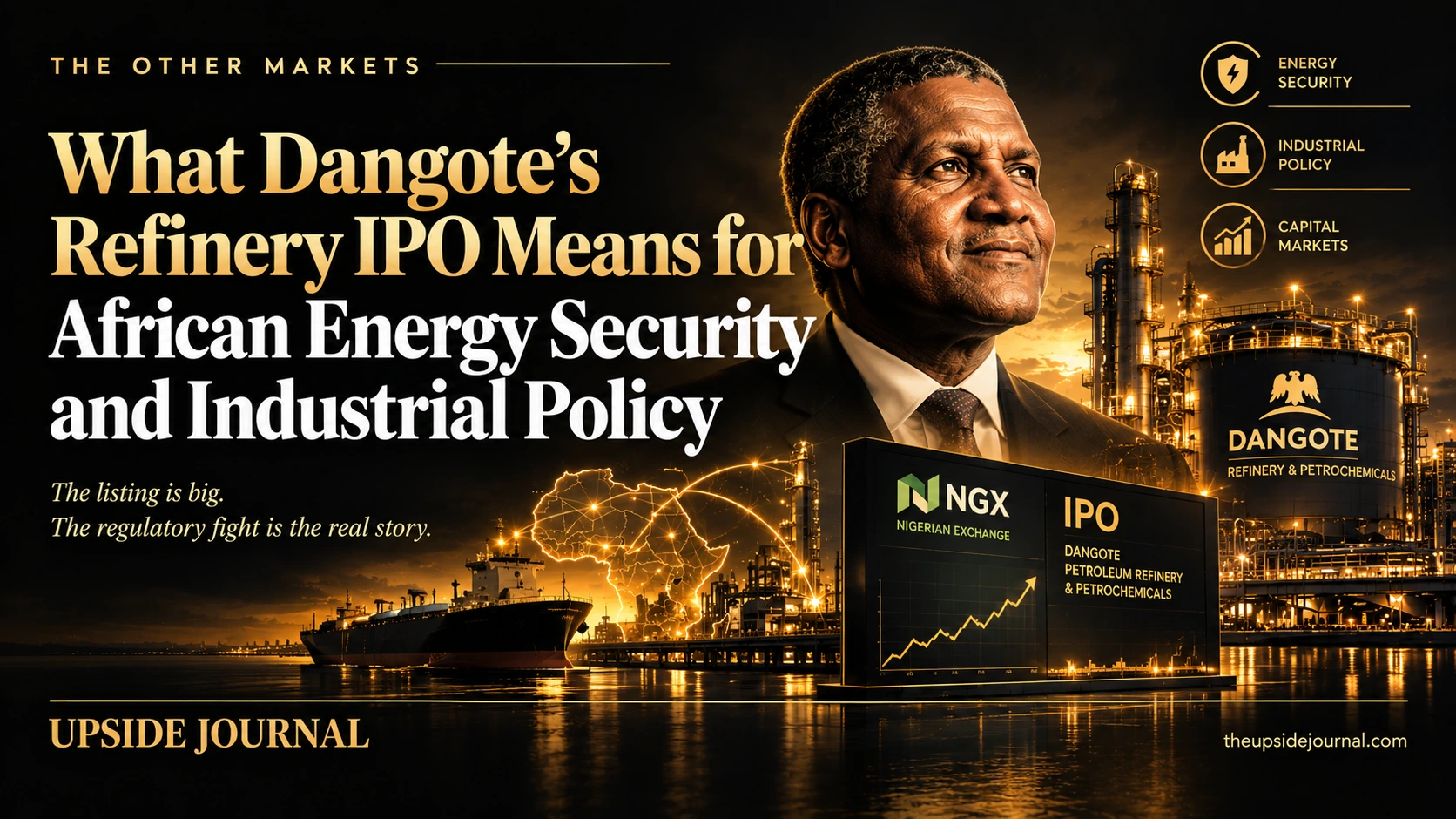
What Dangote's Refinery IPO Means for African Energy Security and Industrial Policy
The number everyone is covering is ₦2.15 trillion. The number that actually matters is the regulatory fight happening at the same time.
On 14 September 2026, Aliko Dangote sounded the closing gong at the Nigerian Exchange to open the largest listing in the NGX's 66-year history: 4.1 billion new shares in Dangote Petroleum Refinery & Petrochemicals, priced at ₦525 each, targeting ₦2.15 trillion in gross proceeds for roughly 3.3% of the enlarged company. This is one of the four capital-allocation events this publication's African Capital Builders network is tracking in 2026, examined here specifically for its policy consequences rather than its place in that wider pattern. Most coverage will stop there — deal size, subscription window, minimum lot. That framing misses the more consequential story running underneath it. Weeks before this IPO opened, Dangote Industries was in active legal conflict with Nigeria's own petroleum regulator over import licences the company argues undermine the domestic refining capacity it just spent a decade building. The IPO is not happening despite that fight. It is happening because of what that fight reveals: energy security in Nigeria is no longer a state capacity question. It is a private balance sheet question, and this listing is the first real test of whether public capital markets can hold that responsibility.
What Happened
The subscription window opened 14 September 2026 and closes 13 October 2026. The offer is a straightforward one to describe and an unusual one to execute at this scale: new shares, not existing owners cashing out, meaning the ₦2.15 trillion raised goes directly onto the refinery's balance sheet rather than into Dangote's pocket — a capital-raising route structurally distinct from the venture-funding mechanics this network has already covered for African startups. At 30–35% of NGX total market capitalisation once listed, this single stock will move the index on its own. It follows a $2.5 billion private placement that closed in July 2026 at 3.7 times oversubscription — the market had already signalled appetite before the public offer opened.
That is the financing story. The policy story is what was happening in parallel. Nigeria's Midstream and Downstream Petroleum Regulatory Authority relaxed restrictions on petrol imports even as the refinery's domestic capacity was approaching levels sufficient to meet demand — supplying nearly 80% of domestic petrol demand by April 2026, per the Economist Intelligence Unit. Dangote Industries responded with legal action, arguing the import approvals conflict with the Petroleum Industry Act's own stated objective of encouraging local refining and reducing import dependence. Nigeria's downstream oil sector, the EIU noted, had been "long dysfunctional" for decades before the refinery existed at all — and the dispute is, in effect, an argument over who gets to define dysfunction now that a private company has fixed most of it.
Who This Affects Operationally
For Nigerian retail and institutional investors, the IPO is the only near-term way to hold equity in an asset that has already reshaped the country's energy balance — refining's share of real GDP rose to 4.16% in the most recent quarter against 4.05% a year earlier, growing at nearly ten times the rate of the broader economy. For international investors, the NGX listing is also the only route available for years: CEO David Bird has confirmed no foreign listing is planned for at least three years, meaning the diaspora and international capital this network already tracks has one door, not several.
For NNPC, which holds a stake in the refinery alongside its own production-sharing obligations to crude producers, the IPO complicates an already tangled governance picture: a partly state-owned entity now co-owns equity in a company that is simultaneously suing a state regulator — the same dynamic this network examined from the technology side in its account of how open banking and data-protection rules became a strategic lever rather than a constraint. For other African governments and financiers — Afreximbank has already committed $2.5 billion of a $4 billion financing package to the refinery's expansion and is replicating similar refinery and storage investment in Ethiopia, Kenya, Tanzania, Uganda, Angola, Chad, Congo, and Namibia — the Nigerian regulatory fight is a preview of the same tension those markets will eventually face: what happens to a domestic refining champion once its incentives no longer match the state's import-revenue interests, and what the institutional infrastructure underneath that tension needs to look like before it can be resolved cleanly.
Why This Has a Washington and London Dimension
Neither government has taken a public position on this specific listing, and this analysis makes no claim that either has. What the listing does is change the shape of a question both capitals already track under separate names — energy-security diversification and frontier-market capital deepening, the same terrain this network has already mapped from a different angle in its analysis of what AIDA actually changes for remittance-to-VC flows. Nigeria's refined-product exports rose from an annual average of 46,000 barrels a day in 2023 to 350,000 barrels a day in the second quarter of 2026, according to the US Energy Information Administration — a reduction in African reliance on Middle Eastern refined-product imports achieved by private industrial capital, not by the kind of energy-security financing programmes Washington has historically used to pursue the same outcome. London's dimension is narrower but sharper: Nigerian issuers have historically dual-listed in London to access deeper liquidity and a broader institutional base, and Dangote's decision not to do so for this offer — choosing instead to test whether the NGX alone can absorb an asset this large — is itself a policy-relevant signal about where African capital-market depth is heading.
What to Watch Before the Next Milestone
The subscription window closes 13 October 2026. Allotment and refunds follow over the subsequent two to three weeks, with shares expected to begin trading in late November or early December. Three things are worth tracking in that window, none of which are guaranteed: whether the offer is fully subscribed at ₦525 a share given the refinery's swing from a $476 million loss in 2025 to $1.82 billion in first-half 2026 profit — a volatile earnings base for a first-time public investor base to underwrite; whether the NMDPRA import dispute is resolved, escalated, or simply left unresolved through the listing, since an unresolved regulatory fight sitting under a newly public company's balance sheet is a disclosure question the prospectus will eventually have to answer more directly than it has so far; and whether the 15% greenshoe option is exercised, which would be the clearest signal of institutional demand beyond the base offer.
Where This Fits
This is a policy read of one event — the IPO and the regulatory conflict sitting underneath it — not a verdict on where Dangote's model goes if it scales continent-wide, and not the broader argument about whether Africa's real constraint is capital structure rather than industrialisation. Both of those are separate, deliberately distinct questions this network is built to hold apart rather than collapse into one billionaire story.
Key Takeaways
Dangote Refinery's ₦2.15 trillion NGX offer (4.1 billion new shares, ₦525 each, 14 September–13 October 2026) is the largest listing in the exchange's 66-year history, representing roughly 3.3% of the enlarged company.
The listing opened while Dangote Industries was in active legal conflict with Nigeria's petroleum regulator over import licences the company argues undermine the domestic refining capacity the IPO is meant to capitalise on further.
NNPC's existing stake in the refinery means a partly state-owned entity now holds equity in a company suing a state regulator — a governance tension the prospectus does not resolve.
No foreign listing is planned for at least three years, making the NGX the only near-term access point for both Nigerian and international capital — including the diaspora investors this network already tracks.
Afreximbank's parallel financing of refinery and storage infrastructure across eight other African countries makes Nigeria's regulatory fight a preview, not an isolated case.
Conclusion
The headline number was always going to be the deal size. The number that will actually determine whether this listing succeeds as a policy signal, not just a financing event, is how the import-licence dispute resolves — because a public company's energy-security case is no stronger than the regulatory environment it operates inside, whatever it raises on the exchange floor.
Related Reading
African Capital Builders: How the Continent's Billionaires Are Shaping Its Economic Future — Pillar
The African Diaspora and Investment Act: What AIDA Actually Changes for Remittance-to-VC Flows — the same Washington-shapes-African-capital lens, applied here to public equity rather than remittance-to-VC flows
Regulatory Weaponization: How Open Banking and Data Protection Laws Became Africa's Ultimate Tech Defense — the parallel argument that policy is a strategic lever, not just a constraint, extended here from tech regulation to energy and industrial policy
Startup Funding Intelligence: How African Startups Raise Capital — the venture-funding route this IPO structurally bypasses
Digital Trust Infrastructure: The Foundation of Africa's Next Economic Leap — the institutional-infrastructure consequence chain this node's policy argument feeds into
The $705 Million Surge: De-Risking the Non-Traditional Venture Hubs — capital-geography parallel, for contrast rather than repetition
What Governments Must Change to Modernise Property Ownership — the parallel case for policy modernisation as a precondition for private capital to function
Forthcoming: the remaining founder-entity nodes on this cluster — the pan-continent scaling scenario (Long Horizon) and the capital-structure contrarian thesis (Contrarian), both of which deliberately exclude the regulatory-dispute detail this node owns.
External References
Vanguard — Dangote Launches Refinery's ₦2.15tn IPO on NGX: offer terms, share count, pricing, historic first for the exchange
Economist Intelligence Unit (via Dangote Industries) — Dangote Refinery Ends Nigeria's Era of Fuel Import Dependence: import-substitution data, NMDPRA legal dispute, Petroleum Industry Act conflict
Billionaires Africa — Nigeria's Oil Refining Grew 43.94% on Dangote Output: GDP-share and crude-allocation data, most recent quarter
Afreximbank Mid-Year Media Roundtable (via Brand Icon Image) — Dangote Refinery Helped Stabilise Naira: Afreximbank financing, pan-African refinery replication
Daba — Dangote Refinery IPO: Status, Price and Date: verified offer tracker, subscription mechanics, greenshoe option