
Executive Summary
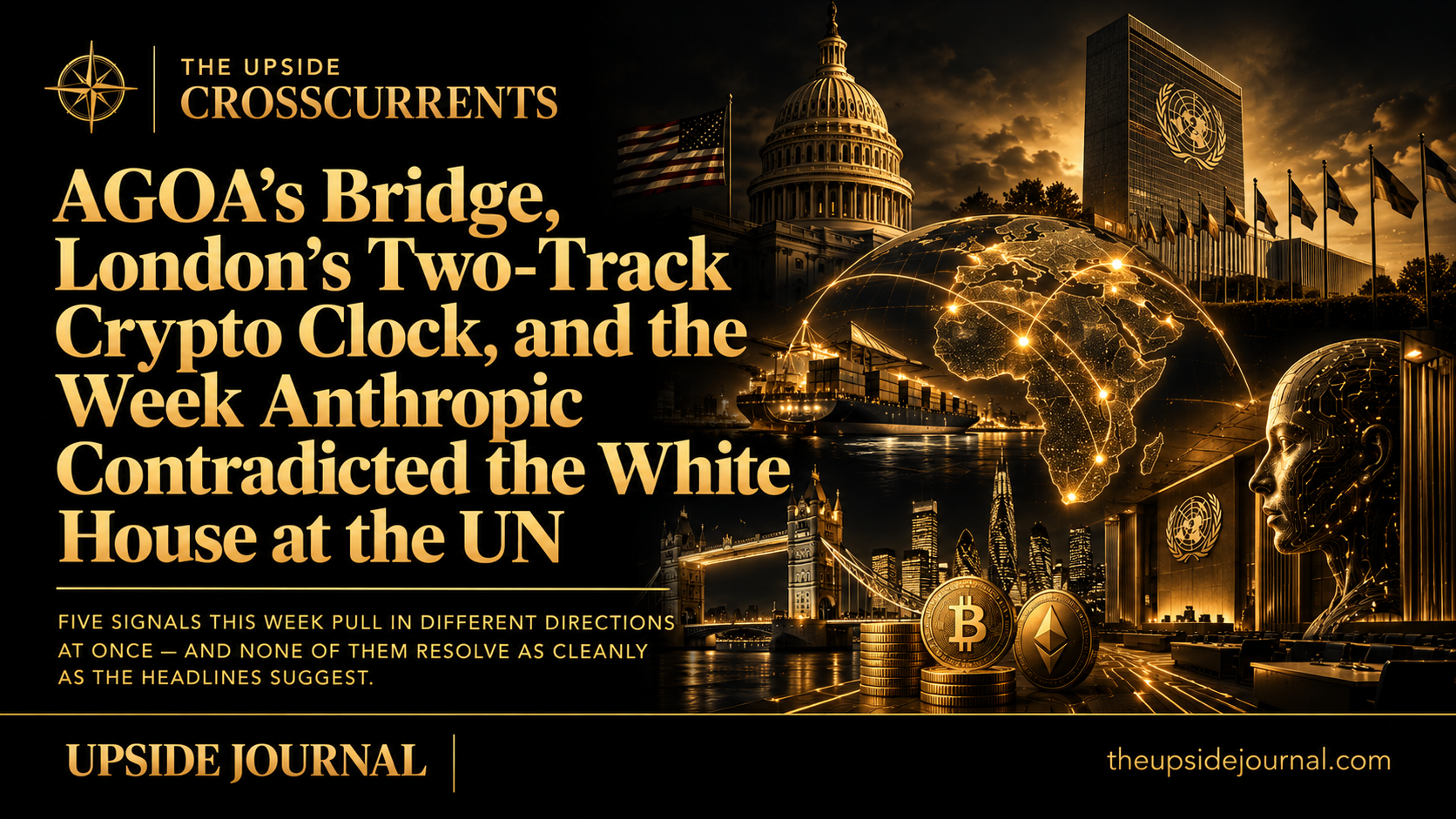
Five signals this week resist being read as one story. In Washington, AGOA's two-year extension through 2028 gives Nigerian and South African exporters a longer runway than the one-year patch they got in February, but the annual eligibility review, not the expiry date, is the variable that actually governs investment decisions. In London, the Bank of England's stablecoin Code of Practice consultation and the FCA's cryptoasset authorisation gateway close and open, respectively, within the same eight days, compressing a firm's window to shape the rulebook before the licensing clock starts. In Lagos, Nigeria Fintech Week put a number on what founders have been doing quietly: 62.5% of Nigerian fintechs, per the CBN's own 2026 report, plan regional expansion. In Kenya, an e-mobility financing round turned a single-country battery-swap network into a four-country expansion plan financed by patient, blended capital. And at the UN, Anthropic co-founder Dario Amodei told the Security Council AI could pose a risk to humanity "as a whole," a day after the Trump administration told the same body it rejects any "globalist scheme" to govern the technology — the clearest public daylight yet between a frontier AI lab and the government that regulates it.
Does AGOA's Two-Year Extension Actually Buy Nigerian Exporters Certainty?
The easy read treats AGOA's signing as a resolved question: the programme lapsed, Congress and the White House extended it through December 2028, exporters can plan again. That reading mistakes a longer clock for a settled one. AGOA's annual presidential eligibility review — not the 2028 expiry — is the mechanism that actually governs whether a given country keeps its duty-free access from one year to the next, and that review sits entirely at the discretion of an administration that spent months threatening to exclude South Africa before signing anything.
For Nigerian exporters specifically, the two-year window is long enough to justify restarting production lines that went idle after the September 2025 lapse, but not long enough to justify the multi-year capital investment — new tooling, new supplier contracts — that would let Nigeria's textile and agricultural exporters compete for the market share AGOA nominally protects. A bridge that gets rebuilt annually is not the same instrument as a bridge built to last the full span.
What Happens When London's Stablecoin Rulebook and Crypto Licensing Window Open in the Same Ten Days?
Treating UK crypto regulation as a single 2026 milestone misses the sequencing that actually matters this month. The Bank of England's feedback window on its draft systemic stablecoin Code of Practice closes September 22; the FCA's cryptoasset authorisation gateway — the mechanism firms will need to legally conduct regulated cryptoasset activity under the new FSMA regime — opens eight days later, on September 30.
That sequencing is not an accident of two regulators moving independently. A firm that wants its objections to the stablecoin Code reflected before it has to commit to an authorisation application has a genuinely narrow window to act — and firms that miss the consultation now face a licensing regime shaped without their input, with no comparable second chance before applications open.
What Does the CBN's Own Data Say About Nigerian Fintech's Next Move?
Nigeria Fintech Week's theme language — "Legacy in Motion" — is the kind of framing that tells you nothing. The number cited on stage does: the Central Bank of Nigeria's 2026 Fintech Report found that 62.5% of surveyed Nigerian fintech firms plan regional expansion. That is a regulator's own survey data, not a marketing claim from the firms themselves, which changes its evidentiary weight considerably.
The mechanism worth tracking is what regional expansion actually requires beyond ambition: multi-jurisdictional licensing, compliance infrastructure built for more than one regulatory regime, and settlement rails that work across currencies. A fintech that expands without building that layer first is exporting Nigerian product-market fit into markets that don't share Nigeria's regulatory or payment-rail assumptions — a different and riskier bet than the survey number alone implies.
Can a Kenyan Battery-Swap Network Become a Four-Country Mobility Grid?
Framing ARC Ride's raise as another African e-mobility funding round undersells the mechanism actually financed. The round combined equity from Novastar Ventures and Norrsken22 with debt from three development finance institutions — a blended capital structure that funds both the 5,000 new electric motorcycles and the harder, less glamorous work of replicating a battery-swap network's charging and logistics infrastructure across Ghana, South Africa, Tanzania and Uganda.
A single-country battery-swap network and a four-country one are not the same business at different scale — they are different businesses, because each new market requires its own charging infrastructure, regulatory relationships and driver-onboarding logistics rather than simply exporting the Kenyan model wholesale.
Can Washington Reject Global AI Rules While Its Own AI Lab Warns the UN Otherwise?
The instinct is to read Trump's UN General Assembly remarks — rejecting any "globalist scheme" to control AI — as a single, coherent US position. That reading survives for less than 24 hours. The next day, at the UN Security Council, Anthropic co-founder Dario Amodei told the same institution that AI "could be a risk to humanity as a whole" if managed poorly, while White House science adviser Michael Kratsios argued the UN should focus on "sharing best practices," not "establishing a global regulatory scheme." China's UN ambassador Fu Cong called instead for continuous regulatory frameworks and cross-border cooperation.
The operator-relevant mechanism here is not the disagreement itself but what it reveals: the US position is not "no AI policy" — it is "no policy we did not write," and having the administration's own most prominent domestic AI lab publicly contradict that line, in the same forum, in the same week, is a genuine crack in a supposedly unified national position.
Key Takeaways
- AGOA's two-year extension through 2028 is real relief, but the annual discretionary eligibility review — not the expiry date — is what Nigerian and South African exporters are actually underwriting.
- London's stablecoin Code of Practice consultation and the FCA's cryptoasset authorisation gateway open within eight days of each other, giving firms a narrow, closing window to shape the rulebook before licensing begins.
- The CBN's own 2026 data shows 62.5% of Nigerian fintechs planning regional expansion — but expansion intent and the multi-jurisdictional compliance infrastructure it requires are two separate numbers.
- ARC Ride's blended equity-and-debt raise is financing a genuinely different business — a four-country mobility grid — not a scaled-up version of its single-country Kenyan network.
- The clearest AI-policy signal from this week's UN session wasn't Trump's rejection of global AI rules — it was Anthropic publicly warning the Security Council in direct tension with that position, in the same forum, one day later.
Conclusion
None of this week's five signals resolves cleanly, and that is itself the pattern worth naming. A trade extension, a regulatory sequencing window, a survey statistic, a financing round and a diplomatic contradiction all share the same underlying shape: each looks like a settled outcome from a headline's distance and reveals a genuinely open question up close. Operators pricing exposure to any one of these five should be watching the mechanism, not the announcement.