


Venture Capital Operating Systems: How Venture Capital Actually Works
How venture capital actually works, from LP capital through fund structure, deal flow, due diligence, portfolio construction, and returns — the operating system behind every VC fund.

Executive Summary
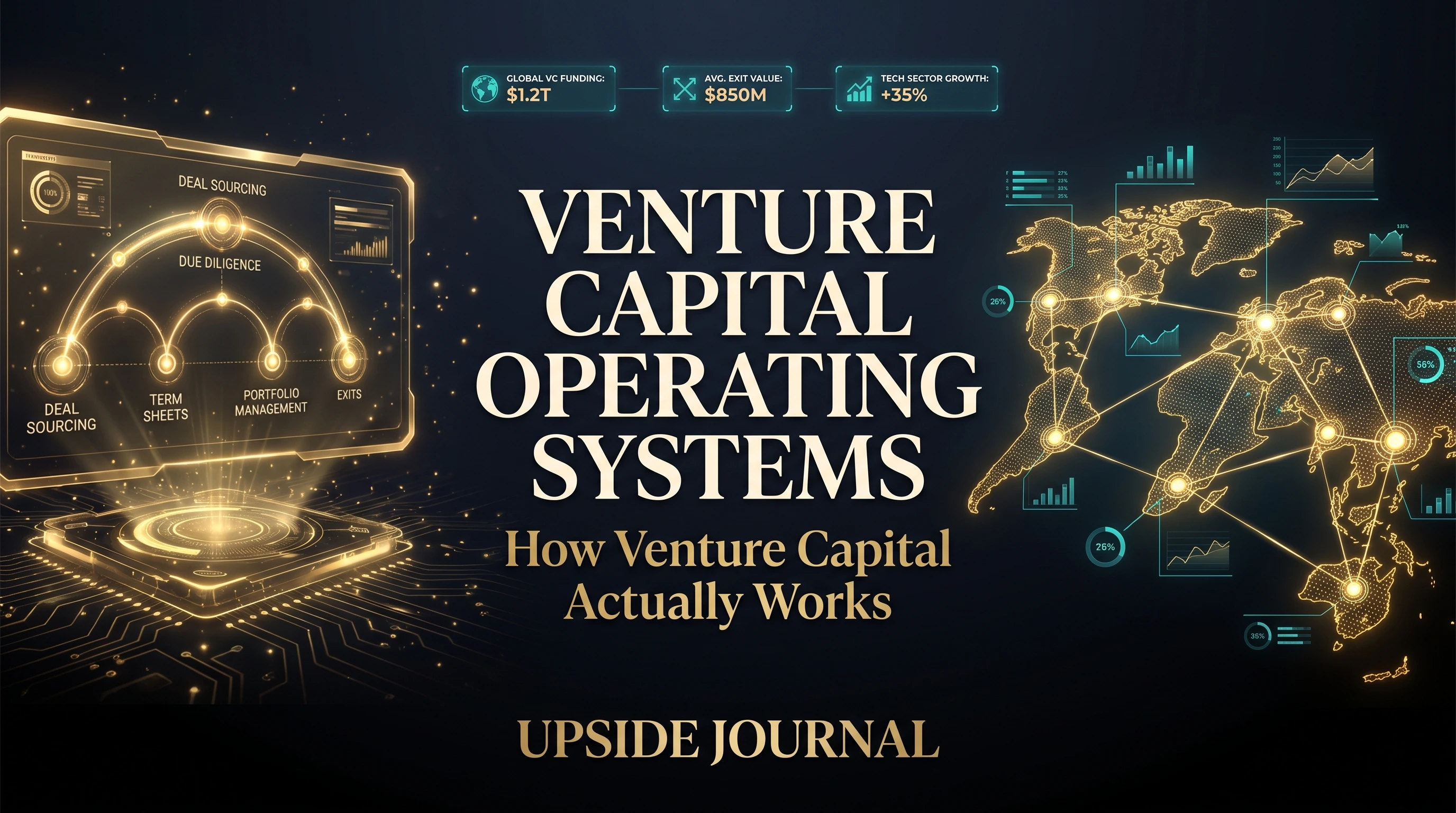
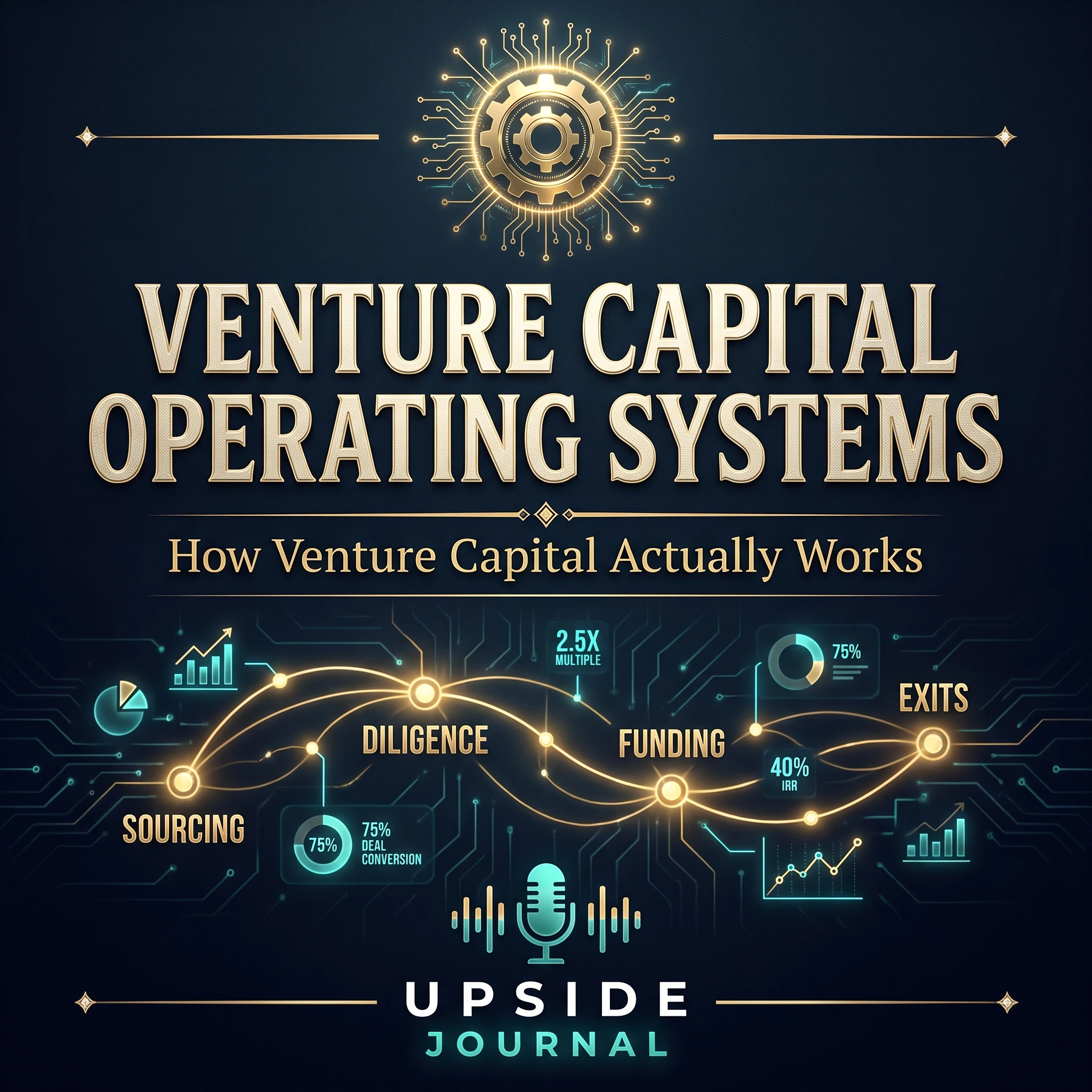
Venture capital is not money that finds startups. It is a closed-loop capital allocation system, engineered to take a small number of concentrated, high-variance bets and convert them into outsized returns for a narrow set of institutional and individual investors. Most explainers describe what venture capital is. This one maps how it actually runs — LP capital into a fund, capital moving through Deal Flow, screening, and diligence, decisions made through an Investment Committee, term sheets converting decisions into ownership, portfolios constructed under power-law assumptions, follow-on capital rationed by conviction, and returns eventually cycling back to the LPs who funded the system in the first place. Understanding this operating system — not the vocabulary around it — is what separates founders and allocators who can navigate venture capital from those who are simply subject to it.
Introduction
Ask most people how venture capital works and the answer stops at "investors give startups money for equity." That sentence is true and almost useless. It explains a transaction, not a system. A venture fund is closer to a designed machine with defined inputs, defined decision gates, and a defined output horizon — typically ten years — than it is to a pool of money waiting for good ideas to arrive.
This article treats venture capital as that machine. It follows capital through its full lifecycle: from a limited partner's commitment, through a general partner's fund structure, through the deal flow and screening process that filters thousands of opportunities down to a handful of investments, through the Investment Committee governance that turns conviction into a decision, through the term sheet that turns a decision into ownership, through portfolio construction and follow-on capital that determine which companies get reinforced, and finally through exit and distribution — the mechanism by which a fund's paper gains become an LP's realized cash. Five deeper explorations sit beneath this pillar in Upside Journal's Venture Capital cluster: how VC differs structurally from private equity, what actually sits inside a term sheet, how Investment Committees make (and mis-make) decisions, why most startups that seek VC never raise it, and what separates a fund that returns capital from one that does not. This article connects those pieces into one operating map rather than exhausting any of them individually.
Background
Venture capital as an institutional asset class is barely seven decades old, formalized in the United States after the 1958 Small Business Investment Act and matured through the rise of Silicon Valley partnerships in the 1970s and 1980s. What has stayed constant since is the underlying economic logic: because most early-stage companies fail, a fund must be structured so that a small number of extreme winners can outweigh a majority of losses. That single constraint — not founder pedigree, not sector fashion — is what shapes every structural decision a fund makes, from how it raises capital to how it exits it.
The System
Where the Capital Actually Comes From
A venture fund does not start with an investment decision. It starts with a fundraise, and the fund's own investors — its Limited Partners, or LPs — are structurally distinct from the company founders the fund eventually backs. LPs are typically pension funds, university endowments, sovereign wealth funds, insurance companies, family offices, and increasingly corporate venture arms and fund-of-funds vehicles. They commit capital to a fund for a fixed term, usually ten years with possible extensions, in exchange for a share of the fund's eventual returns.
The people managing that capital are the General Partners, or GPs — the venture firm itself. GPs raise a "close" of committed capital, then draw it down from LPs over time through capital calls rather than receiving the full sum upfront. This distinction matters enormously and is frequently missed in casual explanations: a fund that has "raised $200 million" has secured commitments, not cash sitting in an account. The GP calls capital as investments and fund expenses require it, which is itself a discipline — it forces LPs to maintain liquidity against a schedule they don't fully control, and it forces GPs to pace deployment against a multi-year investment period rather than spending everything in year one.
How a Venture Fund Is Structured
Structurally, most venture funds are organized as limited partnerships, with the GP entity serving as the general partner of the fund and LPs holding limited partner interests. This legal structure exists specifically to align two things that would otherwise pull apart: it caps LP liability at their committed capital while giving the GP full discretion over investment decisions, in exchange for a defined economic split covered later in this piece.
A single venture firm frequently manages several funds simultaneously — Fund I fully invested and heading toward exits, Fund II actively deploying, Fund III newly raised — each with its own LP base, its own term, and its own dedicated capital pool. This is why a firm's public "brand" can be misleading: when people refer to "Sequoia" or "a16z" investing in a company, the actual legal counterparty is almost always one specific fund vehicle within that firm's broader family, governed by its own partnership agreement.
Deal Flow: How Opportunities Enter the System
Deal flow is the raw material entering the fund's operating system — the stream of potential investment opportunities a fund sees, sourced through founder networks, other investors' referrals, accelerator programs, cold inbound, and increasingly, proactive thesis-driven outreach where a fund identifies a category it wants exposure to and goes looking for the company rather than waiting for one to arrive.
The volume gap here is the first thing most people underestimate. An active early-stage fund might see several thousand opportunities in a year and fund perhaps 1–2% of them. That filtering ratio is not incidental friction — it is the fund's central mechanism for managing risk before capital is ever committed. A fund with weak deal flow is structurally disadvantaged before diligence even begins, regardless of how sound its later-stage decision process is, because it is choosing from a smaller and typically lower-quality pool.
Screening and Due Diligence
Most opportunities that enter deal flow are eliminated in an initial screen — a fast, often heuristic-driven assessment of team, market size, and basic thesis fit, usually completed within days. The small fraction that survive screening move into formal due diligence: reference checks on the founding team, market sizing and competitive analysis, technical or product review where relevant, and increasingly, data-room review of the company's own metrics and cap table.
Due diligence exists to compress uncertainty, not eliminate it — early-stage venture investing operates with genuinely incomplete information, and no diligence process changes that fundamental condition. What diligence actually does is surface the specific risks a fund is choosing to underwrite, so that the eventual investment decision is made with those risks named rather than assumed away. A full breakdown of term-sheet mechanics that flow from this stage — valuation, liquidation preferences, pro-rata rights, board composition — sits in the next article in this cluster; here, the term sheet matters only as the artifact that converts a diligence-informed decision into legal ownership.
The Investment Committee
The Investment Committee, or IC, is the formal decision gate where a partner's conviction becomes fund capital. Composition varies by firm — some ICs include every general partner, others are a smaller subset with final authority — but the function is consistent: it exists specifically so that no single partner can unilaterally commit fund capital without structured internal challenge.
This is a governance mechanism, not a formality. An IC forces the sponsoring partner to defend a thesis under scrutiny from colleagues who have no personal stake in that specific deal succeeding, which is one of the few structural checks against the deal-champion bias that affects every investment organization. The mechanics of how ICs actually deliberate, what data they demand, and where they systematically fail are covered in depth in the dedicated article on Investment Committee decision-making later in this cluster.
Portfolio Construction and the Power Law
Once an investment clears the IC and a term sheet is signed, the company becomes one position inside a broader portfolio — and portfolio construction is where venture capital's defining mathematical assumption becomes operational. Venture returns follow a power-law distribution, not a normal distribution: a small number of investments generate the overwhelming majority of a fund's total returns, a substantial share of positions return less than capital invested, and the median outcome for any individual investment is frequently zero.
This is not a flaw in venture investing — it is the design constraint every fund builds around. A fund must make enough initial bets, and reserve enough capital for follow-on investment in its eventual winners, to have a statistically credible shot at capturing at least one outsized outcome. Portfolio construction decisions — how many companies to back, how much capital to reserve versus deploy initially, how concentrated or diversified to be by sector and stage — are all downstream of this single mathematical reality.
Follow-On Investment and Capital Rationing
Not every portfolio company receives follow-on capital in its next round, and the decision of which companies get reinforced is one of the most consequential a fund makes after the initial investment. Because reserved capital is finite, a GP effectively re-underwrites each portfolio company at every subsequent round: has the thesis strengthened, has the team executed, does the company remain a plausible power-law outcome. Companies that clear this bar get pro-rata or above-pro-rata follow-on capital, protecting or increasing the fund's ownership. Companies that don't get diluted in later rounds as the fund declines to participate — a quiet but material signal in the market that founders and other investors read closely.
Exit, Fund Returns, and LP Distributions
The system closes its loop at exit — an acquisition, an IPO, or occasionally a secondary sale of the fund's position to another investor. Exit is where paper valuation converts to realized capital, and it is the point at which the fund's actual return, as opposed to its projected return, becomes measurable.
Fund economics run on two revenue mechanisms for the GP. Management fees, typically around 2% of committed capital annually, fund the firm's operations regardless of performance. Carried interest — typically 20% of the fund's profits above the capital LPs originally committed — is the GP's share of actual returns, and it is the mechanism that aligns GP incentives with LP outcomes: a GP earns meaningfully only if the fund generates real profit, not merely if it deploys capital.
Once exits generate distributable proceeds, capital flows back through the fund structure to LPs according to the fund's waterfall — the contractually defined order in which capital is returned, LP capital plus preferred return first, GP catch-up next, and profit split according to the carried interest terms thereafter. This is the point at which the entire system's original premise resolves: LP capital that entered the fund a decade earlier returns, ideally with the outsized gain that justified underwriting a decade of illiquidity and concentrated risk in the first place.
Key Takeaways
- Venture capital is a closed-loop system — LP capital in, GP-managed deployment through defined stages, capital and profit back to LPs — not a one-directional flow of money to founders.
- Capital calls mean a fund's committed size is not cash on hand; deployment is paced deliberately across the fund's investment period.
- Deal flow volume and quality set the ceiling on fund performance before diligence or IC decisions ever occur.
- The Investment Committee exists specifically to structurally check individual partner bias, not merely to approve deals.
- Portfolio construction and follow-on capital rationing are both direct responses to venture's power-law return distribution — most positions will not return capital, and the fund is built around the few that will.
- Carried interest, not management fees, is what aligns GP incentives with LP outcomes over the fund's life.
Conclusion
Venture capital's public narrative tends to collapse an entire operating system into a single moment — the pitch, the term sheet, the funding announcement. The actual system is longer, more structured, and more mathematically deliberate than that narrative suggests: a decade-long architecture built to move capital from LPs through a filtering and governance process, into a small number of concentrated positions, and eventually back to the LPs who financed the whole system, with the fund's entire design oriented around the small number of outcomes that make the other losses statistically acceptable. Understanding that architecture — not the vocabulary that surrounds it — is the actual edge for anyone operating inside, around, or in response to it.
External References
- National Venture Capital Association (NVCA) — Yearbook and Industry Data
- Cambridge Associates — US Venture Capital Index and Benchmark Statistics
- PitchBook-NVCA Venture Monitor
- Institutional Limited Partners Association (ILPA) — Principles and Reporting Standards
- U.S. Small Business Administration — Small Business Investment Company (SBIC) Program History
Intelligent. Cultural. Global. Human. "Where the world's conversations become movements."