Executive Summary
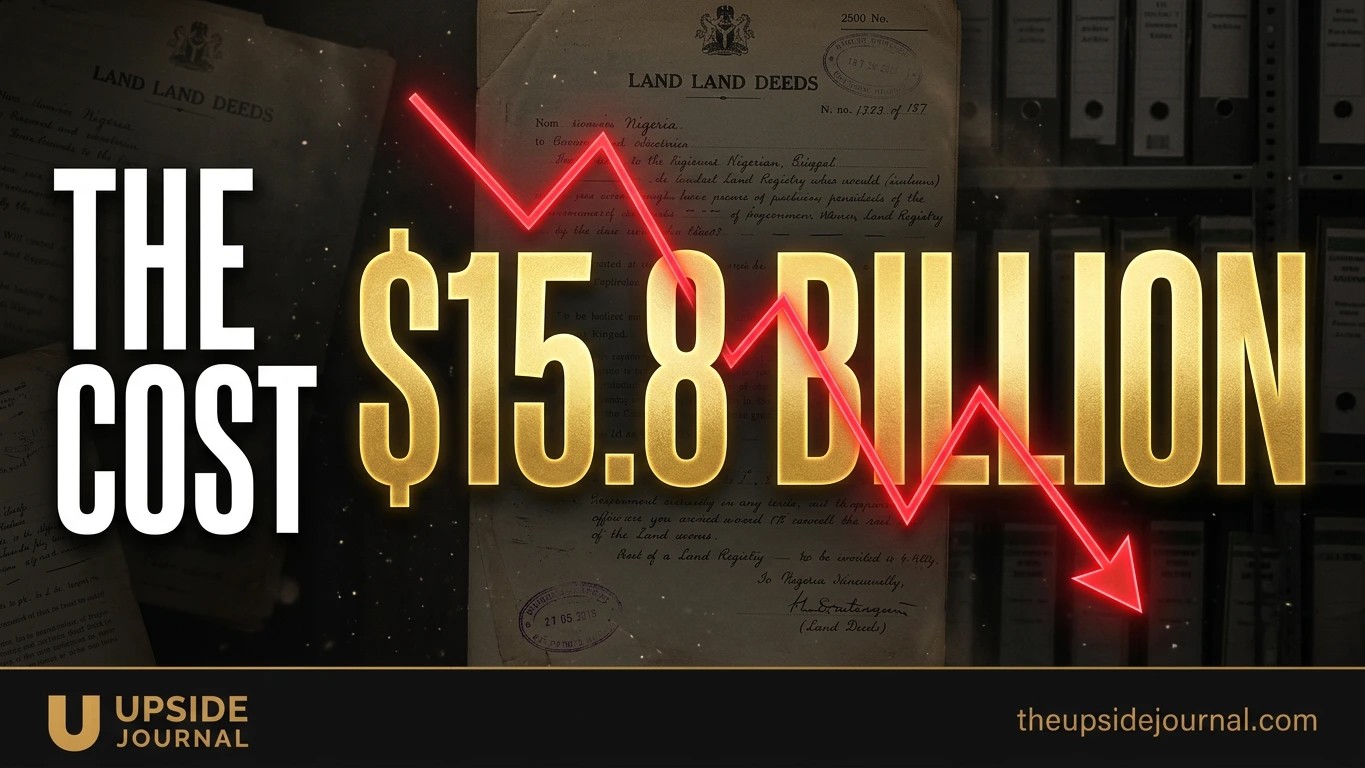
Nigeria's land registration system is one of the largest, least-discussed drags on the country's economic productivity. Property registration in Lagos alone can take months and pass through more than a dozen discrete steps across separate ministries, each with its own paper file and its own point of failure. The result is not simply inconvenience. It is dead capital — real estate assets that cannot be reliably used as collateral, cannot be insured against title disputes, and cannot be taxed at anything close to their real value.
This article is the first supporting piece in Upside Journal's Digital Trust Infrastructure cluster. It isolates the problem: why Nigeria's land registry specifically has become a structural bottleneck on investment, credit access, and state revenue. The solutions — digital land registries built on blockchain and digital identity, and the governance reforms required to modernise property ownership — are addressed in the two articles that follow this one.
Why This Matters Now
Nigeria's population is on track to exceed 400 million by 2050, with the bulk of that growth concentrated in cities already straining under informal land markets. At the same time, the country's banking sector remains chronically under-collateralised relative to the value of the real estate its citizens actually hold. These two facts are connected by a single institutional failure: land in Nigeria is difficult to prove ownership of, and therefore difficult to lend against, insure, or tax.
For long-term capital allocators, this is not an abstract governance complaint. It is a quantifiable drag on the return profile of nearly every sector that touches real property — banking, agriculture, construction, and diaspora remittance-linked investment.
Background: A System Built for a Smaller, Slower Economy
Nigeria's land administration architecture traces back to the Land Use Act of 1978, which vested control of land in state governors and created a structure where land allocation and registration are handled separately by each of the country's 36 states plus the Federal Capital Territory. There is no unified national land registry. There is no single, authoritative digital source of truth.
The consequence is a system defined by fragmentation rather than corruption alone. Even a well-intentioned state land registry office is working from paper files that may be decades old, incomplete, or duplicated across competing claims. A single plot of land in a peri-urban area of Lagos or Abuja can plausibly carry multiple, conflicting "ownership" documents — a customary allocation from a traditional ruler, a government-issued Certificate of Occupancy, and an informal sale agreement between private parties — with no automated way to reconcile them.
The System: How Property Registration Actually Works Today
To understand the scale of the bottleneck, it helps to walk through what formal land registration in a major Nigerian city typically involves.
* Title search. A prospective buyer or lender must physically request a search at the relevant state Land Registry to check whether the property has existing encumbrances, disputes, or competing claims.
* Governor's consent. Under the Land Use Act, most land transactions require the consent of the state governor before a transfer is legally valid — a step that can take months and depends heavily on the responsiveness of a specific ministry.
* Stamp duty and capital gains assessment. Separate state and federal tax authorities must independently verify and stamp the transaction.
* Registration of title. The transaction is then formally entered into the state's land register — a step that, in many states, still means a physical file is updated by hand.
* Survey and charting. A licensed surveyor must confirm the plot's boundaries against the state's cadastral maps, which are themselves frequently outdated or incomplete.
Each of these steps sits in a different office, often reporting to a different agency, with no shared digital record connecting them. A delay or error at any single stage can stall the entire transaction indefinitely.
The Institutional Trust Gap
This fragmentation produces what economists call an institutional trust deficit. Banks cannot rely on a Certificate of Occupancy alone to confirm clean title, so they discount the value of real estate collateral heavily, or refuse it outright. Foreign and diaspora investors — a growing share of capital flowing into Nigerian real estate — routinely report months-long delays and unresolved disputes as the single largest friction point in deploying capital into the market.
The Economic Cost of Land Inefficiency
The scale of this problem is difficult to overstate, though it is rarely presented as a single line item because it is distributed across so many parts of the economy.
* Dead capital in informal markets. The World Bank and other development institutions have long estimated that the majority of urban land and housing across Sub-Saharan Africa sits outside formal registration systems entirely — meaning it cannot be used as collateral or reliably transferred, regardless of its underlying market value.
* Constrained credit markets. Nigerian banks maintain some of the most conservative loan-to-value ratios on real estate collateral in the world, a direct consequence of the difficulty and cost of verifying clean title before a default forces a lender into a contested foreclosure process.
* Foregone tax revenue. State and local governments in Nigeria collect a small fraction of the property tax revenue that a formally registered, accurately valued land base would generate — a gap that directly constrains the very infrastructure spending (roads, drainage, utilities) that would otherwise increase land values further.
* Transaction cost inflation. Formal registration costs in Nigeria — including governor's consent fees, stamp duties, and legal fees — have historically ranked among the highest as a share of property value anywhere in the world, pushing many transactions into informal, unregistered arrangements that compound the underlying data problem.
Each of these costs reinforces the others. Informal transactions generate no data to formalise the registry. An unreliable registry keeps credit expensive. Expensive credit keeps formal registration financially unattractive relative to informal workarounds. The system is, in effect, a low-trust equilibrium that is expensive to escape and expensive to remain inside.
Business and Investment Implications
For operators and investors evaluating Nigerian real estate, construction, or agribusiness exposure, the land registry bottleneck should be treated as a distinct and quantifiable risk category, not folded generically into "emerging market risk."
* Title insurance and due diligence costs. Serious institutional investors now routinely budget for extended, multi-month title verification processes and independent legal opinions before closing — a cost structure that smaller domestic developers and smallholder landowners cannot absorb, further concentrating formal land ownership among larger players.
* Collateral value discounting. Any underwriting model for Nigerian real estate debt should explicitly discount collateral value to reflect realistic time-to-foreclosure and dispute-resolution risk, rather than relying on the nominal Certificate of Occupancy value.
* Diaspora investment friction. Diaspora-linked capital flowing into Nigerian real estate — a significant and growing category — is disproportionately exposed to title fraud precisely because remote buyers cannot easily conduct the kind of in-person, relationship-based verification that domestic buyers rely on to compensate for weak formal records.
Capital Allocation Implications
From a macro allocation standpoint, the land registry problem functions as a hidden tax on Nigeria's entire capital stock. Sovereign and sub-sovereign borrowing capacity, banking sector health, and the multiplier effect of infrastructure investment are all constrained by the same underlying weakness: the state cannot reliably say who owns what.
This has a direct read-through for anyone modelling Nigeria's medium-term growth trajectory. Formalising land records is not a niche governance reform — it is closer to a monetary-policy-adjacent lever, because it directly determines how much of the country's existing wealth can be mobilised as productive capital rather than sitting inert.
Operator Playbook
For executives and investors operating in or evaluating the Nigerian property and lending markets today, several practical steps reduce exposure to the registry bottleneck while structural reform proceeds.
* Commission independent title searches at both the state Land Registry and relevant local government level, not just one, given the frequency of overlapping jurisdictional claims.
* Budget realistic timelines — measured in months, not weeks — for governor's consent and formal registration, and structure transaction financing accordingly.
* Prioritise properties with a clear, unbroken chain of documented transfers over those relying solely on customary or informal allocation, even where the latter appears cheaper upfront.
* Track state-level digitisation initiatives directly, since reform progress varies significantly by state and can materially change the risk profile of a given transaction within a single administration's term.

Long Horizon View
Nigeria's land registry problem is ultimately a data architecture problem wearing the costume of a legal and bureaucratic one. Over a ten-year horizon, the states that succeed in building a genuinely authoritative, digitised, and interoperable land record will see a measurable and compounding advantage in credit availability, foreign investment inflows, and municipal tax revenue relative to states that do not.
This is the structural argument for why Digital Trust Infrastructure — encompassing not just land registries but the digital identity and public infrastructure layers beneath them — represents one of the highest-leverage, lowest-glamour investment categories in African markets over the next decade. The specific technical architecture for how such a registry should be built is addressed in the next article in this cluster.
Key Takeaways
* Nigeria's land administration system is fragmented across 36 states with no unified national registry, producing chronic title uncertainty.
* This uncertainty translates directly into dead capital: real estate that cannot be reliably used as collateral, insured, or taxed.
* Banks respond by heavily discounting or refusing real estate collateral, constraining credit availability across the broader economy.
* State and local governments forgo substantial property tax revenue as a direct consequence of incomplete and inaccurate land records.
* The problem compounds itself — informal transactions starve the formal registry of data, while an unreliable registry pushes more transactions into informal channels.
* Structural reform requires both technical modernisation and governance change, addressed in the following two articles in this cluster.
Related Reading
External References
- International Finance Corporation — Access to Finance and Collateral Constraints in Emerging Markets
Intelligent. Cultural. Global. Human. "Where the world's conversations become movements."