
Executive Summary
Africa’s economic trajectory is constrained not by a lack of entrepreneurial energy or capital availability, but by an institutional deficit. Across the continent, trillions of dollars in real estate and enterprise value remain dead capital because they lack verifiable, interoperable proof of ownership.
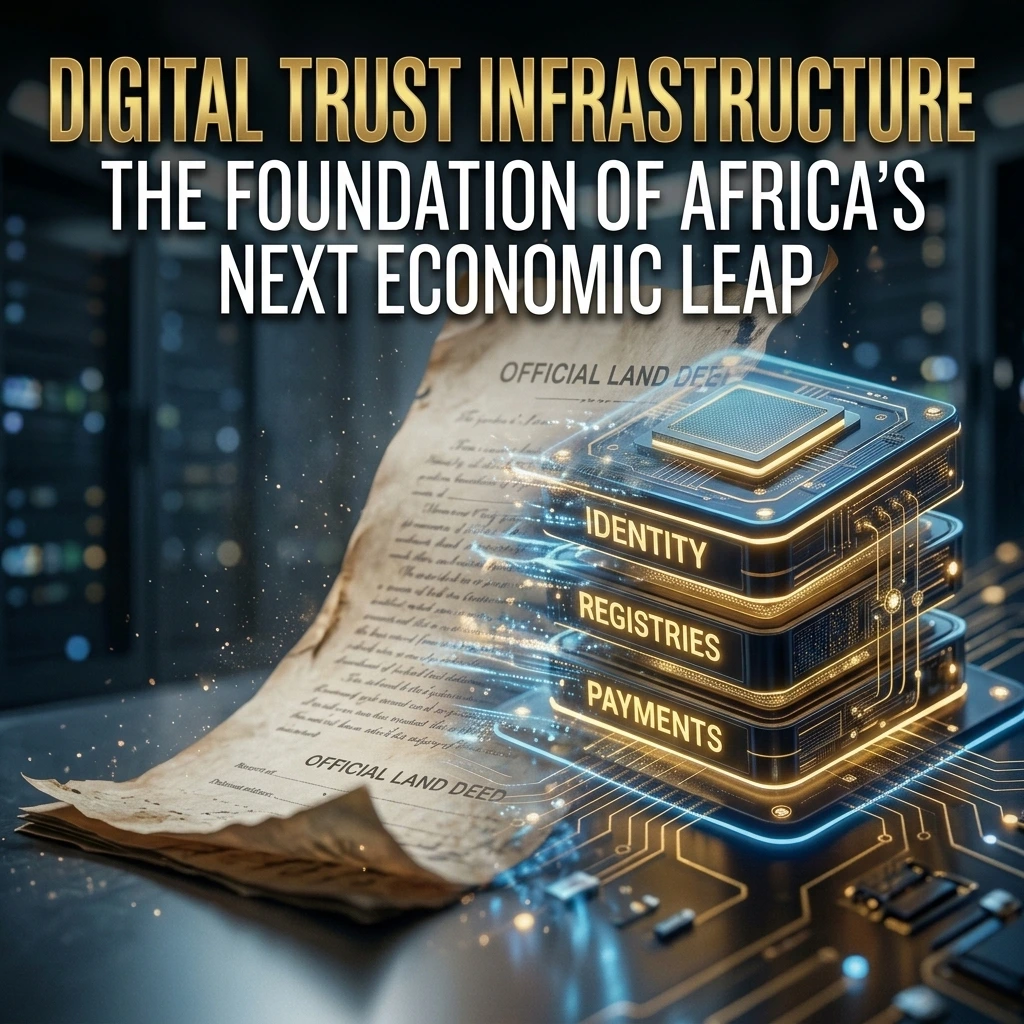
Digital Trust Infrastructure (DTI) resolves this deficit. By integrating secure Digital Identity, Digital Public Infrastructure (DPI), and modernized Land Administration, DTI replaces fragmented paper-based trust with cryptographic and cryptographic-grade institutional certainty.
For long-term capital allocators, understanding DTI is essential. It represents the foundational operating system upon which the next decade of African enterprise value, sovereign debt stability, and foreign direct investment will be built.
Introduction
Modern economies do not run on cash alone; they run on trust. In advanced economies, trust is a hidden public utility maintained by centuries of land registries, corporate registries, credit bureaus, and judicial consistency.
In many emerging markets, these institutional layers are incomplete, siloed, or corruptible. Transactions default to high-friction interpersonal verification. This reliance on manual proof creates a massive economic drag, shutting billions of people out of formal credit markets and corporate supply chains.
The emergence of Digital Trust Infrastructure changes this equation. By decoupling trust from physical geography and manual bureaucracy, DTI enables secure, instant, and borderless economic verification.
┌─────────────────────────────────────────────────────────>
│ THE ECONOMIC STACKED LEAP │
├─────────────────────────────────────────────────────────┤
│ Application Layer: FinTech, E-Commerce, Lending │
├─────────────────────────────────────────────────────────┤
│ Transaction Layer: Interoperable Payments & Contracts │
├─────────────────────────────────────────────────────────┤
│ Trust Layer: Digital Identity & Digital Land Registry │
├─────────────────────────────────────────────────────────┤
│ Foundational Layer: Digital Public Infrastructure (DPI) │
└─────────────────────────────────────────────────────────┘
The Anatomy of Digital Trust Infrastructure
Digital Trust Infrastructure is not a single piece of software or a government database. It is a modular stack composed of three interdependent pillars: foundational identity, institutional registries, and secure data exchange rails.
Framework
- Foundational Identity: Cryptographically secure, privacy-preserving Digital Identity systems that establish unique legal personhood.
- Institutional Registries: Digitized, tamper-evident records for Property Ownership, corporate registration, and civil status.
- Exchange Rails: Consent-driven data sharing networks that allow verified entities to interact across public and private sectors without exposing raw personal data.
Key Takeaways
- DTI shifts trust verification from analog institutions to cryptographic and protocol-driven systems.
- Interoperability between identity and property registries is mandatory to eliminate systemic fraud.
- Public sector leadership is required to build the foundational layer, while the private sector builds the value-adding applications on top.
Why Digital Trust Infrastructure Matters for Africa
Africa possesses the youngest demographic profile globally and rapid mobile adoption rates. Yet, the absence of robust National Digital Infrastructure caps the velocity of capital.
When a small business owner cannot prove identity or ownership of their storefront, commercial banks cannot extend credit. When a government cannot verify property boundaries through a Digital Land Registry, municipal taxation fails, and infrastructure financing stalls.
Implementing robust DTI unlocks liquidity across domestic markets. It transforms informal economic activity into formal, bankable enterprise value.
Framework
- Credit Market Expansion: Verified identity and asset registry enable automated credit scoring, slashing interest rates driven by high default uncertainty.
- Capital Velocity: Instantaneous verification of Property Rights reduces commercial real estate transaction times from months to minutes.
- Fiscal Optimization: Automated Government Digital Transformation closes tax leakage loops, providing governments with predictable revenue streams for capital projects.
Key Takeaways
- Economic growth in emerging markets is bounded by the speed and security of trust verification.
- Informal markets are not inherently untrustworthy; they are simply starved of scalable trust infrastructure.
- Structural reforms in Institutional Trust yield higher compounding returns than direct capital subsidies.
Digital Identity and Economic Growth
At the core of DTI lies Digital Identity. A secure digital identity acts as the master key to the modern economy. It allows individuals to open bank accounts, sign legally binding contracts, and access government services remotely.
The relationship between digital identity and economic growth is direct and measurable. According to global development studies, robust identification systems can unlock between 3% to 6% of GDP value by reducing administrative friction, leakage in social safety nets, and corporate fraud.
Framework
- Inclusion: Brings unbanked populations into the formal financial sector.
- Reduction of Fraud: Eliminates ghost workers, duplicate identities, and synthetic fraud in public procurement.
- Mobility: Empowers workers to carry their professional and credit history across regional and national borders.
Key Takeaways
- Digital identity must be designed with privacy-by-design principles to ensure citizen trust.
- Without foundational identity, all downstream financial technology remains restricted to elite populations.
- Economic mobility is bottlenecked by the analog verification of legal personhood.
The Foundation of Digital Public Infrastructure
Digital Public Infrastructure (DPI) provides the public-goods rails that power competitive digital economies. Just as physical roads and ports enable the physical movement of goods, DPI enables the secure movement of identity, money, and data.
DPI is built on open standards, modular architecture, and non-discriminatory access principles. It ensures that no single private monopoly can capture the fundamental layers of national communication and commerce.
Framework
- Open Standards: APIs and protocols that allow any licensed private or public actor to connect safely.
- Modular Design: Separation of identity verification, payment routing, and data exchange into distinct blocks.
- Public-Private Partnership: Public governance over security and privacy, paired with private-sector innovation in user interfaces and applications.
Key Takeaways
- DPI treats foundational digital services as essential public utilities rather than commercial fiefdoms.
- Scalable economies require open protocols to prevent vendor lock-in and high transaction tolls.
- Public sector innovation in DPI sets the floor for national competitiveness.
Enabling Investment Through Digital Trust Systems
Institutional investors evaluate emerging markets through the lens of risk-adjusted returns. Political instability, contract enforcement failures, and title disputes create high risk premiums that deter long-term foreign direct investment (FDI).
DTI directly compresses these risk premiums. When land titles are clear, corporate registries are transparent, and judicial execution is supported by immutable digital records, investor confidence surges.
Comparison: Traditional Trust Systems vs. Digital Trust Infrastructure
* Traditional Trust Systems
* Registry Method: Paper-based deeds and manual searches
* Corporate Verification: Manual corporate verification
* Approval Mechanism: Discretionary bureaucratic approvals
* Capital Impact: High title dispute risk and elevated cost of capital
* Digital Trust Infrastructure
* Registry Method: Cryptographic Digital Land Registry (90% reduction in title dispute risk)
* Corporate Verification: Instantaneous registry API queries
* Approval Mechanism: Automated rule-based compliance
* Capital Impact: Elimination of petty corruption vectors and attraction of institutional-grade private equity
Key Takeaways
- Clear property rights attract institutional grade private equity and pension fund allocation.
- Predictable administrative systems reduce the cost of capital for domestic entrepreneurs.
- Transparent public records act as a beacon for cross-border venture and infrastructure capital.
Conclusion
Digital Trust Infrastructure is not merely a technical upgrade; it is the fundamental architecture of modern economic sovereignty. For Africa, building robust DTI bridges the gap between massive demographic potential and actualized wealth creation.
By prioritizing investments in Digital Public Infrastructure, secure Digital Identity, and modernized Land Administration, African nations can unlock trillions in dormant capital, empower local operators, and establish a permanent foundation for sustainable, long-term economic growth.
Related Reading
Nigeria's Land Registry Bottleneck Is Costing Billions Designing a Digital Land Registry Using Blockchain and Digital Identity What Governments Must Change to Modernise Property OwnershipExternal References
World Bank - Digital Public Infrastructure Insights IMF - Digital Money and Institutional Trust in Developing Economies Center for Global Development - Digital Identity and Economic InclusionIntelligent. Cultural. Global. Human. "Where the world's conversations become movements."