


Nigeria–UAE Capital Links Are Becoming an Industrial Infrastructure Story
BUA's sugar deal with AD Ports reverses the usual Gulf-capital-into-Africa story, testing whether Nigeria's UAE pact builds or offshores industrial capacity.
Executive Summary:
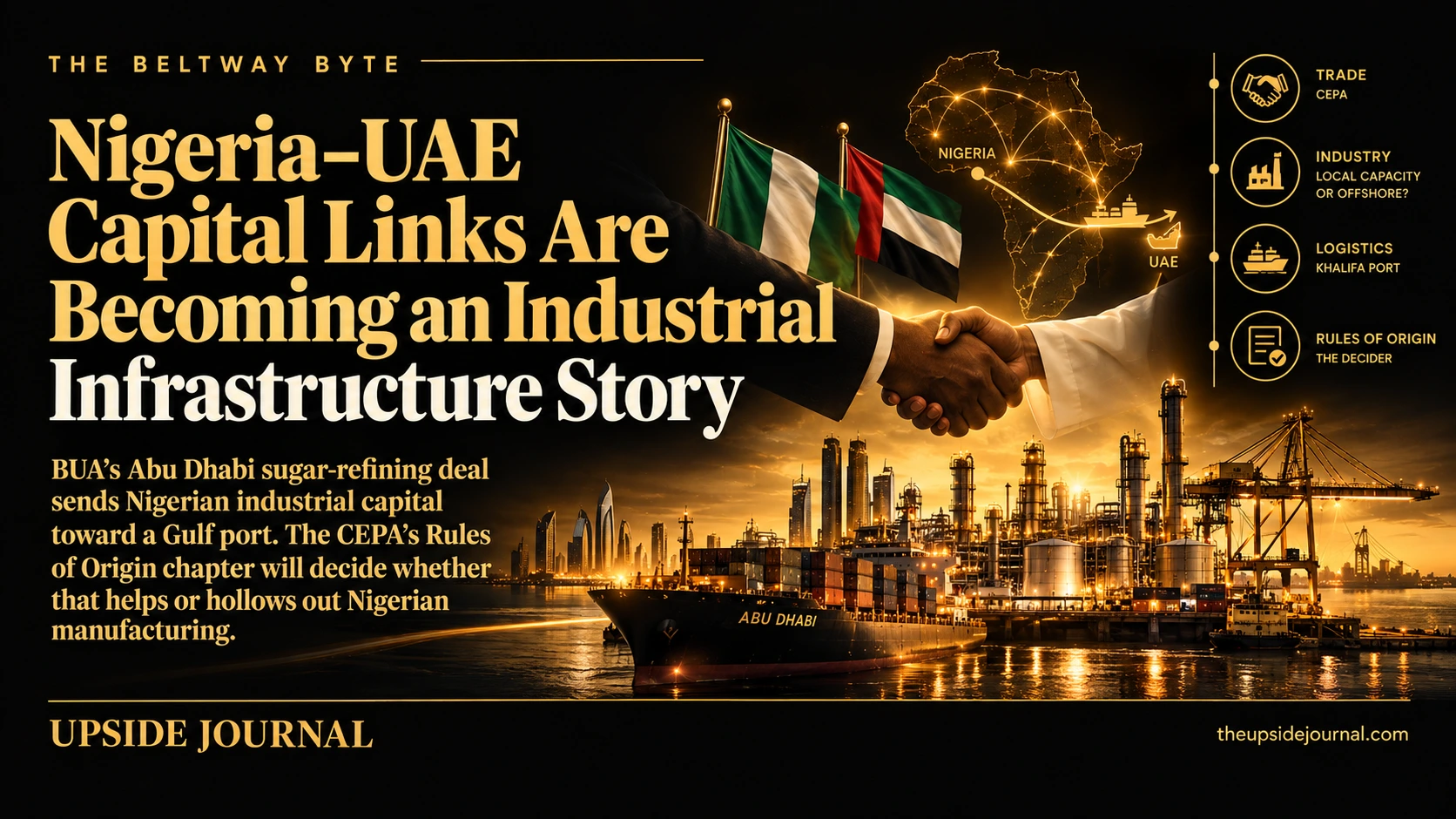
Nigeria and the UAE signed a Comprehensive Economic Partnership Agreement in January 2026, eliminating tariffs on thousands of goods and easing duties on industrial inputs. Eight months on, the first industrial deal built on that framework has arrived, and it inverts the direction most coverage assumes. Abdul Samad Rabiu's BUA Group signed an MoU with Abu Dhabi's AD Ports Group and MAIR Group to ship Nigerian sugar to Khalifa Port for refining and re-export — Nigerian industrial capital building processing capacity inside a Gulf hub, not Gulf capital building a factory in Nigeria. What the CEPA's Rules of Origin chapter does with that flow, once deals like this scale, determines whether the agreement expands Nigeria's manufacturing base or exports the value-adding step BUA's own domestic sugar strategy was built to capture.
Introduction
The standard read of a Gulf-Africa trade pact is capital flowing one way: Emirati sovereign wealth into African ports, farmland, or energy assets. The Nigeria–UAE relationship doesn't fit that template, and the first industrial project to emerge from January's Comprehensive Economic Partnership Agreement makes the mismatch explicit. Rabiu's BUA Group isn't receiving Gulf investment into a Nigerian facility. It is deploying its own commercial and logistics expertise to build processing capacity inside a UAE port — a Nigerian industrial group using a bilateral trade agreement to move a stage of production offshore, not onshore.
That distinction is the entire policy stake in this story. A trade agreement that lowers the cost of Nigerian manufacturers importing machinery is one kind of instrument. A trade agreement whose first concrete industrial outcome relocates a refining step to a foreign port is a different kind of instrument, even when the same signature created both possibilities. This piece treats the Nigeria–UAE capital relationship as a mechanism — capital relationships → productive assets → infrastructure → domestic capacity → industrial policy — and asks which direction that mechanism is currently running.
What the CEPA Actually Changed
The framework signed in Abu Dhabi on 13 January 2026 establishes reciprocal tariff elimination on the substantial majority of goods traded between the two countries, with a dedicated Rules of Origin chapter determining which goods qualify for preferential treatment. On the Nigerian side, the agreement immediately eliminates tariffs on 3,949 products (63.3% of the total), phases out duties on a further 2,294 products over five years, and excludes 123 products from liberalisation entirely. The UAE's reciprocal schedule removes duties on more than 7,000 Nigerian products.
Two clauses matter more than the headline tariff count for the industrial-capital question this piece is tracking. First, the agreement gradually removes duties on machinery, vehicles and industrial inputs imported into Nigeria — a direct capital-expenditure benefit for any Nigerian manufacturer sourcing equipment from or through the UAE. Second, the Rules of Origin chapter exists specifically to ensure tariff preferences apply only to goods genuinely produced in Nigeria or the UAE — the clause that will eventually have to classify a Nigerian sugar refined at an Emirati port, and decide which country's manufacturing base gets credit for it.
A named critical assessment of the agreement argues it raises a systematic asymmetry that favours a highly efficient re-export economy over Nigeria's domestic industrial clusters. That is a contested claim, not a settled one, and it is the frame this piece uses to evaluate the BUA deal rather than a conclusion to import wholesale.
The BUA Deal: What Was Actually Signed
On 16 February 2026, BUA Group signed a Memorandum of Understanding with AD Ports Group and MAIR Group — a UAE-based investment firm — to explore collaboration in sugar refining, agro-industrial development, and integrated global logistics. An MoU is an agreement to explore, not a committed investment: no disclosed capital expenditure, capacity figure, or construction timeline exists yet, and the article treats it accordingly.
What the MoU does specify is the commodity flow. Agricultural commodities, primarily sugar, would be shipped from Nigeria to Abu Dhabi, where they would be refined and redistributed across the Middle East and Asia — with Khalifa Port, which serves more than 25 shipping lines and connects to more than 70 destination ports, serving as the receiving, processing and re-export hub. One market analysis framed the arrangement as a strategic shift from purely domestic refining toward export-oriented integration.
That framing deserves scrutiny rather than repetition. BUA's core Nigerian business is precisely the kind of vertically integrated domestic manufacturing this publication's African Capital Builders network exists to track — Rabiu built a sugar, cement and food conglomerate on the logic of processing Nigerian raw material inside Nigeria. A deal that moves the refining stage to Abu Dhabi is not an extension of that logic; it is, on its face, a departure from it, unless a substantial share of the value the refining step creates flows back to Nigeria through pricing, offtake volume, or reinvestment BUA has not yet disclosed.
Where the Value-Add Actually Lands
Refining is where a commodity's value is created — raw sugar sold as raw sugar earns a fraction of what refined sugar sold into Middle Eastern and Asian markets earns. The BUA-AD Ports-MAIR structure places that refining step at Khalifa Port, inside UAE customs territory, supporting a UAE strategic objective: the initiative aligns with the objectives of the UAE Food Security Strategy 2051, which seeks to position the UAE as a global leader in sustainable food production and resilient supply chains.
Analysis, explicitly labelled: a bilateral trade agreement designed to expand Nigerian manufacturing capacity has, as its first significant industrial outcome, a project whose refining value-add is captured on the UAE side of the corridor. That is not necessarily a failure of the CEPA — Nigeria still gains a predictable, high-volume export channel for a commodity it may otherwise struggle to move at scale, and structured export demand can justify upstream investment in Nigerian sugar cultivation and aggregation that would not otherwise be commercially viable. But it means the deal's benefit to Nigerian industrial capacity is indirect (via upstream agricultural investment) rather than direct (via a domestic refining facility), and the two are not the same claim.
This is the specific question the Rules of Origin chapter will eventually have to resolve at scale: if raw Nigerian sugar refined in Abu Dhabi is later re-exported back toward African or global markets, which country's manufacturing base does the trade data credit? The CEPA's tariff architecture was built around goods moving between two national manufacturing bases, not a three-party corridor where the input originates in one CEPA country and the value-adding step happens in the other.
Why the Ownership Structure Matters Here
BUA's ability to move decisively on cross-border deals like this one is inseparable from how the group is owned. Rabiu holds roughly 98.2% of BUA Cement and about 95% of BUA Foods — concentration levels that let him commit the group to a Gulf logistics partnership without the shareholder consultation a more widely held conglomerate would require, but that also mean the capital-allocation decision embedded in the AD Ports MoU reflects one individual's judgment about where value should be captured, not a board balancing domestic manufacturing employment against export-corridor economics. This publication has raised the concentration question directly in the context of Africa's broader conglomerate consolidation wave; the BUA-UAE deal is a live instance of that same structural feature determining where an industrial value chain's most valuable stage physically sits.
The comparison worth drawing is with Dangote's approach to industrial capital, a sibling Beltway Byte node in this network: Dangote's refinery IPO deliberately built public-market ownership around a domestically sited industrial asset, converting concentrated private capital into a Nigerian Exchange-listed vehicle. Rabiu's UAE deal, at least as currently structured, keeps ownership concentrated and sites the value-adding infrastructure abroad. Both are legitimate capital-allocation strategies; they represent different answers to where an African industrial fortune should build its next stage of infrastructure.
The Broader Test This Sets Up
The Nigeria–UAE capital relationship is not limited to BUA. Structured trade and investment agreements of this kind depend on macro conditions this publication has examined directly — Nigeria's foreign-exchange convertibility and capital-repatriation record, the same variables that determined whether Nigeria's public markets retained institutional investor confidence after 2015. A Gulf partner committing to a multi-year processing corridor is making a currency and repatriation bet alongside an industrial one, and that bet sits on the same foundation this publication has already scrutinised in a different market.
The larger question the BUA deal previews — whether African industrial capital can build genuinely continental or intercontinental infrastructure networks without simply relocating the most valuable production stage abroad — is the subject this publication's Long Horizon analysis of Dangote's continental refining expansion already treats at length for the energy sector. This node does not repeat that scenario architecture; it establishes the parallel case in agro-industrial capital, and flags it as evidence for the same underlying pattern.
Why This Matters for Policymakers and Founders
For Nigerian trade officials, the practical signal is that the Rules of Origin chapter is not a technical afterthought — it is the mechanism that will determine whether deals structured like BUA's count as Nigerian export success or as offshored value addition once enough of them exist to matter at a macro level. That chapter deserves the same scrutiny trade negotiators gave the headline tariff schedule.
For Nigerian manufacturers and founders evaluating the CEPA's machinery and industrial-input tariff relief, the BUA deal is a useful data point precisely because it shows the same agreement can be used for opposite purposes: importing cheaper capital equipment to build domestic capacity, or exporting a processing step to a partner jurisdiction. Which use case a given company chooses will depend on where it judges the value-adding infrastructure is cheapest and most strategically secure to build — a decision the CEPA makes easier in both directions at once.
Key Takeaways
The Nigeria–UAE CEPA's first significant industrial outcome — BUA's sugar-refining MoU with AD Ports and MAIR — moves capital and expertise from Nigeria into a UAE port, reversing the Gulf-capital-into-Africa direction most coverage assumes.
The MoU is an agreement to explore collaboration, not a committed investment; no capital expenditure, capacity, or timeline has been disclosed.
The refining step, where a commodity's value is actually created, is sited at Khalifa Port under the deal's current structure — meaning the arrangement's benefit to Nigerian industrial capacity runs through upstream agricultural investment rather than domestic manufacturing capacity directly.
The CEPA's Rules of Origin chapter, not its tariff schedule, is the clause that will determine whether corridors like this one count as Nigerian export success or offshored value addition once they scale.
BUA's near-total founder ownership let Rabiu commit the group to this structure unilaterally — the same concentration dynamic this publication has flagged as a risk across Africa's conglomerate wave, now visible in a live cross-border capital decision.
Conclusion
Nigeria–UAE capital links are becoming an industrial infrastructure story precisely because the infrastructure being built doesn't sit where the diplomatic framing implies. The CEPA created the legal and tariff conditions for deeper capital flow in both directions; BUA's first move under that framework sent Nigerian commodities and industrial expertise toward a Gulf port rather than drawing Gulf capital into a Nigerian facility. Whether that becomes the corridor's dominant pattern, or a first move that upstream Nigerian investment eventually balances, is a question the Rules of Origin chapter and BUA's next disclosed capital commitment — not the MoU signing ceremony — will actually answer.
Related Reading
Pillar
"The Upside Journal: African Capital Builders: How the Continent's Billionaires Are Shaping Its Economic Future — network gateway that establishes Abdul Samad Rabiu as one of four founding capital-builder entities"
Siblings
"The Upside Journal: The African Industrial Supercycle: What Happens If Dangote's Model Scales Across the Continent? — owns the import-substitution and regional-integration scenario architecture this piece references rather than repeats",
"The Upside Journal: What Dangote's Refinery IPO Means for African Energy Security and Industrial Policy — sibling Beltway Byte node; the contrasting domestic-siting, public-ownership route to industrial capital",
"The Upside Journal: The Oligopoly Illusion: Why Africa's Super-Conglomerate Wave is a Danger to Diaspora Innovation — the concentration risk behind BUA's unilateral capital-allocation decisions",
"The Upside Journal: Nigeria Doesn't Have a Capital-Market Access Problem. It Has an Investor-Confidence Problem. — the FX-convertibility and repatriation history that underpins any Gulf partner's currency risk in this corridor"
Forthcoming
"What BUA's Expansion Says About Africa's Next Manufacturing Cycle — Market Signal node using BUA's broader manufacturing footprint as evidence",
"Can Africa Build Industrial Conglomerates Large Enough to Compete Globally? — Long Horizon node on global competitiveness of African conglomerates"
ExternalReferences
"Federal Ministry of Industry, Trade and Investment: Nigeria–UAE CEPA 2026 Information Note — official primary source for the tariff-elimination framework and the Rules of Origin chapter",
"Forbes Africa: Nigeria Signs Landmark Partnership With UAE, Seeks $30 Billion In Green Finance — covers the removal of duties on machinery, vehicles and industrial inputs, and the scope of products affected",
"Leadership: BUA, AD Ports, MAIR Groups Sign MoU on Sugar Refining, Agro-Industrial Development — BUA Group's own disclosure of the MoU's scope and policy alignment",
"TheNigeriaLawyer: 'Food Security Push' — BUA Conglomerate Signs MoU With AD Ports, MAIR To Build Sugar Hub In UAE — the commodity-flow detail showing raw sugar shipped from Nigeria for refining at Khalifa Port",
"Alliance for Economic Research and Ethics: The Nigeria-UAE Comprehensive Economic Partnership Agreement 2026 — named critical analysis of re-export asymmetry and domestic manufacturing risk under the CEPA"