


Mohammed Dewji's Mozambique Pledge and Botswana Talks Test How Far Tanzanian Manufacturing Capital Can Travel
A privately held Tanzanian manufacturer has, as reported, pledged US$250 million in Mozambique and held exploratory investment talks in Botswana. Neither is an investment yet. The Mozambique figure is
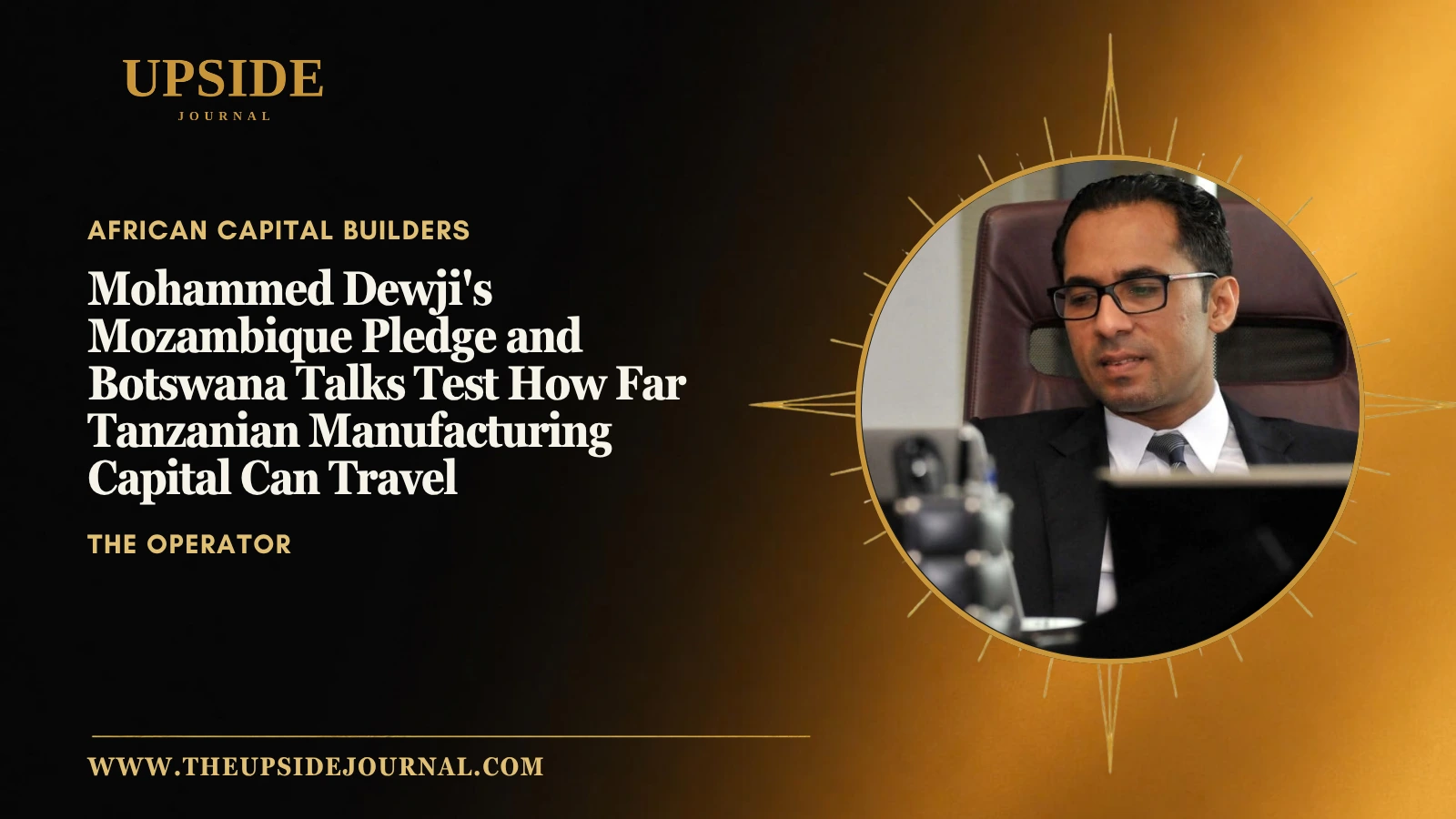
Executive Summary
A privately held Tanzanian manufacturer has, as reported, pledged US$250 million in Mozambique and held exploratory investment talks in Botswana. Neither is an investment yet. The Mozambique figure is a statement made after a presidential audience, with no reported breakdown, project list, timetable or binding terms, and the Botswana talks have no reported amount at all. The useful question is therefore not how large the numbers are, but what it would take for a group of this size to turn announced intent into financed, operating capacity across borders.
This profile of Mohammed Dewji and his group, Mohammed Enterprises Tanzania Limited (METL), separates pledge from investment and talks from agreement. It sets the reported pledge against the group's reported scale, states what is and is not disclosed about funding it, and reads the case as a test of cross-border industrial capital in the African Capital Builders network. The verdict is narrow: a pledge is a claim on capital, and the claim is only as strong as the financing behind it.
Introduction: A Pledge Is Not a Plant
Dewji's expansion is usually reported as investment news, with the headline figure treated as the event. That framing is understandable and misleading. A figure announced after a meeting with a head of state describes what a group intends to attempt, not what it has built, funded or committed in a contract. The distinction matters more for a private group than a listed one, because there is no filing to check the claim against.
The Upside Journal's African Capital Builders analysis argues that what Africa's wealthy fund is a better guide to the economy than how much they are worth. This article applies that test to one entity. It leaves net worth aside, attributes every figure to the report that carries it, and labels the arithmetic that follows as derived from those reports rather than disclosed by the group.
Who Is Mohammed Dewji, and What Does METL Own?
METL is the Tanzanian conglomerate Dewji leads as chief executive. Reports describe a group that moved from trading into manufacturing, agriculture, agro-processing and logistics, with interests that span agriculture, manufacturing, logistics, energy, trade and financial services. Prime Business Africa reported on 20 August 2026 that the group employs about 37,000 people and already operates in Mozambique and more than a dozen other African markets, while Financial Afrik, on 27 August 2026, put the group at more than 50 product lines and described an annual turnover approaching 8 trillion Tanzanian shillings, about US$3 billion by that report's conversion.
The scale figures do not match exactly, and the differences are worth stating. Prime Business reports about 37,000 employees; Financial Afrik reports about 40,000 and attributes the figure to the company. Prime Business says the group already operates in Mozambique, while Financial Afrik says its report does not describe any existing Mozambican operations. Neither is a filing. METL is privately held, no financial statements for the group were found, and every scale figure in this article is a press figure or a company claim, labelled as such.
The working definition is therefore modest. METL is a privately held, diversified Tanzanian manufacturer whose reported size is large enough to make a US$250 million pledge a meaningful event, and whose reported disclosure is thin enough that the pledge cannot be checked against its books.
What Has Been Pledged, and What Is Only Under Discussion?
Mozambique: a reported pledge
The Citizen reported on 20 August 2026 under the headline "Tanzanian businessman Mo Dewji to invest $250m in Mozambique", with a caption placing Dewji in a meeting with Mozambique's President Daniel Chapo. The body of that article did not load when opened, so this article relies on its headline and caption only. The detail comes from Prime Business Africa, which quotes Dewji after the talks: "We had a very fruitful discussion", and reports that the group committed to investing US$250 million and is trying to employ 20,000 Mozambicans.
Ecofin Agency, in its report of 4 September 2026, dates the meeting to 18 August in Maputo. Prime Business reports that the presidency described the commitment as able to support investment in strategic sectors and new production, distribution and service networks. What the reports do not give is the useful part: a breakdown of the US$250 million, named projects, a timetable, how the 20,000 jobs would be spread, or whether the commitment is binding. The jobs are described as a target.
The classification is plain. This is a reported pledge, stated by the group's chief executive, framed by the presidency as supporting industrialisation, and unaccompanied by any reported project or schedule.
Botswana: reported exploratory talks
Ecofin Agency reports that Botswana's President Duma Boko received Dewji on 25 August 2026, and that the discussion covered investment opportunities, including possible investment through the Botswana Stock Exchange and across several economic sectors. The same report states that neither METL nor Aliko Dangote, whom Boko received on 2 September, has announced a specific investment amount for Botswana, and that it remains unclear whether the talks will produce concrete projects.
That is a conversation, not an agreement. No sector is named, no amount is reported, and no signed document is reported. The Botswana story is useful as a sign of where METL is looking and as a case of a government actively recruiting private industrial capital, but it carries no financial weight yet.
Kenya: a smaller reported step
Ecofin Agency also reports a plant of about US$50 million for soft drinks in Mombasa, announced in May 2026, which it describes as the group's first major industrial investment in Kenya. It is the only one of the three moves described as a specific facility with a stated cost, and it is reported by the same source as the Botswana talks. The sequence matters: a defined plant in Kenya, a large undefined pledge in Mozambique, and open-ended talks in Botswana.
The verdict on the three: one project, one pledge and one conversation are three different claims on capital, and only the first has an object.
Pledge Against Scale: What the Arithmetic Can and Cannot Show
The Standard for this profile calls for setting the pledge against the group's scale. The comparisons below are derived from reported figures, are not group disclosures, and each shows its inputs.
Against reported turnover of about US$3 billion, a US$250 million pledge equals about 8 percent of one year's turnover. Turnover is not profit, cash or borrowing capacity, so the ratio describes size relative to sales and nothing about affordability. Against the roughly 37,000 to 40,000 employees reported, the 20,000-job target equals 50 to 54 percent of the current workforce, which would make Mozambique a very large addition if it were achieved. Dividing the pledge by the jobs target gives US$12,500 of capital per job, a derived figure that depends on the target being met and on the whole pledge being spent on job-creating assets.
The host-country comparison is sharper. Financial Afrik, citing the Observatory of Economic Complexity, reports that Tanzania exported about US$65 million of goods to Mozambique in 2024, and that Mozambique exported about US$4.59 million to Tanzania. The pledge is nearly four times Tanzania's annual goods exports to Mozambique, derived from those two reported numbers. It describes an investment large enough to be a different kind of relationship from trade.
A short hypothetical shows how timing changes the picture. Hypothetical, not reported: if the pledge were deployed evenly over five years, it would equal US$50 million a year, about 1.7 percent of reported annual turnover. No timeline has been reported, so the five-year period is an assumption chosen for illustration, and a shorter or longer period would change the figure proportionally.
The verdict: the pledge is large against Tanzania's trade with Mozambique and moderate against the group's reported sales, but no reported number says what the group can fund.
How Would an Expansion of This Size Be Financed?
For the Mozambique pledge and the Botswana talks, the answer is that nothing has been disclosed. No reported source describes the equity contribution, the debt, the lenders, the structure or the timeline. Any statement beyond that would be inference, and this article does not make one.
What is on record is how the group described funding an earlier programme. Bloomberg reported in 2022 that Dewji planned to invest at least US$1 billion over three to five years, with about 15 percent for operations in neighbouring countries, funded by roughly 40 percent equity and the rest debt, and that he was in talks with the African Development Bank and Proparco. That is a statement of intent from a different year and a different programme, and nothing in the sources opened shows how that programme was delivered. It shows the funding mix the group has described for a previous programme, and nothing more.
The general problem of financing industrial assets is covered elsewhere. The capital-structure analysis of African industrialisation explains why long-dated, high-risk industrial capital is hard to assemble, and a later piece in this cluster will examine how Tanzanian manufacturing groups finance cross-border expansion. The point here is only that a pledge is a claim on capital that has to be raised, and the first evidence that matters is a named project with a named funding source.
The verdict: until the financing is described, the Mozambique figure measures ambition and the Botswana talks measure interest.
Who Benefits If the Capital Arrives?
The beneficiaries depend on what is built, which is not yet known. If the capital is deployed, the host economies gain plant, employment and local production. Mozambique's government, in the reported presidency statement, framed the commitment as support for industrialisation and private capital. Botswana's case is more specific: Ecofin Agency reports that diamonds account for more than 90 percent of export earnings according to the World Bank, that the economy contracted 2.8 percent in 2024 and 0.7 percent in 2025, and that the government's transformation programme lists 186 projects, about 60 percent expected to be private-sector led. A private industrial investor fits that gap.
The second group is suppliers and distributors inside the group's own chain. A manufacturer that opens plants abroad usually brings inputs, brands and logistics with it, which can pull Tanzanian suppliers into the new markets and give the group's trading arms new volume. That is a structural expectation, not a reported outcome, and no source opened describes supplier effects.
The economic consequence is that the beneficiaries are conditional on the financing. A pledge that is not funded benefits neither group, and a funded one benefits host economies only to the extent that the assets are productive.
What This Adds to the Capital Builders Network Beyond Dangote
The best-known case of African private capital building industrial assets is Dangote's refinery, which the Upside Journal examined in its analysis of the refinery IPO and industrial policy. This profile does not compare the two. It adds a different structure: a privately held, diversified group whose disclosure is limited to what the group and the press say.
That contrast shows up in the network. The First HoldCo case examined a capital builder that reached investors through an index and a listed bank. Dewji's group sits at the opposite end: scale built privately, expansion announced by its chief executive, and verification limited to what the press carries. The network gains a case where the evidence problem is itself the finding.
It also tests the claim that scale in one market can be exported. The industrial supercycle analysis asks whether a model proven in one market can scale across the continent, and it identifies regional integration and deeper capital markets as the conditions. Dewji's Mozambique and Botswana moves are an early, private-sector test of the first of those conditions.
Where This Profile Stops
Four boundaries apply. The article does not treat the Mozambique pledge as a capital-flow signal for the wider region, which belongs to a separate analysis in this cluster. It does not explain how Tanzanian manufacturers finance cross-border expansion in general, which belongs to a third. It does not project scenarios for African industrial conglomerates, which belongs to a fourth. And it does not discuss net worth, since a wealth ranking is not evidence about what a group has funded.
Two practical limits also apply. The Citizen's articles on both the Mozambique pledge and the Botswana talks did not fully load, so the reports of Prime Business Africa, Financial Afrik and Ecofin Agency carry the detail, and any difference between those reports and The Citizen's full text is not reflected here. And the reported dates differ between sources, so this article uses the dates as Ecofin Agency states them and treats them as reported.
Why This Matters for Operators and Investors
For operators in manufacturing, agribusiness and logistics in Southern and Eastern Africa, a cross-border pledge from an established Tanzanian group is a signal about where demand for inputs, services and local partners may form. The signal is early. The sensible response is to watch for a named project, a site, a permit or a local partner, which would turn the pledge into something commercially actionable.
For investors and lenders, the case is a screening exercise. A private group with a large announced pledge and no filings presents a diligence question before it presents an opportunity: what is the funding plan, who stands behind it, and what would be disclosed if the plan changed? The group's own 2022 account described a funding mix that included debt, which makes lender identity and terms the information to look for.
For governments courting private capital, the lesson runs in the other direction. A presidential audience produces a headline quickly; converting it into a plant requires a project pipeline, permits and a financing structure that lenders will accept. Botswana's list of 186 projects is the kind of pipeline that can absorb a pledge, and the reported absence of a named project in either country shows what still has to happen.
What would change this reading?
Four developments would. A named Mozambican project with a site and a cost would convert part of the pledge into an investment. A disclosed lender or development finance institution would answer the funding question. A signed agreement or memorandum in Botswana would convert talks into a commitment. And a published set of group accounts would allow the scale and capacity comparisons above to be checked instead of inferred.
Key Takeaways
- The Mozambique US$250 million figure is a reported pledge with no breakdown, projects, timetable or binding terms, so it is a claim on capital and not an investment.
- The Botswana talks are exploratory, with no reported amount or named sector, and the Kenya soft-drinks plant is the only one of the three moves with a stated cost and object.
- Against a reported turnover of about US$3 billion the pledge is about 8 percent of one year's sales, but turnover is not funding capacity and no group accounts were found.
- The pledge is nearly four times Tanzania's reported 2024 goods exports to Mozambique, which makes it a different kind of relationship from trade.
- The decisive evidence is a named project and a disclosed funding source, which would convert announced intent into financed capacity.
Conclusion
Dewji's Mozambique pledge and Botswana talks are best read as claims that have not yet been tested. The group is large by the figures reported, the host governments are receptive, and the numbers announced are significant against the trade they would sit beside. None of that is a project, a loan or a signed agreement.
The test the headline poses is whether a privately held Tanzanian manufacturer can turn announced intent into financed capacity in neighbouring markets. The sources opened can say what was pledged and what was discussed. They cannot yet say who will fund it, when, or to build what, and until they can, the figure measures ambition more than capital.
External References
- Prime Business Africa: Tanzania's MeTL Group targets $250 million Mozambique investment, 20,000 jobs
- Ecofin Agency: Botswana holds back-to-back investment talks with Dewji, Dangote
- The Citizen: Tanzanian businessman Mo Dewji to invest $250m in Mozambique
- Financial Afrik: MeTL Group plans to invest $250 million in Mozambique and create 20,000 jobs
- Bloomberg (BNN): Tycoon Dewji takes on Coca-Cola with Tanzania investment ramp up