


Why Digital Identity Infrastructure Matters More Than Startup Funding
Capital doesn't build markets — identity does. Why digital identity infrastructure, not funding volume, determines whether African startups can actually onboard, verify, and scale customers.

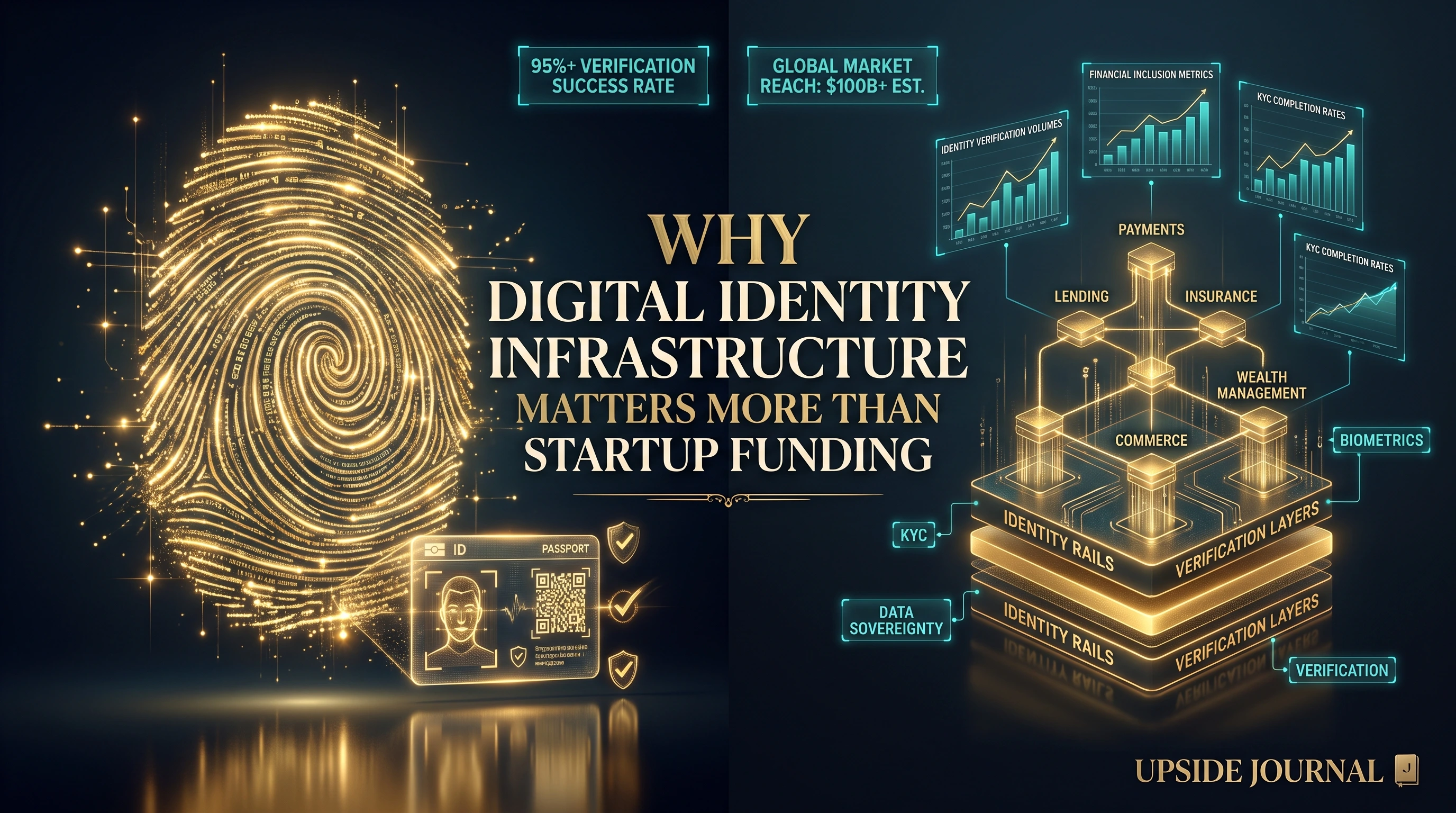
Executive Summary
Startup coverage in Africa is obsessed with a single number: how much a company raised. That number is a poor predictor of whether the company can actually operate. Before a startup can open an account, extend credit, process a payment, or satisfy a regulator, it must answer one question with certainty: who is this customer? Digital identity infrastructure — the systems that verify, authenticate, and credential a person or business — is the layer that answers that question. Without it, capital sits idle, onboarding stalls, and every downstream system, from compliance to credit scoring, inherits the uncertainty. This article argues that identity infrastructure, not funding volume, is the more reliable predictor of which African startups convert opportunity into durable scale.
Introduction
A founder can close a well-covered funding round and still be unable to answer the most basic operational question their business depends on. Every meaningful digital transaction — opening an account, extending a loan, verifying an insurance claim, processing a payment above a fraud threshold — begins with the same unresolved question: who, precisely, is on the other side of this interaction? If a startup cannot answer that question quickly, cheaply, and reliably, no amount of capital changes the outcome. The transaction stalls at the front door.
This is the argument this article makes: digital identity infrastructure is economically prior to funding. It is not a nice-to-have layered on top of a working product. It is the precondition for the product working at all. This article owns that specific claim within Upside Journal's Startup Infrastructure knowledge cluster — it does not re-litigate KYC process design, which the Compliance Infrastructure article in this same cluster already covers, and it does not revisit blockchain-based land registry architecture, which belongs to the separate Digital Trust Infrastructure cluster.
Background: Identity as the First Link in a Longer Chain
Every digital business, regardless of sector, depends on a chain of infrastructure that has to function in a specific order. Identity comes first, because nothing after it can function without it.
The chain runs: identity → verification → trust → compliance → account → transaction → credit → service. A startup cannot verify a customer without first establishing who that customer is. It cannot extend trust — in the form of an account, a credit line, or a service relationship — without verification behind it. It cannot satisfy a regulator's compliance requirement without a verified identity underpinning the compliance record. And it cannot generate revenue through a transaction, a loan, or a subscription without an account that a verified identity made possible in the first place.
This is why identity infrastructure is foundational rather than incidental. Weakness at the identity layer does not stay contained to identity. It propagates through every link that follows, degrading verification accuracy, inflating compliance cost, suppressing account creation, and ultimately capping the addressable market a startup can safely and profitably serve.
The System: What Digital Identity Infrastructure Actually Is
Digital identity infrastructure is the set of systems, standards, and APIs that allow a startup to establish, with a defensible level of confidence, that a person or business is who they claim to be — without building that verification capability from scratch for every product, every market, and every customer.
It is easy to conflate this with a national ID database, but the two are not the same thing. A national ID database is a record of who exists. Digital identity infrastructure is the operational layer that makes that record usable in real time by a private-sector product: the APIs that query it, the verification logic that cross-references it against other data sources, the credentialing systems that convert a one-time verification into an ongoing, reusable trust signal, and the interoperability standards that let one company's verification be recognised by another without repeating the entire process.
Framework: The Four Functions of Identity Infrastructure
- Establishment. Confirming a unique legal identity exists — the foundational record, whether government-issued, biometric, or a hybrid of both.
- Verification. Matching a person or business, at the moment of interaction, against that established identity with a defensible confidence level.
- Credentialing. Converting a verified identity into a reusable digital credential — a token of trust that downstream systems can accept without re-running the full verification process.
- Interoperability. Allowing that credential to be recognised across products, platforms, and — ideally — borders, rather than being locked to a single company's proprietary system.
A market that has strong establishment but weak interoperability still forces every startup to build its own verification pipeline in isolation. A market with strong interoperability but weak establishment has credentials with nothing reliable behind them. Both scenarios produce the same result: startups absorbing verification cost and risk that should be handled once, at the infrastructure layer, and reused indefinitely.
Technical Breakdown: Why Startups Cannot Substitute Capital for Identity
Consider two startups with identical products — a digital lending platform — operating in markets with different identity infrastructure maturity, and identical funding.
In the identity-poor market, the startup cannot rely on a single authoritative source to confirm a borrower's identity. It must instead assemble a patchwork: a national ID number that may or may not be current, a phone number that may be shared across a household, and a manual document review process that adds days to onboarding and cost to every application. Every borrower the startup wants to serve requires this bespoke, expensive verification effort. Fraud risk rises because the underlying verification is probabilistic rather than authoritative. The startup's growth is capped not by demand or capital, but by how fast its own internal verification team can process applications.
In the identity-rich market, that same startup queries a verification API, receives a credentialed, interoperable confirmation of identity within seconds, and moves the borrower directly into underwriting. The cost of customer acquisition drops because onboarding friction drops. Fraud exposure drops because the identity behind the credential is authoritative rather than assembled from fragments. Critically, funding plays no role in closing this gap — a better-funded startup in the identity-poor market still has to build or buy the same missing verification infrastructure that a modestly funded startup in the identity-rich market simply consumes.
This is the core argument against treating funding as the leading indicator of startup success. Capital can be deployed to acquire customers, hire engineers, or extend runway. It cannot manufacture a reliable identity layer that does not already exist in the market. A founder in an identity-poor market has exactly two options: absorb the cost of building identity infrastructure themselves, which is a fundamentally different — and far more capital-intensive — business than the one they set out to build, or wait for someone else to build it, which is precisely the dependency this cluster's pillar article maps across every infrastructure layer.
Business Implications
For operators, the practical consequence is that onboarding friction should be diagnosed as an identity-infrastructure problem before it is diagnosed as a product or marketing problem. A startup with a strong product and a high customer drop-off rate at account creation is frequently not failing on design — it is failing on identity verification latency, cost, or accuracy, and no amount of interface polish resolves that.
This also reframes the build-versus-buy decision facing most operators scaling across African markets. In markets with mature identity infrastructure, buying — consuming an existing verification API — is almost always the correct call, because the infrastructure has already absorbed the cost of hardening against fraud and edge cases at scale. In markets without that maturity, founders should treat the decision as a genuine strategic fork: absorb the build cost consciously, with a clear view of what it does to unit economics, rather than discovering the cost incrementally as onboarding friction erodes conversion.
Capital Implications
For investors, identity infrastructure maturity belongs in the diligence process as a distinct, quantifiable variable — not folded generically into "market risk." Two startups with identical total addressable markets can have structurally different unit economics purely because one operates in a market where identity verification costs cents and takes seconds, while the other operates where it costs dollars and takes days.
That difference compounds across every customer acquired, and it shows up eventually in customer acquisition cost, fraud losses, and time-to-scale — metrics investors already track, but frequently without connecting them back to the identity layer as the root cause.
This is also where identity infrastructure connects directly to Digital Trust Infrastructure as a broader institutional category. Digital identity is one component of that larger trust architecture — the layer that, combined with property and corporate registries, determines whether an economy can convert informal activity into bankable, investable enterprise value.
But the two should not be conflated. Digital Trust Infrastructure is the institutional, public-sector-anchored story of how trust gets built at a national level. This article's claim is narrower and startup-specific: that identity, specifically, is the layer a founder depends on before their business model can function at all, regardless of how the broader trust architecture around it eventually matures.
Operator Playbook
- Audit onboarding drop-off by verification step, not just by funnel stage. Isolate whether abandonment happens during identity verification specifically, rather than treating the entire onboarding funnel as one undifferentiated metric.
- Price identity verification cost per customer explicitly into unit economics. Treat it as a distinct line item, not an absorbed cost buried inside customer acquisition cost.
- Evaluate identity vendors on interoperability, not just accuracy. A highly accurate verification system that only works within one closed platform still forces rebuilding for every new product or market.
- Distinguish a national ID database from usable identity infrastructure before assuming a market is "solved." The existence of a government ID system does not guarantee an API-accessible, real-time verification layer exists on top of it.
- Treat repeated re-verification as a design flaw, not a compliance necessity. Credentialing exists specifically to avoid re-running full verification for every new interaction; failing to use it re-introduces the friction it was built to remove.

Long Horizon View
Over a ten-year horizon, the African markets that convert the largest share of their population into active participants in formal digital and financial systems will not be the markets that raised the most venture capital. They will be the markets where identity infrastructure reached interoperable, API-accessible maturity earliest. This is a structurally different bet than funding volume, and it is a more durable one, because identity infrastructure — once built to a credible, interoperable standard — does not depreciate the way a funding cycle does. It compounds. Every new startup that consumes an existing identity layer instead of rebuilding one adds usage, data, and hardening to that same infrastructure, making it more valuable and more accurate for the next company that relies on it.
Contrarian Perspective
The conventional read on slow startup growth in identity-constrained African markets blames capital scarcity — the assumption that more funding would resolve onboarding friction, fraud losses, and slow customer acquisition. This article takes the opposite position. Capital deployed against a missing identity layer does not fix the underlying problem; it simply pays, at a premium, for a startup to rebuild — badly, and in isolation — the infrastructure that should have existed for it to consume.
The startups that appear "underfunded" relative to their growth trajectory are, in a meaningful number of cases, actually operating in markets where identity infrastructure was strong enough that they never had to spend capital solving a problem their better-funded competitors elsewhere are still absorbing.
Key Takeaways
- Digital identity infrastructure is the first link in a dependency chain — identity, verification, trust, compliance, account, transaction, credit, service — that determines whether every downstream startup function can operate.
- A national ID database is not the same as usable identity infrastructure; the latter requires real-time, API-accessible verification and interoperable credentialing on top of the former.
- Capital cannot substitute for a missing identity layer — a well-funded startup in an identity-poor market still has to build or buy the same infrastructure a modestly funded startup elsewhere simply consumes.
- Identity infrastructure maturity should be treated as a distinct investor diligence variable, not folded into generic market risk.
- Digital identity is one component of the broader Digital Trust Infrastructure category, but this article's claim is narrower: identity specifically determines whether a startup's business model can function at all.
Conclusion
Funding headlines answer the question of how much capital a startup has raised. They do not answer the question of whether that startup can actually verify who its customers are — and without that answer, capital cannot be deployed effectively, regardless of how much of it arrives. Digital identity infrastructure is the layer beneath every other layer of a startup's operating stack: the precondition for verification, the input to compliance, and the gate through which every account, transaction, and credit relationship must pass.
Capital can fund a startup. Identity infrastructure determines whether millions of people and businesses can reliably participate in the digital economy that startup is trying to build. This cluster continues with a full map of the startup technical stack that sits on top of this identity layer.
External References
- World Bank — Identification for Development (ID4D)
- GSMA — The State of Mobile Money and Digital Identity in Sub-Saharan Africa
- McKinsey — Digital Identity: The Value Proposition
- Center for Global Development — Digital Identity and Economic Inclusion
"Where the world's conversations become movements."