Executive Summary
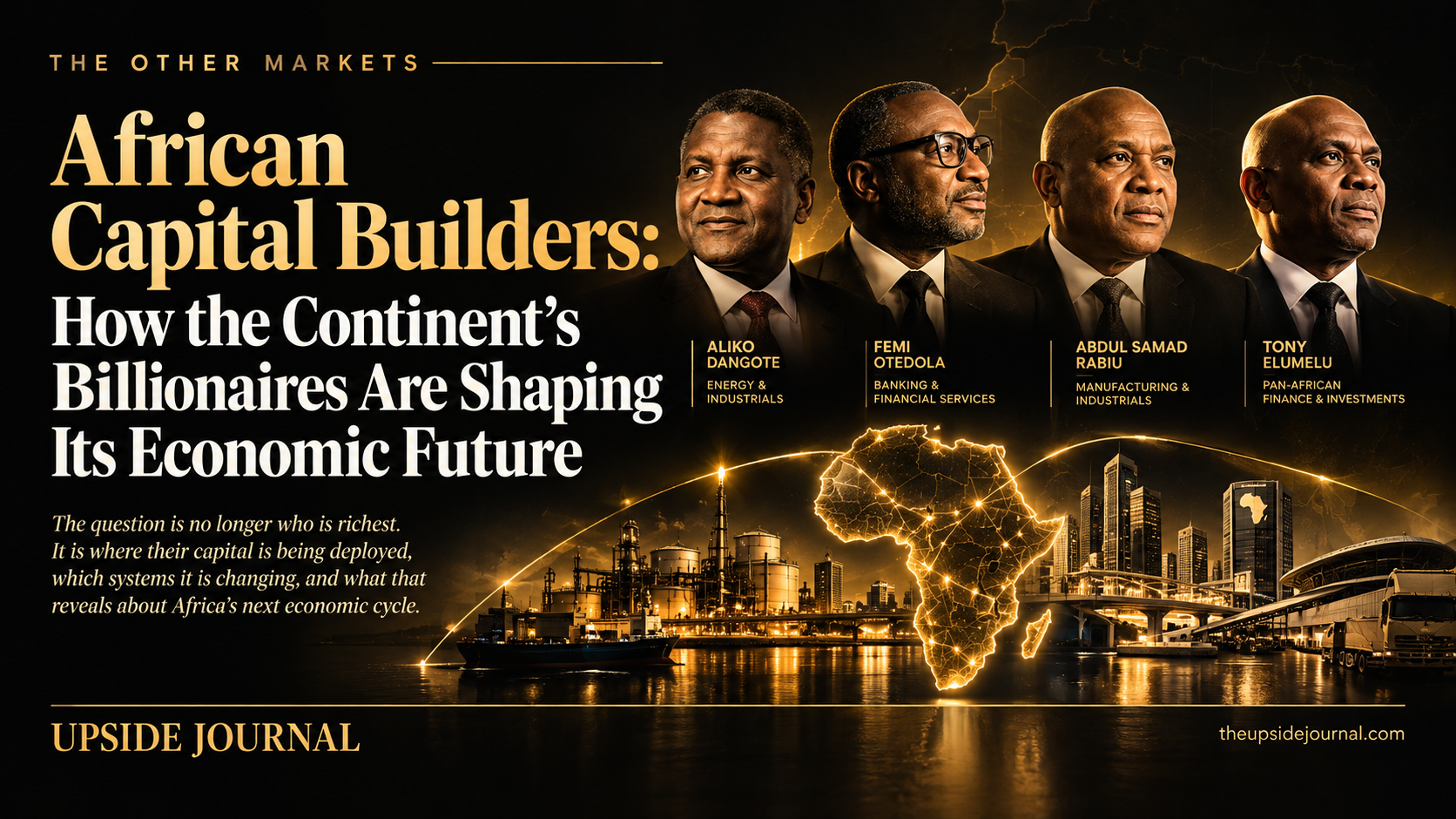
The question is no longer who is richest. It is where their capital is being deployed, which systems it is changing, and what that reveals about Africa's next economic cycle.
Every January, the same list circulates: Africa's richest people, ranked by net worth, illustrated with private jets. It is directionally accurate and analytically useless. Aliko Dangote, Femi Otedola, Abdul Samad Rabiu, and Tony Elumelu are not simply Africa's wealthiest individuals — they are the people currently deciding where private capital flows into African energy, banking, manufacturing, and pan-African finance. Dangote's 650,000-barrel-a-day refinery reached full nameplate capacity in February 2026 and is now expanding toward 1.4 million barrels a day. Otedola has committed over ₦600 billion of personal capital to rebuilding First HoldCo since 2024. Rabiu is doubling BUA Cement's output while publicly challenging African trade protectionism. Elumelu spent twelve years building UBA into a 20-country pan-African bank before stepping down in August 2026, and remains chairman of a diversified holding company spanning power, hospitality, and healthcare. This article introduces African Capital Builders as the concept this network will track — not a wealth ranking, but a lens on what happens when private capital starts building the infrastructure that governments and markets have not.
Introduction
Coverage of Africa's billionaires almost never gets past net worth. A number goes up or down, a ranking shifts, the story ends. That framing treats wealth as the finding, when wealth is only the residue of a decision that happened earlier and matters more: what did this person's capital actually build, and what did that construction change?
That reframe matters because these four individuals are not passive holders of wealth. Dangote is building the refining capacity that could end Nigeria's decades-long dependence on imported fuel. Otedola is rebuilding the balance sheet of the country's oldest bank with his own money, at scale. Rabiu is expanding industrial cement and food-processing capacity faster than the domestic market has historically absorbed it. Elumelu spent over a decade turning a single-country bank into a continental institution, then built a separate holding company to do the same thing again in power and healthcare. Their capital is not sitting in portfolios — it is deployed into physical plant, balance sheets, and institutions that outlast any single fortune.
This article does not rank them. It names the pattern: African Capital Builders, not "African billionaires." The distinction is not cosmetic. "Billionaire" is a wealth category. "Capital builder" is an economic-function category — and function is what this network will track. It sits alongside, rather than inside, this publication's Diaspora Operators network: that network tracks capital built abroad and brought home; this one tracks capital built and deployed domestically. Same continent, same infrastructure question, two different capital sources.
What "African Capital Builders" Means
An African Capital Builder is a private individual whose capital allocation decisions are large enough, and directed enough, to shape an entire economic system — an energy grid, a banking sector, an industrial supply chain, a cross-border financial network — rather than simply a company's balance sheet. The distinction from "billionaire" is deliberate: net worth is a market's valuation of past decisions. Capital-builder status is a claim about what a person's capital is doing now, and what system it is changing.
That reframing follows the same analytical formula this publication applies elsewhere: what the capital allocation says, what it means structurally, who benefits, and what economic consequence it creates. Applied to net worth alone, that chain terminates at step one. Applied to capital allocation, it runs the full distance — from a refinery commissioning to a country's fuel-import bill, from a bank recapitalisation to a re-rating on a frontier-market index.
The First Research Cohort
Four individuals open this network — not because they are Africa's four richest people by Forbes ranking, but because each gives this network access to a distinct economic system that private capital is currently reshaping.
Capital builder | Primary vehicle | System it gives access to | What changed in 2026 |
|---|---|---|---|
Aliko Dangote | Dangote Group — Dangote Refinery, Dangote Cement, fertiliser | Industrial and energy infrastructure | Refinery reached full 650,000 bpd nameplate capacity in February 2026; expansion to 1.4 million bpd underway, targeting an NSE listing |
Femi Otedola | First HoldCo (parent of First Bank of Nigeria) | Financial and institutional capital | Chairman since January 2024; personal stake built past 25%, over ₦600 billion committed, framed publicly as a "generational commitment" rather than a trade |
Abdul Samad Rabiu | BUA Group — BUA Cement, BUA Foods | Manufacturing and industrial capital | BUA Cement capacity expansion from 11 million to 20 million tonnes announced; publicly contesting African trade-protection practices that disadvantage domestic producers |
Tony Elumelu | Heirs Holdings, Transcorp; formerly UBA | Pan-African private and development capital | Retired as UBA Group Chairman in August 2026 after twelve years and the CBN's tenure limit, leaving a 20-country pan-African bank; remains chairman of Heirs Holdings' power, hospitality and healthcare portfolio |
Each row is a different economic system, deliberately. Energy infrastructure, financial-sector recapitalisation, industrial manufacturing capacity, and pan-African institution-building are not the same story told four times — they are four separate tests of what happens when private capital, rather than the state or foreign direct investment, becomes the primary builder of a system Africa's growth depends on.
Dangote: capital as energy sovereignty
The Dangote Refinery's path to full capacity is not a corporate milestone. Nigeria has spent decades importing more than 80% of its refined fuel despite being a major crude producer — a structural absurdity that Dangote's capital, not government policy, is now correcting. Analysts estimate the refinery could save Nigeria up to $10 billion annually in foreign exchange once fully ramped. The 1.4-million-barrel expansion, if completed on the announced three-year timeline, would make it the largest single-train refinery in the world. That is not a wealth story. It is a sovereignty story, funded privately.
Otedola: capital as institutional trust
First HoldCo's turnaround began with a Central Bank intervention in 2021 that dissolved the board over governance failures and left the bank carrying over ₦1.7 trillion in bad-loan write-offs. Otedola's response was not to acquire cheaply and exit — it was to keep buying, publicly, past the point most investors would call a position closed. That behaviour is itself the signal: capital that behaves like permanent ownership rather than a trade is doing something structurally different from the fund-cycle logic that governs venture and much of private equity. First HoldCo's H1 2026 profit before tax rose 83.5% year-on-year on a 30.4% return on equity — the highest among Nigeria's major banking groups — while the bank was simultaneously absorbing fresh recapitalisation.
Rabiu: capital as industrial capacity
BUA's expansion from 11 million to 20 million tonnes of cement capacity narrows the gap with Dangote Cement's roughly 52-million-tonne output — not a rivalry story, but evidence that African industrial capacity is being built ahead of confirmed demand, on the calculation that infrastructure spending across the continent will eventually absorb it. Rabiu has also been unusually direct about what constrains that calculation: in a widely covered account of a blocked sugar deal in Mali, he argued that African governments protect politically connected importers over domestic producers — industrial capital's own diagnosis of what slows industrial capital.
Elumelu: capital as institution-building, twice
Elumelu's UBA tenure is the clearest existing case of private capital building durable pan-African infrastructure: a single-country bank turned into an institution operating in 20 African countries plus London, Paris, the UAE, and the United States, serving more than 20 million customers. His retirement in August 2026, under Central Bank governance limits rather than by choice, does not end the pattern — it tests whether the institution he built can outlast him, which is precisely what "infrastructure" is supposed to do. Heirs Holdings, his separate investment vehicle spanning power, hospitality, energy, and healthcare across 24 countries, is the same institution-building logic applied a second time, without the tenure clock.
Why This Isn't a Wealth Ranking
It would be easy to mistake this network for a rebrand of the annual rich list. It is the opposite. A wealth ranking asks how much someone is worth. This network asks what their capital is doing, which is a materially different — and more durable — question, because net worth moves with share prices while capital allocation moves with decisions.
That distinction also explains why this article deliberately stops short of the territory reserved for future nodes: Dangote Refinery's engineering economics, First HoldCo's balance sheet mechanics, BUA's manufacturing footprint, and UBA's pan-African expansion history each deserve their own analysis, on their own terms, without net worth anywhere near the centre of the argument. Treating four individuals as a single node here would flatten four distinct economic systems into one billionaire story — exactly the reduction this network exists to avoid.
It also explains the deliberate framing of "first research cohort" rather than a fixed list. All four are Nigerian and all four are men — an accurate description of where this specific pattern is most visible today, not a claim about where it ends. The network is built to extend to South African, Egyptian, Kenyan, Ghanaian, and Moroccan capital builders, and to African women allocating capital at comparable scale, without requiring a new taxonomy each time.
Why This Matters for Investors, Policymakers, and Operators
For investors, capital-builder behaviour is a different risk signal than net worth. Otedola's decision to keep buying First HoldCo shares past the point of an obvious exit, or Dangote's decision to commit to a second, larger refinery expansion before the first has fully proven out commercially, both say something about conviction that a valuation multiple does not capture on its own. It is the same signal, from a different capital class, that corporate venture capital quietly becoming Africa's biggest LP category represents: capital committing past the point a purely opportunistic allocator would.
For policymakers, the concentration of energy, financial, and industrial infrastructure in a small number of privately controlled balance sheets is itself a policy fact worth tracking — independent of whether the outcomes it produces are judged favourably. That concentration also extends into softer infrastructure: the same capital increasingly underwrites the digital trust infrastructure this publication has argued Africa's next economic leap depends on. Rabiu's public complaint about protectionist trade practices is a data point about where private industrial capital believes African policy is still working against its own stated industrialisation goals.
For operators building in African markets, the pattern worth extracting is not "become a billionaire" — it is that capital committed as permanent ownership, rather than opportunistic positioning, behaves differently in the invisible infrastructure layers that high-growth companies depend on. That is an operating lesson as much as a capital-markets one, and it is the thread the founder-entity nodes in this network will each test against a single system in depth.
Key Takeaways
African Capital Builders is a distinct concept from "African billionaires" — it tracks what private capital is building (energy, banking, manufacturing, pan-African institutions), not what individuals are worth.
Dangote, Otedola, Rabiu, and Elumelu open this network because each gives access to a different economic system currently being reshaped by private rather than state or foreign capital.
2026 alone produced four separate, verifiable capital-allocation events across the cohort: a refinery reaching full nameplate capacity and expanding further, a bank recapitalisation funded from personal wealth, an industrial capacity expansion, and the end of a twelve-year pan-African institution-building tenure.
This is explicitly a first research cohort, not a definitive list — the network is designed to extend beyond Nigeria and beyond men without requiring a new framework each time.
Net-worth figures are deliberately excluded from the evidentiary centre of this analysis; company filings, regulatory disclosures, and named financial reporting carry the argument instead.
Conclusion
The question worth asking about Africa's billionaires was never how much they are worth. It is where their capital is being deployed, which systems it is changing, and what those decisions reveal about the continent's next economic cycle. Dangote's capital is answering that question in energy. Otedola's is answering it in banking. Rabiu's is answering it in manufacturing. Elumelu's already answered it once in pan-African finance and is now answering it again in power and healthcare.
None of that requires a ranking. It requires tracking the decisions as they happen, in the systems they are changing — which is what each of the founder-entity nodes that follow this one will do, one system at a time.
Related Reading
The Rise of Diaspora Operators: How African Founders Are Building Global Infrastructure Companies — the diaspora-capital counterpart to this domestic-capital network
Why Corporate Venture Capital Is Quietly Becoming Africa's Biggest LP Category — the parallel story of capital quietly becoming institutional, from a different capital class
Venture Capital vs Private Equity: Why They're Fundamentally Different Operating Systems — the operating-system distinction that places permanent industrial capital on a different spectrum from fund-cycle VC
Startup Infrastructure: The Invisible Systems Powering Africa's Next Generation of High-Growth Companies — the infrastructure-consequence thesis this network's capital increasingly funds
Digital Trust Infrastructure: The Foundation of Africa's Next Economic Leap — the institutional-infrastructure argument this network's capital is beginning to underwrite
Who Are Africa's Most Active VC Firms in 2026? A Deal-Count Map — an existing capital map from a different capital class, for contrast rather than repetition
The $705 Million Surge: De-Risking the Non-Traditional Venture Hubs — where institutional venture capital is spreading, against where this network's private industrial capital currently concentrates
Forthcoming: founder-entity nodes on Aliko Dangote (industrial and energy infrastructure), Femi Otedola (financial and institutional capital), Abdul Samad Rabiu (manufacturing and industrial capital), and Tony Elumelu (pan-African private and development capital).
External References
Bloomberg — Dangote Says Refinery Units Reach 650,000 Barrel-a-Day Capacity: nameplate capacity milestone, February 2026
Vanguard via AllAfrica — Dangote Refinery Announces Expansion From 650,000 to 1.4 Million Barrels Daily: expansion plan, NSE listing intent
Starconnect Media — How Femi Otedola Repositioned FirstHoldCo After Record ₦1.7tn Clean-Up: First HoldCo turnaround, H1 2026 results
Billionaires Africa — Abdul Samad Rabiu's BUA Cement to Nearly Double Production Capacity: capacity expansion to 20 million tonnes
Heirs Holdings — About Us: UBA pan-African footprint, Heirs Holdings portfolio scope