EXECUTIVE SUMMARY
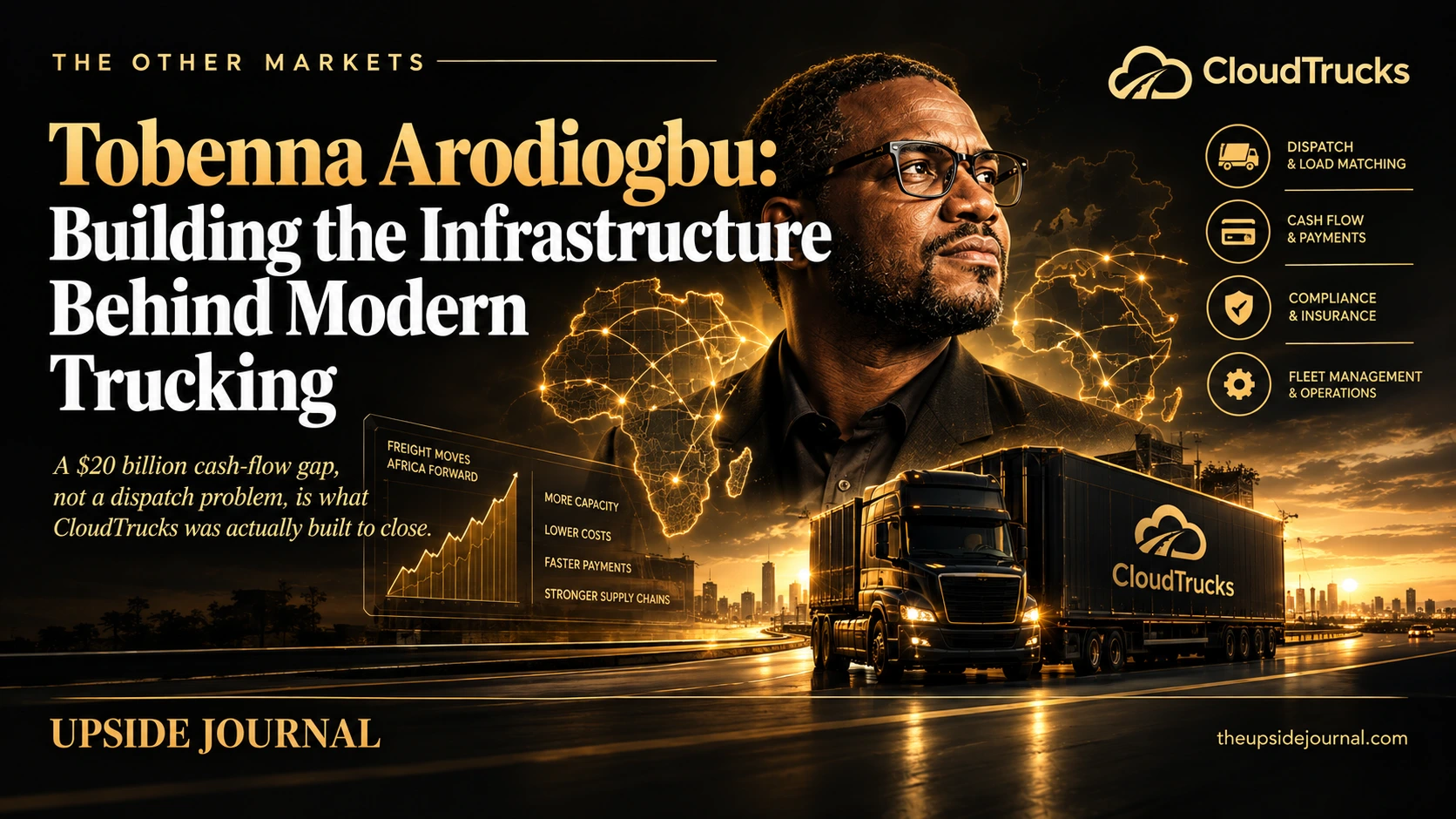
Tobenna Arodiogbu built CloudTrucks because a $800 billion American industry could not build the infrastructure it needed for itself. Trucking moves roughly 70% of everything sold in the United States, yet it is run by an estimated 350,000 independent owner-operators and small carriers, 97% of them fleets of twenty trucks or fewer — too fragmented, individually, to buy or build enterprise-grade software, and too collectively important to keep running on spreadsheets, fax-era brokers, and 30-day payment cycles. CloudTrucks is Arodiogbu's answer: a virtual trucking carrier that gives independent drivers the scheduling, dispatch, and cash-flow infrastructure that only large fleets could previously afford. The company is one instance of a pattern this network calls the Rise of Diaspora Operators — African-born founders who treat structural fragmentation not as a market to disrupt with a consumer app, but as a missing operating layer to be built.
INTRODUCTION
The conventional read on immigrant-founder stories is biographical: humble beginnings, hard work, an American success story. That framing is directionally true and analytically useless. It explains nothing about why CloudTrucks exists, what it actually does, or why trucking — of all industries — needed a founder who had already spent years building software for a very different fragmented market. The more useful question is mechanical: what specific failure in a $800 billion industry did Tobenna Arodiogbu see clearly enough to build a company around, and why had nobody already operating inside trucking built it first? The answer says less about Arodiogbu's biography than about who trucking's existing intermediaries were incentivised to protect.
WHO IS TOBENNA ARODIOGBU?
Arodiogbu was born in Enugu, Nigeria, and later studied in the United States before co-founding Scotty Labs, a remote-vehicle-operation startup acquired by DoorDash in 2019. That acquisition is the one biographical detail worth keeping, because it is where Arodiogbu met Jin Shieh, CloudTrucks' eventual co-founder and CTO, and where both absorbed a specific engineering discipline: coordinating physical assets — vehicles, routes, timing, payments — in real time, at a level of reliability that consumer software rarely demands. CloudTrucks, launched in 2019 with its consumer-facing app arriving in May 2020, is that same discipline redirected at a much larger and much older industry. Within six months of the app's launch, the company reported completing more than 1,000 long-haul deliveries and over $1.8 million in freight transactions, growing roughly 40% month-over-month — evidence less of hype than of an unmet, and previously unmeasured, level of demand for the operating layer CloudTrucks was building.
WHAT IS CLOUDTRUCKS?
CloudTrucks describes itself as a virtual trucking carrier: independent owner-operators plug into CloudTrucks' operating layer — an aggregated load board, a schedule optimizer, dispatch support, and compliance and insurance handling — without becoming CloudTrucks employees. Drivers who want to keep their own operating authority and insurance can instead use CloudTrucks Flex, a lighter-touch version of the same tools. The company's own framing is "business in a box" for truckers, and it is a useful one: CloudTrucks does not sell software to trucking companies, it sells the missing back office to people who are, functionally, one- or two-truck businesses without the administrative capacity a business that size cannot support alone. The technical architecture of that operating layer — how the scheduling and matching engine actually works, module by module — is the subject of a forthcoming companion piece in this network; this article is concerned with what the founder saw, not how the platform is engineered.
WHY TRUCKING IS THE HARDEST KIND OF FRAGMENTED
Fragmentation is not, by itself, an opportunity. Plenty of fragmented industries have resisted software for decades because the unit economics of serving thousands of tiny, low-margin operators rarely justify the cost of building for them — independent trucking is fragmentation at its most structurally punishing. Fixed costs are high and largely unavoidable: fuel, insurance, equipment financing, and maintenance all scale against a single truck's revenue rather than against a fleet's. Margins are thin. And the payment cycle works against the smallest operators hardest: brokers routinely take 30 to 45 days to pay a completed load, and the factoring companies willing to advance cash sooner typically charge 3% or more to do it. A driver running one or two trucks has no treasury function to absorb that timing gap — for that driver, the gap between delivering a load and being paid for it is not an inconvenience, it is the business's binding constraint.
This is the structural condition every prior wave of trucking software failed to change. Load-matching apps made it marginally easier to find freight; compliance software made it marginally easier to stay legal; neither touched the cash-flow mechanism that determined whether a small operator survived a slow month. Arodiogbu's read of the industry was that the point of failure was not discovery, it was liquidity — and that observation, more than any single feature, is what separates an infrastructure company from a point-solution app.
WHAT PROBLEM DOES CLOUDTRUCKS ACTUALLY SOLVE?
Arodiogbu's answer was not a better invoicing app. It was CT Cash, a payments product built in partnership with Visa and Stripe that pays drivers within roughly two hours of a completed, proof-of-delivery load rather than the industry-standard 30 to 45 days, with a linked cash card usable anywhere Visa is accepted and free standard transfers to an external bank account. CloudTrucks later added CT Credit, a Visa-backed credit line letting owner-operators smooth fuel, maintenance, and other costs between completed jobs rather than waiting on the next payout cycle. Both products attack the same mechanism from different angles: trucking's cash-flow gap is not a nuisance to be smoothed over with a fee-based workaround, it is the reason small operators stay small, remain dependent on predatory factoring, or exit the industry entirely.
The Mechanism, Stated Plainly
What it says: independent truckers routinely wait weeks to get paid for completed work. What it means: the businesses least able to absorb a 30-day cash gap are structurally forced to either accept factoring fees of 3% or more, or under-invest in their own equipment, insurance, and safety margins to preserve cash. Who benefits when that gap closes: the driver directly, in the form of retained earnings that would otherwise go to a factoring company; and indirectly the broader freight market, which depends on solvent, well-maintained owner-operator capacity staying on the road rather than exiting during tight cash periods. What economic consequence it creates: a small but compounding effect on how much of the country's trucking capacity survives a downturn intact — precisely the kind of outcome that depends on operating infrastructure, not additional point software, being present underneath a fragmented industry.
WHERE THIS FITS IN THE DIASPORA OPERATOR PATTERN
CloudTrucks is not an isolated case in this network. Ridwan Olalere built LemFi on the same premise applied to remittances: a diaspora population underserved by incumbent financial rails, addressed not with a marginally cheaper transfer app but with the underlying payments infrastructure those rails were missing. Joe Kinvi's Borderless applies the same logic to diaspora investment access, building the infrastructure layer that let capital move where none previously could. Arodiogbu's trucking bet has no diaspora customer base at all — his drivers are overwhelmingly domestic American owner-operators — and that absence is precisely what makes the pattern worth naming as a pattern rather than a coincidence of geography.
The table below makes the comparison explicit: three founders, three different fragmented markets, and the same underlying decision to build the missing operating layer rather than a better front end for an existing one.
FOUNDER / COMPANY | FRAGMENTED MARKET | MISSING LAYER IDENTIFIED | INFRASTRUCTURE BUILT |
|---|---|---|---|
Tobenna Arodiogbu / CloudTrucks | Independent US trucking, 350,000+ owner-operators | Cash-flow timing between delivery and payment | CT Cash, CT Credit — instant pay and credit rails |
Ridwan Olalere / LemFi | African diaspora remittances | High-cost, slow cross-border transfer rails | Direct payments infrastructure for diaspora transfers |
Joe Kinvi / Borderless | Diaspora investment access | No route for diaspora capital into home-market assets | Cross-border investment infrastructure |
In each case, a founder who understood structural fragmentation from the outside built the layer that an entrenched, slow-moving incumbent set had no commercial incentive to build. LemFi's own infrastructure build, examined on its own terms elsewhere in this network, is the closest operating analogue to what CloudTrucks has built for trucking: not a better front end, but a different back end.
WHY THIS MATTERS FOR DIASPORA FOUNDERS
For founders reading this network as a playbook, the CloudTrucks case argues against choosing a market because it looks demographically familiar and for choosing one because its fragmentation is structural and unaddressed — regardless of whether that market shares the founder's own background or diaspora community. Arodiogbu did not build for Nigerian truckers, or for a diaspora market at all; he built for whichever fragmented industry had the clearest, most mechanically solvable liquidity gap. That is a narrower and more useful lesson than "immigrants build great companies": the pattern worth copying is choosing the gap, not the geography.
WHY THIS MATTERS FOR INSTITUTIONAL INVESTORS
For allocators evaluating operator-led companies in this network, the relevant diligence question is not whether a founder has relevant lived experience, but whether that founder's product closes an economic gap that the industry's own incumbents were structurally unmotivated to close. CloudTrucks passes that test because factoring companies and legacy carriers had every reason not to give owner-operators same-day cash access at cost — doing so would have undercut a fee structure that depended on the payment gap staying open. Infrastructure businesses built against an incumbent's own disincentive to compete tend to have longer moats than businesses built against mere technical inertia, because the incumbent cannot simply copy the feature without cannibalising its existing revenue. Factoring companies cannot offer two-hour, fee-free payouts without abandoning the fee that funds their business model; CloudTrucks, with no legacy factoring revenue to protect, has no such conflict.
WHAT THIS MEANS FOR FREIGHT CAPACITY BROADLY
The stakes extend past any single driver's cash position. American freight capacity is disproportionately held by exactly the operators CloudTrucks serves — the 97% of fleets running twenty trucks or fewer — which means the health of that segment functions as a leading indicator for the health of freight capacity overall. When fuel prices spike or freight rates soften, it is the smallest operators, with the thinnest cash buffers, who exit first: selling a truck, taking a company-driver job, or simply parking the rig until conditions improve. Each exit removes capacity from a market that, per Arodiogbu's own framing of the industry, is already tight during peak demand periods.
Instant-pay infrastructure does not eliminate that cyclicality, but it changes who survives it. A driver with same-day access to earnings can absorb a bad week without borrowing against a factoring company's terms or missing an insurance payment; a driver waiting 30 to 45 days for the same money has far less room to do either. At scale, that difference shows up not as a headline metric CloudTrucks would publish, but as a marginal increase in how much independent capacity stays available to shippers during the periods when capacity is scarcest — the same periods when freight rates, and therefore the health of the wider logistics economy, are most sensitive to how many trucks are actually on the road.
WHERE THIS DOESN'T FIT
This is a founder-and-mechanism piece, not a technology teardown or an investment thesis. It does not evaluate CloudTrucks' scheduling algorithm in technical depth, its unit economics as a standalone business, or its competitive position against other trucking-fintech entrants — each of those questions belongs to a separate, more technical node in this network. Nor is this a story about immigrant entrepreneurship in the abstract; Arodiogbu's Nigerian origin is relevant only insofar as it places him, like the other founders profiled in this network, outside the assumptions an industry incumbent would have carried into the same problem.
KEY TAKEAWAYS
CloudTrucks exists because trucking's cash-flow cycle, not a shortage of driver-facing apps, is what keeps independent owner-operators structurally small.
CT Cash's roughly two-hour payout, against an industry standard of 30 to 45 days, is the product decision that defines the company — not its scheduling tools.
Arodiogbu's Scotty Labs background, acquired by DoorDash in 2019, supplied the specific discipline — coordinating physical assets and payments in real time — that trucking's fragmentation required.
CloudTrucks belongs to a wider pattern of diaspora-founder infrastructure plays, alongside LemFi and Borderless, defined by closing gaps incumbents had every commercial incentive to leave open.
The founder's background explains why he saw the gap; it does not explain the product, which is a payments and scheduling infrastructure decision that would hold regardless of who built it.
CONCLUSION
The instinct to read Tobenna Arodiogbu's story as an immigrant-success narrative is not wrong so much as it is beside the point. CloudTrucks succeeds or fails on whether same-day payment infrastructure changes the economics of owner-operator trucking at scale — a mechanical question with a mechanical answer, unrelated to where its founder was born. That the answer happens to fit a recognisable pattern among diaspora-led infrastructure companies says more about which founders are currently willing to build unglamorous back-office infrastructure for fragmented industries than it does about any of them individually.
RELATED READING — PILLAR
CLUSTER SIBLINGS
Ridwan Olalere: Building the Financial Infrastructure Connecting Africa's Global Diaspora
Joe Kinvi: Building the Infrastructure That Connects Global African Investors
FORTHCOMING IN THIS CLUSTER
CloudTrucks and the Future of Small-Fleet Trucking Infrastructure
Why Small Trucking Businesses Need an Operating Infrastructure, Not More Trucking Software
How Digital Infrastructure Is Changing the Economics of the Independent Trucking Business