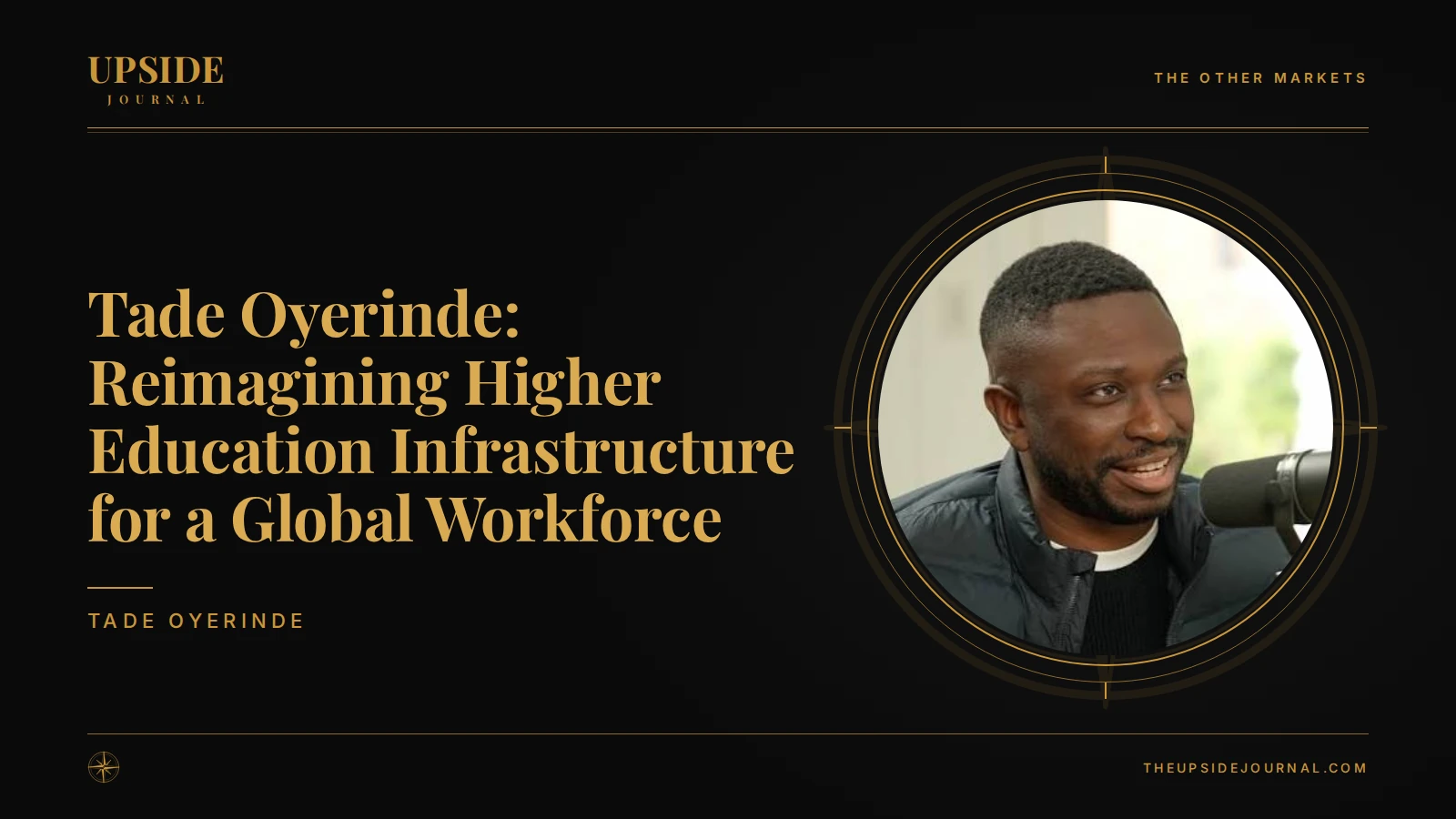
Executive Summary:
Campus is conventionally read as an online community college — a cheaper, more flexible version of a familiar product. That framing is too shallow to be useful. Tade Oyerinde's actual bet is that higher education can function as workforce infrastructure: a system that connects globally distributed talent to career mobility, rather than a service that sells course access. The distinction matters most to the exact reader this publication serves — the operator who has already learned that "infrastructure" beats "product" as a category, because infrastructure compounds and products get commoditized.
The Story Everyone Tells About Campus
The easy version goes like this: student loan debt in the United States has ballooned past $1.8 trillion, traditional four-year degrees have priced out a generation, and Tade Oyerinde built a cheaper alternative. Campus, launched in beta in 2022, offers accredited associate degrees taught live by adjunct faculty from institutions including Princeton, NYU, Vanderbilt, and Howard, at tuition near $7,200–$10,000 a year — below the federal Pell Grant threshold for a majority of enrolled students.
That's directionally true and analytically empty. It explains what Campus charges. It does not explain what Campus is for.
The Actual Mechanism: Rebuilding the Adjunct Market, Not the Classroom
Oyerinde's founding insight didn't come from studying tuition costs — it came from discovering, while demonstrating an earlier product (Campuswire, an online teaching platform he built in 2016) at UCLA, that adjunct professors were being paid so little that some couldn't afford housing near the campuses where they taught. Campus's actual innovation sits on the supply side, not the demand side: it pays instructors roughly double the national adjunct average — reported at around $8,000 per class — while keeping student cost below a traditional community college.
That's the mechanism worth naming precisely: Campus is not a discount marketplace for degrees. It's a two-sided infrastructure layer that repriced the labor market for the people who deliver instruction, and used that repricing to attract faculty from selective institutions who would not otherwise teach at a community-college price point. <strong>Workforce infrastructure</strong>, in this reading, means exactly that — a system that restructures who can supply a service and who can access it, simultaneously, rather than optimizing one side at the other's expense.
The results are still early but directionally real: graduation rates in completed cohorts have run 42–44%, above the national community-college average, with Campus targeting above 50%. Enrollment has scaled from roughly 800 students across 30 states in 2023 to about 2,000 active students by 2025, alongside a five-year capital base that grew from a $29 million Series A — led by Sam Altman and Discord's Jason Citron — to more than $100 million raised cumulatively, including a $46 million round announced in March 2025 and a physical Atlanta hub that opened that May.
Where This Sits Against the Model It's Replacing
Dimension | Traditional Community College | Campus |
Faculty sourcing | Local adjunct pool, often underpaid | National pool from selective universities, paid ~2x adjunct average |
Delivery mode | Physically bound to campus catchment | Live, synchronous, geography-independent |
Cost structure | Varies by state/district | Fixed near or below Pell Grant coverage |
Talent pipeline logic | Local labor market | National and increasingly cross-border |
The geography-independence row is the one operators should sit with the longest. A local community college is, definitionally, bound to whoever lives near it. Campus's live-but-remote model breaks that binding — which is precisely what makes it relevant to a diaspora-operator thesis rather than a purely domestic U.S. education story.
Why a U.S. Community College Belongs in a Diaspora Operators Network</h2>
This is the connective tissue this publication's Rise of Diaspora Operators pillar exists to trace: infrastructure built by a diaspora founder doesn't have to be explicitly "for" the diaspora to matter to it. Ridwan Olalere's LemFi and Joe Kinvi's Borderless both build financial rails that explicitly move money across the diaspora corridor.
Campus builds something adjacent but structurally different: a credentialing and skills layer that is geography-independent by design, which means it is, functionally, workforce infrastructure available to anyone who can get online — including the same globally mobile, cross-border operators and workers this network already covers.
The parallel is instructive precisely because the two categories shouldn't be collapsed into each other. Diaspora payment networks move capital across borders that already exist. Campus's model, if it holds, moves credentialed skill across borders that already exist. One is a financial-infrastructure category; the other is a workforce-infrastructure category. Diaspora operators building in either category are solving the same underlying problem — that talent, capital, and opportunity are unevenly distributed across the same three-market map this publication tracks — from two different layers of the stack.
Where Campus Fits — and Where It Doesn't
It's worth being precise about scope here, because the corrective framing can overreach if left unchecked. Campus is not, today, a pipeline explicitly recruiting African or diaspora students, and this piece is not claiming otherwise. It is U.S.-domiciled, U.S.-accredited, and its enrollment (majority Black or Hispanic, majority women, majority first-generation, per reporting) reflects a U.S. access problem first. The diaspora relevance is structural, not programmatic: a model that decouples instruction quality from physical location is a template — proof that the constraint diaspora-focused workforce platforms are trying to solve (geography rationing access to quality instruction) is solvable at scale, not merely in theory.
That's the boundary a reader should hold onto: Campus is evidence the model works, not yet an instance of the model applied to the diaspora corridor directly. The gap between those two things is exactly where a future workforce-infrastructure node in this network would be pointed.
Why This Matters for Diaspora Founders and Africa-Focused Investors
For founders building education, credentialing, or workforce-development products aimed at African or diaspora talent, Campus is a working proof of two separable claims worth testing independently: that paying instructors well enough to attract selective-institution faculty is a viable unlock even at low tuition, and that live, synchronous, geography-independent delivery can outperform the access-versus-quality tradeoff that has historically defined lower-cost education. Neither claim requires believing the other — a founder could build the compensation-repricing model without the geography-independence bet, or vice versa, and Campus is really running an experiment in combining both at once.
For investors evaluating talent-infrastructure plays adjacent to the AI-driven demand for skilled labor, Campus's five-year capital trajectory — from a $29 million Series A to a cumulative base north of $100 million — is a useful reference point for how patient workforce-infrastructure capital needs to be before unit economics (in this case, graduation and completion rates) mature enough to underwrite a thesis. This is a category where the return on capital is measured in cohorts, not quarters.
Key Takeaways
Campus's actual innovation is repricing the adjunct labor market — paying roughly double the national average — not simply discounting tuition, and that supply-side fix is what let it attract faculty from selective institutions at a community-college price point.
Geography-independent, live-format delivery is the structural feature that makes a U.S. domestic education company relevant to a cross-border, diaspora-operator thesis, even though Campus itself is not diaspora-targeted today.
Campus separates two claims that founders building similar models should treat independently: instructor-compensation repricing, and geography-independent delivery. A new entrant doesn't have to bet on both simultaneously.
Workforce-infrastructure capital is patient capital — Campus's climb from a $29 million Series A to more than $100 million cumulative over roughly five years reflects a category where cohort-level outcomes, not quarterly metrics, are the real underwriting signal.
The gap between "proof the model works" (Campus, domestically) and "the model applied to the diaspora corridor" (not yet built) is where the next workforce-infrastructure node in this network should be aimed.
Conclusion
Campus is not a cheaper college. It is a demonstration that the two constraints usually treated as fixed in education — where good instructors are willing to teach, and where students are physically able to study — are both negotiable when the underlying labor market gets repriced and the delivery format gets decoupled from geography. That is the mechanical difference that matters, and it is the reason a U.S. community-college startup belongs inside a network built to track how diaspora operators are quietly rebuilding infrastructure across three continents, one layer of the stack at a time.
Related Reading
The Rise of Diaspora Operators: How African Founders Are Building Global Infrastructure Companies
Ridwan Olalere: Building the Financial Infrastructure Connecting Africa's Global Diaspora
Joe Kinvi: Building the Infrastructure That Connects Global African Investors
Why Diaspora Payment Networks May Become Africa's Most Valuable Financial Infrastructure
Africa's AI Talent Diaspora Flywheel: Predictable Remittance-to-VC and Startup Acceleration in 2026
External References
The Atlanta Journal-Constitution — reporting on Campus's Atlanta hub opening, enrollment figures, and board leadership (May 2025)
Fast Company — "How Campus is creating an affordable option to the traditional four-year degree" (2024 Most Innovative Companies feature)
Entrepreneur — profile on Campus's tuition model, professor compensation, and Oyerinde's background (November 2024)
AfroTech — coverage of Campus's $29 million Series A funding round and investor syndicate (2023)
The Chronicle of Higher Education — "The Tech Founder Who Bought a College," on Campus's founding and capitalization