Executive Summary
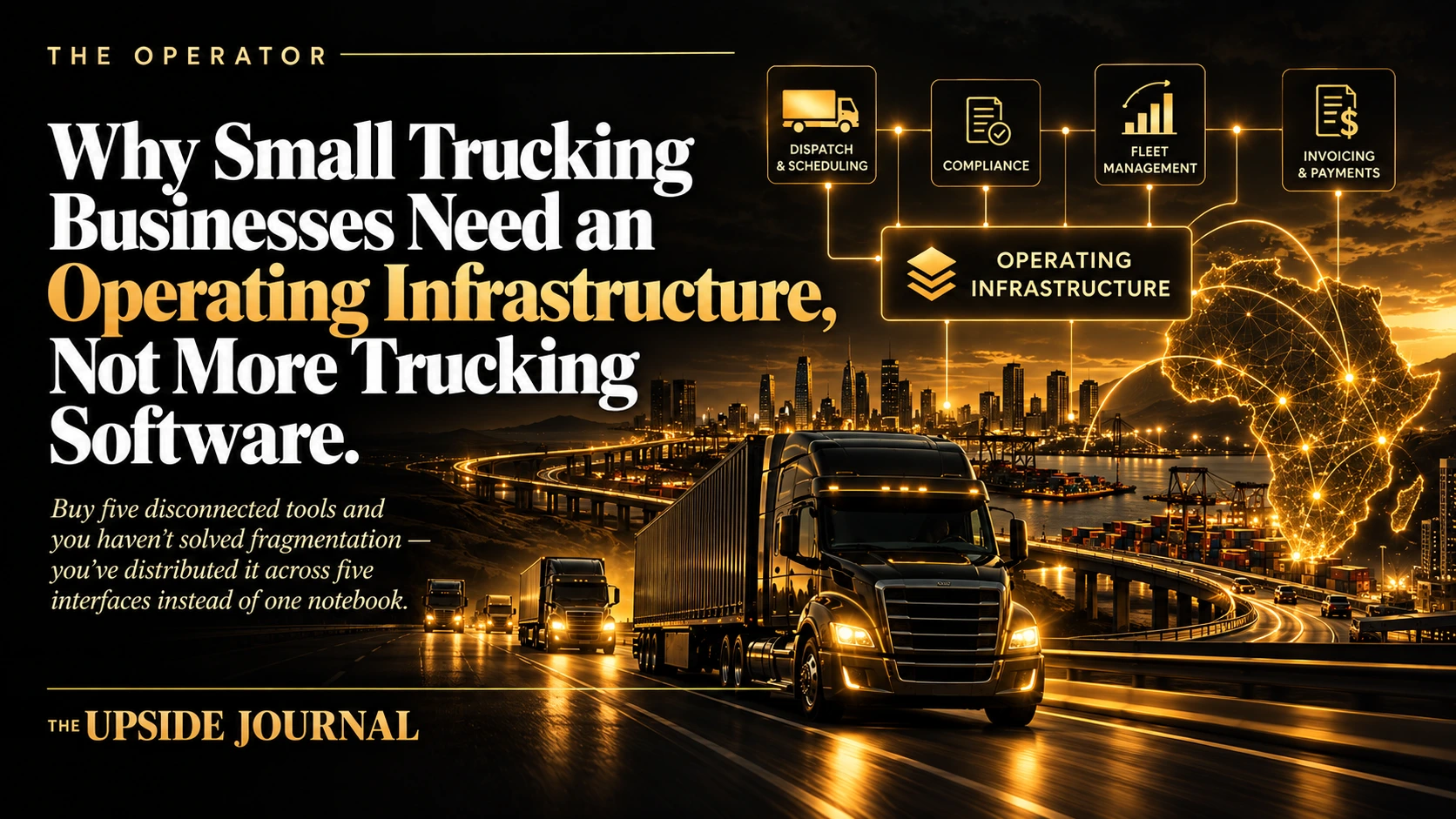
Buy five pieces of software and you have not solved a fragmented business — you have distributed the fragmentation across five interfaces instead of one notebook. That is the uncomfortable finding behind a 2026 industry study of UK road hauliers: 91% report operating below seamless integration between their own business systems, a share that barely improves as fleets grow larger. The lesson generalizes past any one region or company. A small trucking operator does not fail to scale because a given task — dispatch, compliance, invoicing — lacks a tool. It fails to scale because none of those tools were ever asked to work together, and the operator is the only system left to do that integration by hand.
Introduction
Picture a Tuesday that is entirely ordinary for a two-truck operator. A load is delivered on time. The paperwork is signed. And then the actual work of the day begins: logging the delivery in one app, checking a separate compliance tool to confirm hours of service are still within limits before accepting tomorrow's load, opening a third system to submit the invoice, and texting the broker directly because none of the other three systems has any way of updating them automatically. None of this is dramatic. No single step takes more than a few minutes. But it repeats every day, on every load, for as long as the operator runs the business — and it is time and attention that never shows up on an income statement as a cost, because nobody ever wrote it a check.
Ask that same fleet owner what they need and the answer is almost always framed as a missing feature: a better load board, a faster invoicing app, a compliance tool that catches violations before they become fines. That framing is not wrong, exactly — each of those tools would genuinely help. It is incomplete in a specific and costly way: it treats the business as a collection of separate tasks rather than one connected system, and it prices every fix as another subscription rather than as a structural question about whether the tasks were ever meant to be solved separately in the first place.
What Software Solves, and What It Doesn't
Software, as most small trucking operators encounter it, is built to solve one task well: find a load, log hours of service, submit an invoice, track fuel spend. Judged task by task, the software available to independent operators today is genuinely competent — better than what existed a decade ago, in every individual category. The problem is not that any one tool underperforms its narrow job. The problem is what happens in the space between tools, where no vendor's product boundary reaches: a completed delivery in the dispatch app does not automatically update the invoice; a settled invoice does not automatically flow into a cash-position view; a compliance flag raised in one system has no path into the scheduling decisions being made in another. Operating infrastructure, as distinct from software, is the connective layer that makes those handoffs automatic rather than manual — the difference between five tools that each do their job and one business that actually functions as a single system.
Where Does the Friction Actually Show Up?
The friction is not evenly distributed. It concentrates at the seams between four functions every small operator has to run simultaneously, usually without dedicated staff for any of them.
Dispatch and Scheduling
Finding and sequencing loads is the most software-saturated part of the business, and also the one where disconnection is most visible day to day. An operator working across two or three load-matching platforms, alongside direct broker relationships tracked by phone and text, is manually reconciling schedules that no single system actually owns. A missed update on one platform does not automatically propagate anywhere else — it becomes a driver waiting for instructions that never arrive, or a truck sitting idle because nobody's system flagged the conflict before it happened.
Compliance
Compliance tracking — hours of service, vehicle inspection records, insurance documentation — is typically the most legally consequential function and, in a fragmented stack, the one most disconnected from everything else. A compliance flag raised in a dedicated ELD or safety system has no automatic bearing on a dispatch decision being made minutes later in a completely separate tool, which means an operator can schedule a load that a compliance system would have flagged as a violation, simply because the two systems were never designed to talk to each other. Compliance failures under this structure are rarely failures of diligence; they are failures of information reaching the decision at the moment it needed to.
Financing and Cash Position
Financing is where fragmentation turns from an efficiency problem into a solvency one. An operator juggling separate systems for invoicing, factoring, fuel cards, and maintenance financing has no single, current view of cash position — only a set of balances that each looked accurate in isolation the last time they were checked. Decisions about which load to take next, or whether a truck can absorb an unplanned repair this week, end up made on incomplete information, because assembling a complete picture requires manually pulling numbers from systems that were never built to be pulled together.
Customer and Broker Communication
The fourth seam is the one least discussed and most corrosive to relationships: communication with brokers and shippers about status, delays, and documentation. Without a system connecting dispatch status to customer-facing communication, updates depend on someone remembering to make a phone call — and the operators who forget most often are the ones already stretched thinnest managing the other three functions manually. A broker who has to call twice to get a status update does not conclude that the operator is disorganized because they lack a communication app; the broker simply routes the next load to whichever carrier responds faster, regardless of whose fault the delay actually was.
None of these four seams is a defect in any single tool. A good compliance system correctly flags a compliance risk. A good dispatch app correctly assigns a load. The failure sits entirely in the space between them, in the assumption — built into how each tool was designed and sold — that its job ends at its own product boundary, and that connecting to whatever the operator uses next is the operator's problem to solve.
How Does the Cost Compound as a Fleet Tries to Grow?
The arithmetic of fragmentation gets worse, not better, exactly when an operator most needs it to improve: at the point of adding a second or third truck. A single-truck operator can absorb the seams described above through sheer personal effort — working late, double-checking everything themselves, treating the manual reconciliation as simply part of the job. That coping mechanism does not scale. A second truck does not double the coordination burden; it multiplies it, because now two drivers' schedules, two compliance records, and two cash positions all have to be reconciled against each other, manually, by an owner who has not gained a second version of themselves to do it. This is the specific, underdiscussed reason many capable one-truck operators never become five-truck operators: not a shortage of freight, not a shortage of capital, but a coordination burden that grows faster than any individual's capacity to absorb it by working harder.
A forthcoming piece in this network examines how a specific operating layer approaches consolidating this stack into a shared data structure; the point worth establishing here, independent of any single company's approach, is that the growth ceiling itself is real and structural, not a matter of any one operator's discipline or effort.
Why Doesn't Adding More Software Fix This?
The instinct, when one of these seams causes a visible problem, is to buy a tool specifically for that seam — a dedicated app for broker communication, say, or a better compliance dashboard. This rarely helps for long, and the industry data explains why: the same 2026 UK haulier research found that integration levels do not meaningfully improve as fleets grow larger, meaning even operators with more resources to spend on more tools are not closing the gap by spending more. Adding a sixth system does not connect the first five; it adds a sixth seam. Forty-three percent of operators in that research identified manual data entry — the human labor of moving information between systems that don't share it automatically — as their single highest-impact daily friction, and that share held steady across fleet sizes. More tools, without a connective layer between them, simply means more manual data entry, not less.
The research also surfaces a related and more strategic cost: 44% of the smallest fleets in the study reported relying primarily on intuition for strategic decisions, a figure that falls close to zero once a fleet operates more than fifty vehicles. That is not because larger fleets are staffed by better decision-makers. It is because larger fleets can afford the dedicated back-office function that manually reconciles fragmented data into something usable for decisions — an overhead cost a one- or two-truck operator cannot absorb. Fragmentation, left unaddressed, does not just cost time; it removes small operators' ability to make decisions on anything other than gut feel, in an industry where that gut feel is competing against operators large enough to see their numbers clearly.
What Would Operating Infrastructure Actually Look Like?
The distinction worth holding onto is specific: software solves a task; operating infrastructure connects the business. A dispatch decision made inside an infrastructure layer automatically checks against current compliance status, updates a live cash-position view, and triggers the customer communication that decision requires — not because three separate teams remembered to do three separate things, but because the underlying data structure makes each downstream update automatic. This is not a hypothetical design goal; it is the direction the wider industry is now visibly moving, with established fleet-technology vendors explicitly repositioning around unifying data across compliance, toll management, and safety functions that used to be sold as separate products. One such vendor's own leadership has described the current state of the industry plainly: fleets are still keying in the same vehicle information repeatedly across systems that don't share it, a repetitive, manual process the company is now building specifically to eliminate — confirmation that fragmented systems requiring repetitive manual entry have become a recognized constraint on margins industry-wide, not a complaint specific to any one company or geography.
What makes this shift notable is who is driving it: not primarily software companies trying to sell operators a bigger platform, but fleets themselves demanding fewer, better-connected systems after years of accumulating point solutions that never talked to each other. That demand-side shift is itself evidence that the fragmentation problem described here is now widely recognized as structural, not a temporary gap the market simply hasn't gotten around to filling.
For a small operator, the practical test of whether a given tool is software or infrastructure is simple: does completing one action inside it automatically update everything downstream that depends on that action, or does the operator still have to carry the update to the next system by hand? A load board that requires manually re-entering the same delivery into an invoicing tool has not removed fragmentation from the business; it has only made one part of it faster to enter.
Why This Matters for Operators Right Now
For a small trucking business owner deciding where to spend the next available dollar of technology budget, the operator-facing takeaway is this: evaluate any new tool by what it connects to, not only by what it does on its own. A best-in-class point solution that leaves its outputs stranded, unable to automatically inform the next decision downstream, delivers less compounding value than a more modest tool that is genuinely wired into the rest of the operation. Ask a vendor a direct question before buying anything new: when this system completes an action, what happens automatically in the systems I already use, and what still requires me to do it myself? An honest answer to that question is a better predictor of whether a tool will actually reduce daily friction than any list of features on its own.
The fragmentation tax is paid in small increments — a few minutes of re-entry here, a missed compliance flag there, a cash-position guess instead of a cash-position fact — but it is paid continuously, on every load, and it scales against the operator with the least capacity to absorb it. Recognizing that pattern is the first step toward evaluating technology purchases as infrastructure decisions rather than as a series of unrelated feature upgrades.
Where This Doesn't Fit
This is an operational-friction thesis piece, not a CloudTrucks company profile or a technical breakdown of any specific platform's architecture — those questions belong to a companion piece elsewhere in this network. It is not Tobenna Arodiogbu's biography, which is covered on its own terms in this network's founder-entity profile. It is not a generic argument for buying more SaaS, and it is not a survey of broader supply-chain infrastructure or trucking industry history; the friction points described here are deliberately specific to the small, owner-operator scale of business, where the absence of dedicated back-office staff makes disconnected systems most costly.
Key Takeaways
91% of hauliers in a 2026 industry study operate below seamless integration between their own business systems — and that share barely improves as fleets grow larger, meaning more resources alone don't close the gap.
Manual data entry, the human labor of moving information between disconnected systems, is the single highest-impact daily friction reported across fleet sizes — not a lack of software features.
44% of the smallest fleets rely primarily on intuition for strategic decisions, versus near-zero at fifty-plus vehicles — evidence that fragmentation removes small operators' capacity to decide on facts, not just their efficiency.
The functional test for infrastructure versus software: does completing one action automatically update everything downstream that depends on it, or does the operator still carry that update by hand?
Adding another point tool to a fragmented stack adds another seam, not a fix; established fleet-technology vendors are now repositioning around unifying functions that used to be sold separately, because the constraint is industry-wide.
Conclusion
Small trucking businesses have never lacked software. They have lacked a system willing to treat their operation as one connected business rather than five separately purchased tasks. That distinction is not a matter of degree — a slightly better version of the same fragmented stack does not close the gap the data describes. It requires an operating layer built from the outset to make the handoffs between dispatch, compliance, cash, and customer communication automatic, rather than one more login the operator has to remember to check. Until that layer exists underneath a given business, buying more software will keep looking like progress while leaving the actual constraint — the seams between tools — exactly where it started.