Executive Summary:
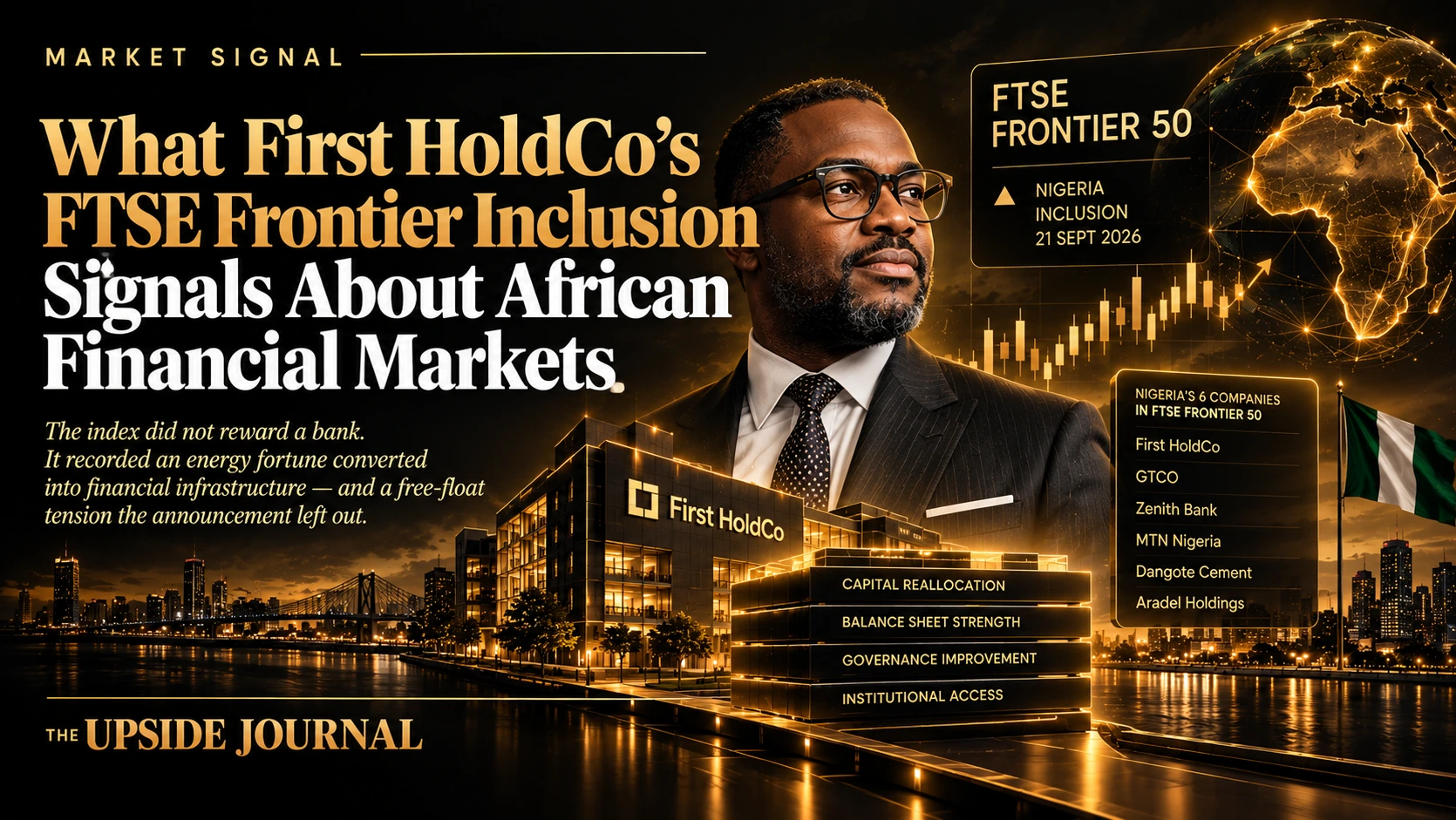
First HoldCo entered the FTSE Frontier 50 on 21 September 2026, one of six Nigerian companies admitted as Nigeria returned to FTSE Russell's Frontier Market universe. Read as a corporate announcement, it is a benchmark honour. Read as a market-structure event, it is the visible end point of a traceable chain: Femi Otedola released capital from Geregu Power, concentrated ownership in First HoldCo, forced a ₦1.7 trillion balance-sheet clean-up, cleared the Central Bank of Nigeria's recapitalisation floor, and turned a governance discount into the size and liquidity an index screen can measure. The inclusion signals that African operating capital can be converted into benchmark-visible financial infrastructure. It also exposes an unresolved tension: the concentrated ownership that made the turnaround possible is the same variable that limits how much of it index-tracking capital can actually hold.
Introduction
Most coverage of First HoldCo's FTSE Frontier 50 admission treats it as recognition: a chairman's statement, a "defining milestone," a share-price narrative. That reading runs causation backwards. Index providers do not confer credibility; they measure it against published screens, and the screens First HoldCo cleared this month are ones the group would have failed for most of the past decade.
This piece treats the inclusion the way an allocator would — as a signal with a mechanism behind it. The mechanism runs from ownership to balance-sheet repair to governance to index visibility to institutional capital, and it ends on a tension the announcement does not mention.
What Did First HoldCo Actually Have to Pass?
Two separate gates sit behind the headline, and most reporting collapses them into one.
The first is the country gate. FTSE Russell confirmed on 27 August that Nigeria's reclassification from Unclassified to Frontier status would proceed from 21 September, after a review found no material settlement or funding issues following the move to T+1 settlement. Nigeria had been dropped to Unclassified in September 2023 over foreign-exchange repatriation problems — a history this publication has examined as an investor-confidence problem rather than a market-access problem. The country gate is macro: FX convertibility, capital repatriation, settlement plumbing. No single company passes or fails it.
The second is the company gate. The FTSE Frontier 50 is the subset of the wider FTSE Frontier Index made up of the 50 largest qualifying companies by full market capitalisation, subject to investability screens on free float, foreign-ownership restrictions and liquidity. This is where individual balance sheets and governance records are tested. Nigeria's reclassification opened the door for every listed Nigerian company at once; only six — First HoldCo, GTCO, Zenith Bank, MTN Nigeria, Dangote Cement and Aradel Holdings — ranked high enough to enter the Frontier 50.
The country gate is the same macro event that drove Nigeria's return to J.P. Morgan's bond benchmark, a mechanism already mapped in this publication's analysis of that index inclusion. The company gate is the part specific to First HoldCo, and it is the part Otedola's capital built. The country reopened the market; the company had to earn its rank inside it.
How Did Otedola's Capital Reach the Index?
The route from an energy fortune to a benchmark constituent runs through five stages. Each one changed a variable the Frontier 50 screen actually measures.
Stage | What happened | What it changed for index eligibility |
|---|---|---|
1. Capital release | Otedola sold his majority stake in Geregu Power in December 2025 for ₦1.088 trillion, in a deal financed by a Zenith Bank-led consortium | Liquid capital available to redeploy into banking |
2. Ownership concentration | Stake rose from roughly 20% at the 30 June 2026 filing to roughly a quarter by early August, with more than ₦600 billion committed | A single decision-maker able to force restructuring |
3. Balance-sheet repair | One-off ₦1.7 trillion impairment of legacy problem loans; divestment of FBNQuest | Removal of the governance overhang behind the valuation discount |
4. Recapitalisation | Cleared the CBN's ₦500 billion floor for international banks; shareholders approved a further ₦253 billion raise toward ₦1 trillion paid-up capital | Capital adequacy that institutional due diligence requires |
5. Market re-rating | H1 2026 profit before tax up 83.5% to about ₦653 billion; market capitalisation near ₦6.8 trillion in early September | Enough size and liquidity to rank among the 50 largest qualifying frontier companies |
The pattern is capital rotation: value built in one operating asset is released and redeployed to take control of another, then used to restructure it into something public markets can price. It is the defining behaviour of the capital builders profiled in this publication's African Capital Builders network — and First HoldCo is the clearest case of it reaching institutional-market infrastructure rather than stopping at a private holding. Geregu matters here only as the funding source; its operations are not the story.
The verdict: the index did not reward a bank. It recorded the end point of an energy fortune converted into financial infrastructure.
The Tension the Announcement Leaves Out
Otedola has said publicly that his "investment threshold is always over and above 51 percent," and that First HoldCo is on the same trajectory as his earlier positions. At Geregu, he took his stake from 51% to 95%, then reduced it to 77% after the company listed.
That history matters for index mechanics. Analysis, explicitly labelled: FTSE weights constituents by investable market capitalisation — adjusted for free float and foreign-ownership limits — not by headline value. A strategic holder's shares are not part of the investable float. Every percentage point Otedola adds narrows the slice of First HoldCo that benchmark-tracking funds can buy. If his stake crosses a majority, First HoldCo could remain large enough to stay in the Frontier 50 while carrying a materially smaller investable weight than its market capitalisation suggests.
This is the same concentration question this publication raised about Africa's super-conglomerate wave, arriving from the other direction: consolidated control can be what repairs an institution, and also what limits outside capital's access to the result. The ownership concentration that made the clean-up possible is the same variable that caps how much of it index capital can own.
Where Index Visibility Fits
Index inclusion is a visibility event, not a funding event. Membership places First HoldCo inside the screening universe of benchmark-aware active managers and frontier-market funds; it does not guarantee a naira of new inflow. Frontier-market passive assets are materially smaller than emerging-market pools, so the direct passive bid is modest. The larger effect runs through active managers, for whom the benchmark defines what they must justify owning — or not owning.
That distinguishes First HoldCo's route from Dangote's. The refinery's IPO created public-market visibility through a new listing. First HoldCo was already listed; the index ranked visibility the company had rebuilt through governance repair. A listing opens the door to public capital; a benchmark admission tells institutions the door is worth walking through.
Why This Matters for Allocators and African Capital Builders
For frontier and Africa-focused allocators, the practical signals are specific and monitorable: the free-float figure at each FTSE review, any filing that moves Otedola's stake toward a majority, and whether the ₦253 billion raise widens the shareholder base or concentrates it further. Those three variables will determine First HoldCo's investable weight more than its earnings will.
For other African capital builders, First HoldCo sets a template for reaching institutional capital that runs through governance repair rather than listing volume. The route is repeatable in principle; whether African public markets can supply the institutional depth to reward it is a separate question, and it is where this node hands off to the rest of the network.
Key Takeaways
First HoldCo cleared two distinct gates: Nigeria's country-level reclassification, which it shared with every Nigerian stock, and the Frontier 50's company-level screen, which only six Nigerian companies passed.
Otedola's capital reached the index through a five-stage rotation — Geregu sale, ownership concentration, ₦1.7 trillion clean-up, recapitalisation, market re-rating — each stage moving a variable the index screen measures.
Index inclusion is eligibility for institutional allocation, not a guarantee of inflows; its main effect runs through active managers' screening universes.
Otedola's stated majority-control threshold sits in tension with free-float weighting: further concentration could shrink First HoldCo's investable index weight even as its market value grows.
The signal for African financial markets is that operating capital can be converted into benchmark-visible financial infrastructure — through governance repair, not simply through more listings.
Conclusion
First HoldCo's Frontier 50 admission is worth reading for what it reveals about the route, not the destination. A fortune built in energy was released, concentrated, used to repair a bank's balance sheet, and turned into the size and liquidity an index screen rewards. That is a genuine signal about how African capital can reach institutional markets. The open question is whether the controlling ownership that produced the signal will leave enough of the institution for index capital to hold.