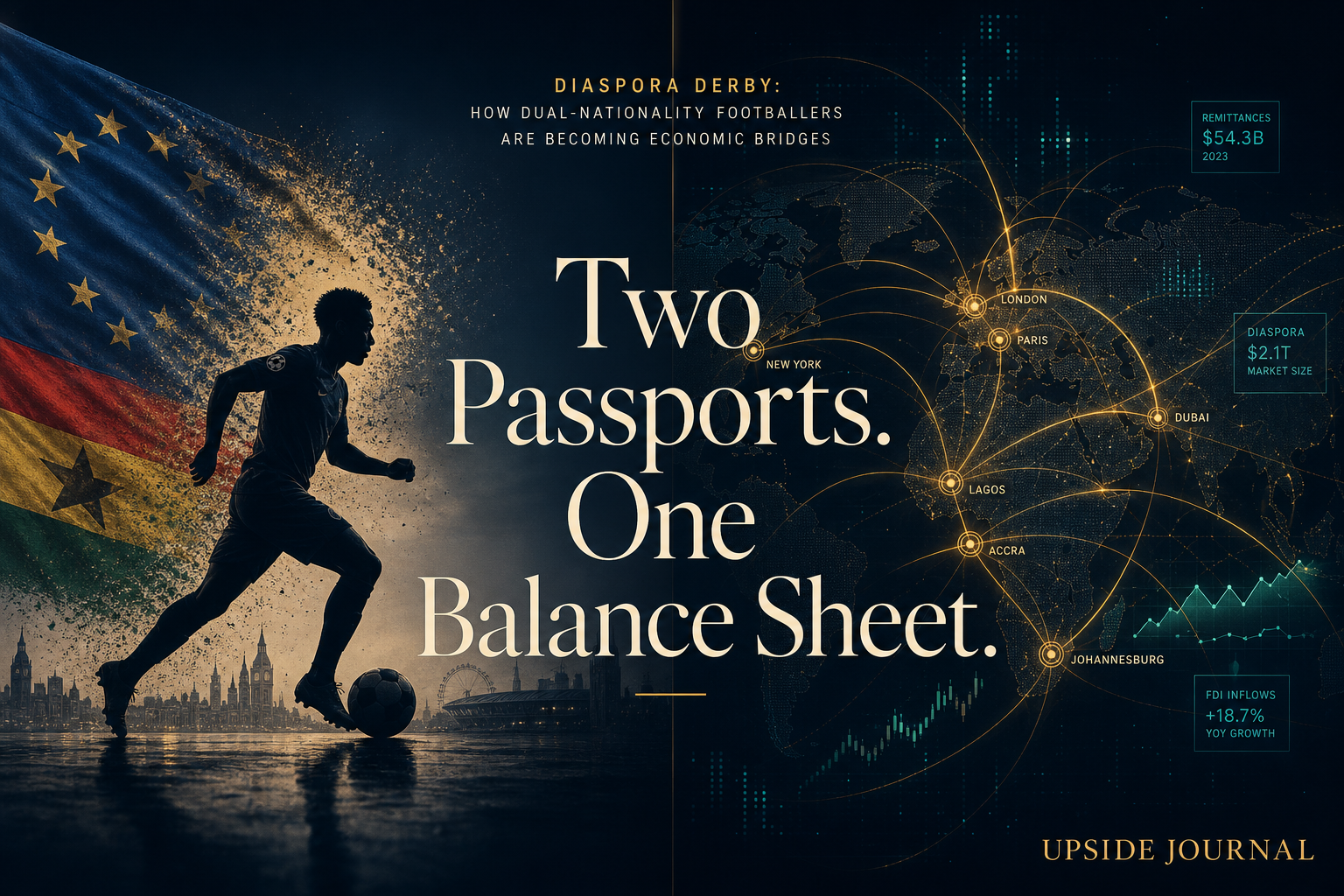
The global sports-business apparatus routinely quantifies the World Cup through predictable parameters: television broadcast rights, corporate stadium sponsorships, player transfer valuations, and localized hospitality metrics. However, an institutional-grade blind spot exists at the intersection of migration patterns and sovereign capital networks.
Modern international football squads increasingly reflect multi-national identities, turning group-stage matches into high-frequency case studies of cross-border financial infrastructure. This intelligence briefing analyses the rise of "Diaspora Economics" — a powerful structural network where dual-nationality athletes serve as trust bridges, acceleration catalysts, and foundational infrastructure for venture capital corridors, digital remittance ecosystems, and sovereign bilateral investments between developed economic centres and emerging markets.
1. Two Passports, One Balance Sheet
Sweden vs Tunisia is a football match. It's also a live case study in how migration reshapes global capital.
When the whistle blows, the physical boundaries of the pitch blur into an economic matrix. On one side are athletes born, trained, and structurally integrated into European sporting academies; on the other is a strategic choice to represent their ancestral sovereignty. This phenomenon is no longer an anomaly of international sports architecture; it is an inevitability driven by decades of shifting global migration trends.
What happens when an elite asset belongs to two economies at once? Historically, sports immigration was viewed through the sterile lens of socio-political integration or identity politics. In the current global economic paradigm, an athlete possessing dual nationality represents a living, multi-market corporate enterprise. They hold domestic bank accounts, commercial properties, and corporate alignments within the G7 nations, while maintaining deep cultural capital, investment channels, and generational networks in emerging economies. By holding two passports, these individuals are immune to the traditional friction points that hinder standard cross-border institutional capital.
The proliferation of dual-nationality athletes directly mirrors the broader demographic reality of major metropolitan hubs like London, Paris, New York, and Brussels. Elite football squads have become micro-maps of globalised labour movement. As talent moves seamlessly across borders, it sets up an intuitive template for how capital will inevitably follow. The modern footballer is not merely a player; they are an economic pipeline connecting disparate financial ecosystems.
2. The Rise of Diaspora Capital
To understand the financial baseline of this tournament, one must zoom out to look at the macroeconomic trend line of diaspora capital flows. For decades, traditional foreign aid and development bank allocations were deemed the primary engines of financial stability for emerging economies. Today, global remittances regularly exceed many forms of foreign aid, charting a direct course toward $1 trillion annually. This is not passive sentimental money; it is a resilient, counter-cyclical asset class that sustains sovereign consumer spending, stabilises balance-of-payments indices, and fills credit gaps left open by commercial retail banking infrastructure.
Remittances may be the world's most underestimated asset class.
Because these capital inflows bypass state bureaucracies and flow directly into households and micro-enterprises, their velocity within the domestic economy is significantly higher than institutional investments. When applied to major international sports tournaments, diaspora networks act as sudden amplifiers of this underlying economic force. The migration maps of competing nations transform instantly into real-time corridors of financial activity.
Venture capitalists and international asset managers are quietly observing how migrant populations influence investment decisions during these high-visibility cultural events. An elite athlete representing a diaspora community serves as a premium human billboard for cross-border affinity. Their visibility triggers a psychological wealth effect across the entire diaspora, leading to measurable spikes in parallel investment channels, equity asset purchases, and real estate allocations in the origin market.
3. From Footballers to Venture Catalysts
The definitive shift in sports business occurs when elite athletes transition from passive capital allocators to aggressive venture catalysts. For generations past, the pinnacle of an athlete's financial post-career roadmap was equity investments in hospitality franchises, physical retail, or regional auto dealerships. The contemporary generation of high-net-worth dual-nationality sports figures operates with the sophistication of seasoned venture capitalists — investing in early-stage tech startups, launching targeted venture capital funds, backing high-growth fintech platforms, and directly funding localised innovation ecosystems.
Are footballers becoming a new class of cross-border investors? The numbers point to a structural change. When a European-born player decides to represent an African or Latin American nation on the international stage, they don't simply bring their boots; they integrate their entire Western network of angel investors, private wealth managers, and corporate venture partners into that market. They become trust bridges. Emerging market startups frequently face a "credibility tax" when pitching to Western institutional capital pools. An elite, globally recognised athlete anchoring a seed round instantly de-risks the asset, signalling validation to international syndicates.
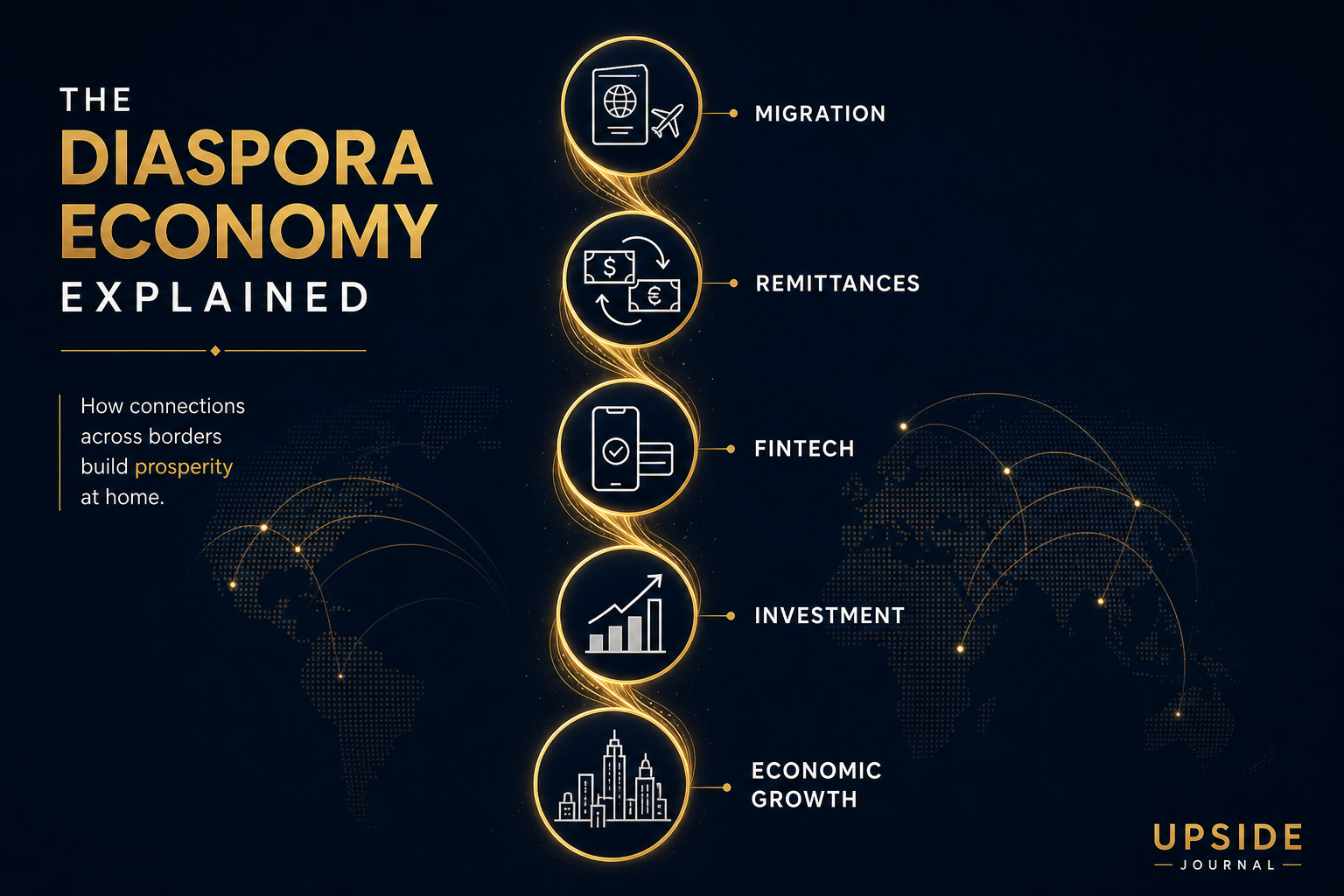
Furthermore, diaspora founders are actively learning to leverage athlete capital as a strategic weapon. By bringing on an international sports figure as an investor, a startup doesn't just gain liquidity; they acquire an unprecedented audience distribution network. In a digital economy where customer acquisition costs (CAC) continue to trend unsustainably upward, the native social capital of a World Cup athlete provides an unfair distribution advantage that traditional venture capital funds cannot replicate.
4. Why Fintech Is Winning the Diaspora Economy
Every diaspora story eventually becomes a payments story. The structural friction of moving money across borders has historically been a highly lucrative extortion model for legacy financial intermediaries. For decades, brick-and-mortar wire institutions extracted up to 12% on cross-border micro-transactions between Western metropolitan hubs and developing markets. The rapid maturity of the fintech sector has fundamentally broken this monopoly, utilising digitised remittance rails, cross-border localised payments API networks, mobile wealth apps, and diaspora banking platforms to capture value previously lost to corporate gatekeepers.
Fintech reduces friction, and by reducing friction, it directly unlocks transaction velocity. When a tournament like the World Cup captures the collective consciousness of millions living in the diaspora, the volume of high-frequency cross-border peer-to-peer capital allocation surges. Whether it is real-time sports betting syndicates, immediate peer-to-peer celebration transfers, or flash consumer retail purchases, digital financial platforms capture every single transaction dollar at a fraction of the legacy operating cost.
This structural synergy explains why the world's fastest-growing fintech enterprises are pivoting away from generic corporate imagery toward deep cultural asset integration. By aligning a fintech platform with the narrative of diaspora football triumphs, companies are tapping into a profound emotional resonance that builds generational brand equity. A payment app is no longer just a utility tool; it becomes the digital plumbing that holds a borderless community together.
5. Why Diaspora Derbies Matter to Investors
To institutional investors looking across a 10-year investment horizon, football matches are no longer simple entertainment packages; they are early-stage signals of economic expansion. We introduce a proprietary analytical framework designed to decode these signals: the Diaspora Derby Index™. This framework quantifies macro-connectivity across specific international match corridors by measuring five core variables: demographic migration depth, formal remittance volumes, cross-border startup ecosystem integration, venture capital syndication activity, and historical trade treaties.
By applying the Diaspora Derby Index™ to high-intensity tournament pairings — such as Sweden vs Tunisia, France vs Morocco, Portugal vs Angola, or England vs Nigeria — investors can uncover highly accurate structural trends before they show up on traditional macroeconomic dashboards. If a corridor scores high on the index, it indicates that the underlying human capital, consumer network, and payments infrastructure are already optimised for rapid enterprise commercialisation.
Investors may learn as much from migration patterns as they do from economic forecasts. Football becomes a predictive signal; diaspora becomes infrastructure; the World Cup transforms into a live, fluid map of future capital flows.
The next generation of global investment opportunities may not emerge from formal state trade agreements or stale diplomatic summits. They may emerge from borderless communities that have spent decades quietly building economic bridges across oceans.
Related: Read The Invisible Tech Running the 2026 World Cup — How AI, Tracking Systems and Predictive Models Are Changing Football Forever for our deep dive into the technology infrastructure powering this tournament behind the scenes.OO
Olusegun Olufunmiloye is a contributing writer at Upside Journal. He writes about diaspora economics, emerging market investment, and the intersection of migration and global capital flows.