Executive Summary
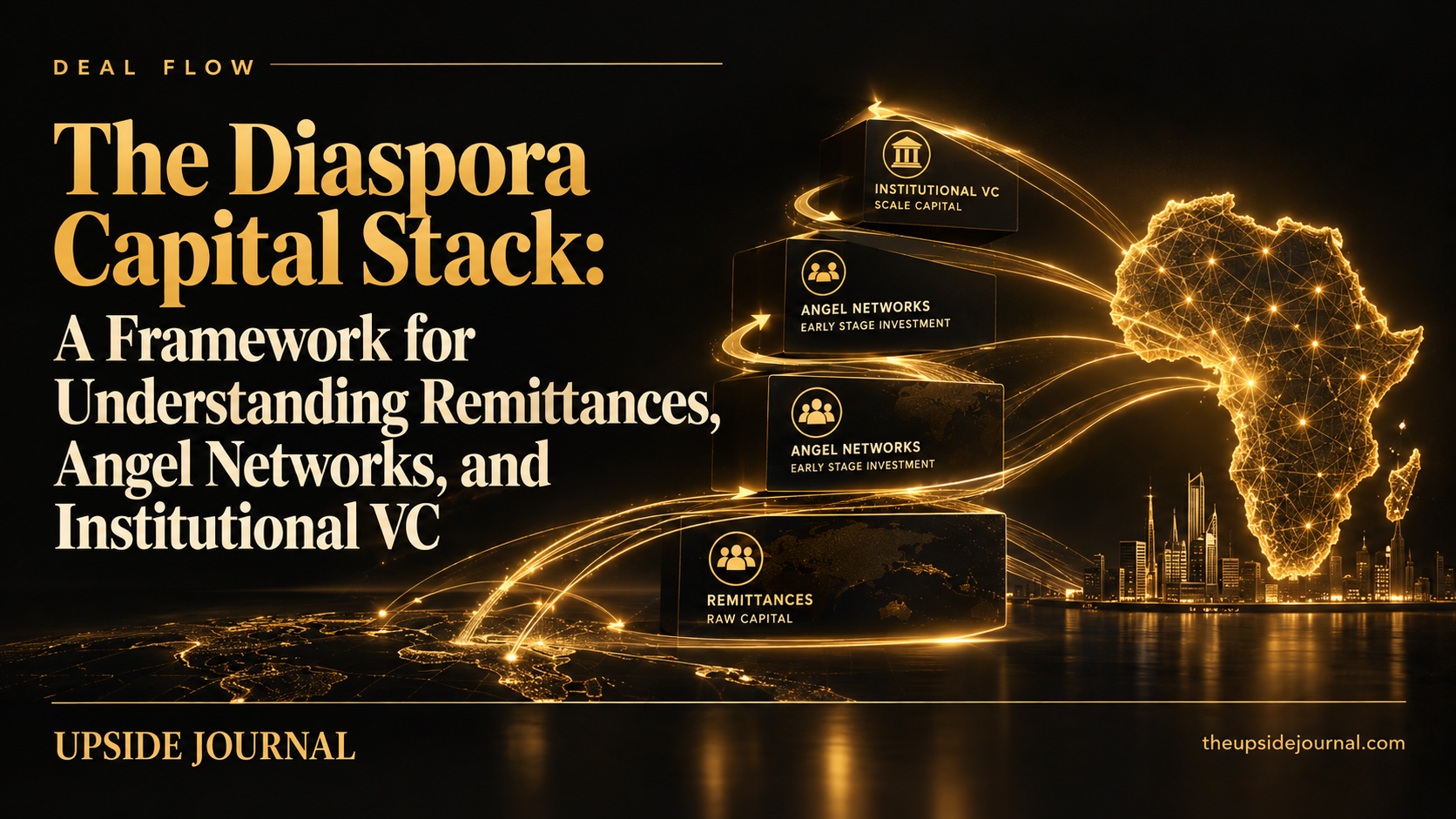
Diaspora capital is not a single mechanism. It's a continuum — money moves from informal remittance flow, to semi-formal angel and syndicate capital, to formal institutional LP participation, and each transition is triggered by a specific structural change, not simply by volume or time. Understanding where a given pool of diaspora money sits on that continuum explains far more about African venture capital's current shape than treating "diaspora capital" as one undifferentiated category.
Introduction
Every year, tens of billions of dollars move from the African diaspora back to the continent. Most of it is never described using the language of venture capital. It's a monthly transfer to a parent, a school fee payment, a contribution to a family project. And yet a meaningful share of that same capital base — moving through the same networks of trust, obligation, and relationship — eventually becomes something that looks structurally identical to early-stage venture investment.
The mistake most coverage makes is treating these as separate phenomena: remittances on one side, diaspora VC on the other, with no connective explanation for how one becomes the other. They are not separate. They are stages of the same capital formation process, and the shift from one stage to the next follows a predictable pattern once you know what to look for.
This matters directly for how you should read corporate venture capital's rise as an LP category: diaspora capital is the fourth distinct pillar sitting alongside it, traditional funds, and DFI money — and it behaves nothing like any of the three.
Stage One: Remittance as Raw Capital
The base of the stack is remittance volume — money sent for consumption, obligation, or family support, with no investment intent attached. This is the largest pool by far, and the one least connected, in the sender's mind, to anything resembling venture capital.
What matters at this stage isn't the intent behind any single transfer. It's the infrastructure that carries it. As the payment rails moving this money become faster, cheaper, and more trackable, the same infrastructure that serves consumption remittances becomes reusable for something else entirely: structured, recurring, investable capital. This is the argument at the center of Why Diaspora Payment Networks May Become Africa's Most Valuable Financial Infrastructure — the rails built for remittance volume are the same rails that later carry angel checks.
The formalization trigger at this stage is simple: a payment platform matures from single-transfer utility into an infrastructure layer with the compliance, identity verification, and repeat-relationship depth to plausibly carry structured investment. LemFi's evolution from remittance product to broader financial infrastructure is the clearest live case study of that transition happening in real time.
Stage Two: The Angel Syndicate
The second stage is where individual diaspora members, connected through professional networks, alumni associations, or shared geographic origin, begin pooling capital into informal or semi-formal syndicates targeting specific startups. This is capital with investment intent, but without institutional structure — no formal fund, no defined LP agreement, often no dedicated legal entity at all.
What separates a functioning diaspora angel syndicate from a WhatsApp group that occasionally discusses startups is structure around three things:
Deal sourcing discipline — a repeatable process for identifying and vetting opportunities, rather than reactive, relationship-only sourcing
Capital pooling mechanics — a defined way to aggregate individual checks into one investable unit, even informally
Decision governance — a process for reaching investment decisions that doesn't collapse under disagreement
The founder-side infrastructure enabling this stage is a genuinely new development. Platforms explicitly built to give diaspora investors a structured way to co-invest — rather than relying entirely on informal trust networks — are what turn a loose group of interested individuals into something that behaves like an actual capital allocator. Joe Kinvi's work building infrastructure connecting global African investors and the broader Borderless platform are the clearest examples of purpose-built tooling for exactly this stage — turning informal syndicate behavior into something closer to a repeatable process.
The formalization trigger moving capital from Stage One to Stage Two is rarely volume alone. It's the emergence of a trusted intermediary — a person or platform — willing to take on the coordination cost that individuals sending remittances independently never had a reason to absorb.
Stage Three: Institutional LP Participation
The third stage is where diaspora capital stops behaving like a syndicate and starts behaving like a limited partner inside a formal fund structure — committing capital on defined terms, over a defined horizon, with the governance rights and reporting expectations that come with institutional LP status.
This stage is still comparatively thin across African venture capital, but it is growing, and its growth is a genuine market signal. The $705 million surge into non-traditional venture hubs reflects, in part, exactly this kind of capital — pools that have moved past informal syndication and are now committing at fund level, often into vehicles specifically structured to de-risk exposure to markets outside the traditional "Big Four" African VC hubs.
The formalization trigger here is track record. A diaspora syndicate that has produced a small number of credible exits, or even strong paper markups, becomes investable by a broader LP base — including other diaspora members who were never part of the original syndicate but trust its demonstrated judgment.
Framework: What Moves Capital Between Stages
Stage | Capital Character | What Triggers Advancement |
|---|---|---|
1. Remittance | Consumption-intent, informal, high-volume | Payment infrastructure matures into a reusable rail for structured transfers |
2. Angel Syndicate | Investment-intent, semi-formal, relationship-based | A trusted intermediary absorbs coordination cost individuals won't |
3. Institutional LP | Formal, fund-structured, governance-bound | Demonstrated track record makes the capital pool investable by outsiders |
This is the framework most coverage skips: capital does not leap from Stage One to Stage Three. It cannot skip the syndicate stage, because the syndicate stage is where trust and process get built — the two things a fund LP agreement assumes already exist.
Why This Matters Alongside Corporate Venture Capital
Diaspora capital and corporate venture capital arrive at African cap tables through entirely different logic. CVC is optimized for strategic access, deployed from a single balance sheet, and answers to a corporate board. Diaspora capital is optimized for relationship trust, aggregated from many small sources, and answers — at least in its earlier stages — to informal social accountability rather than formal governance.
The two are increasingly showing up on the same cap tables, and founders navigating both should understand that they carry almost opposite risk profiles. Corporate capital risk concentrates around a single strategic relationship shifting. Diaspora capital risk, particularly at Stage Two, concentrates around coordination failure — the syndicate disagreeing, fragmenting, or losing its trusted intermediary.
Key Takeaways
Diaspora capital is a three-stage continuum — remittance, angel syndicate, institutional LP — not a single undifferentiated category.
Each stage transition is triggered by a specific structural change: infrastructure maturity, a trusted intermediary absorbing coordination cost, or a demonstrated track record.
Capital cannot skip the syndicate stage — it's where trust and process get built before institutional participation becomes possible.
Diaspora capital and corporate venture capital carry near-opposite risk profiles, despite increasingly appearing on the same cap tables.
Purpose-built infrastructure — payment rails maturing into financial infrastructure, platforms formalizing syndicate coordination — is what's currently accelerating stage transitions across African markets.
Conclusion
Treating diaspora capital as one thing obscures the more useful question: which stage is this specific pool of capital actually in, and what would need to change for it to advance? That question applies whether you're a founder evaluating a term sheet, an operator building the infrastructure that enables a stage transition, or an investor trying to understand where the next wave of institutional diaspora LP capital is likely to come from.
Related Reading
Why Corporate Venture Capital Is Quietly Becoming Africa's Biggest LP Category
Joe Kinvi: Building the Infrastructure That Connects Global African Investors
Borderless and the Next Generation of Diaspora Investment Infrastructure
Why Diaspora Payment Networks May Become Africa's Most Valuable Financial Infrastructure
The $705 Million Surge: De-Risking the Non-Traditional Venture Hubs
The Rise of Diaspora Operators: How African Founders Are Building Global Infrastructure Companies
External References
World Bank — Migration and Development Brief, remittance flow data to Sub-Saharan Africa
AVCA — African Private Capital Activity Report, LP composition data
GSMA — State of the Industry Report on Mobile Money, remittance-to-mobile-money infrastructure trends